Thank you for visiting SNEWPapers!
Sign up free
Letter to Editor
December 8, 1809
Virginia Argus
Richmond, Virginia
What is this article about?
Extract of a letter reporting a duel near Bladensburg on December 4, 1809, between Congressmen J.G. Jackson and Mr. Pearson, wounding Jackson. The writer passionately argues against duelling as barbaric, illogical, and harmful to society, urging its abolition.
Clipping
OCR Quality
98%
Excellent
Full Text
RICHMOND,
FRIDAY, December 8, 1809.
Extract of a letter from our Correspondent at Washington City, December 5, 1809.
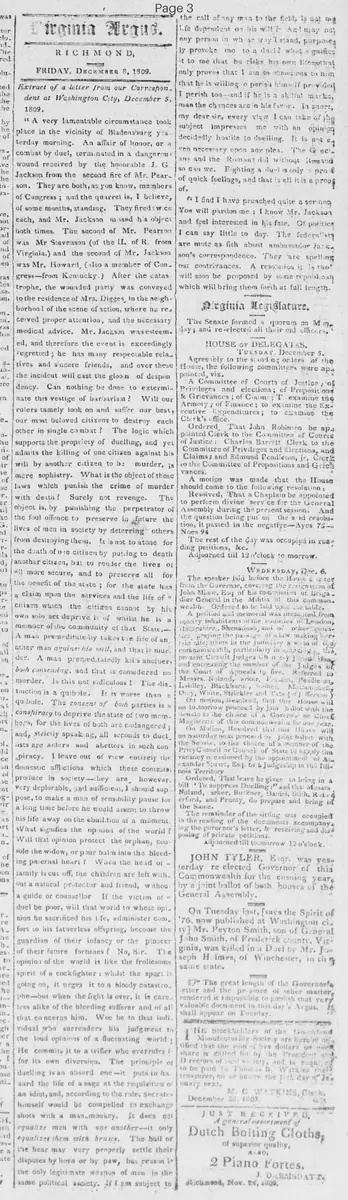
"A very lamentable circumstance took place in the vicinity of Bladensburg yesterday morning. An affair of honor, or a combat by duel, terminated in a dangerous wound received by the honorable J. G. Jackson from the second fire of Mr. Pearson. They are both, as you know, members of Congress; and the quarrel is, I believe, of some months' standing. They fired twice each, and Mr. Jackson missed his object both times. The second of Mr. Pearson was Mr. Stevenson (of the H. of R. from Virginia,) and the second of Mr. Jackson was Mr. Howard (also a member of Congress—from Kentucky.) After the catastrophe, the wounded party was conveyed to the residence of Mrs. Digges in the neighborhood of the scene of action, where he received proper attention, and the necessary medical advice. Mr. Jackson was esteemed, and therefore the event is exceedingly regretted; he has many respectable relatives and sincere friends, and over these the incident will cast the gloom of despondency. Can nothing be done to exterminate this vestige of barbarism? Will our rulers tamely look on and suffer our best, our most beloved citizens to destroy each other in single combat? The logic which supports the propriety of duelling, and yet admits the killing of one citizen against his will by another citizen to be murder, is mere sophistry. What is the object of those laws which punish the crime of murder with death? Surely not revenge. The object is, by punishing the perpetrator of the foul offence to preserve in future the lives of men in society by deterring others from destroying them. It is not to atone for the death of one citizen by putting to death another citizen, but to render the lives of all more secure, and to preserve all for the benefit of the state; for the state has a claim upon the services and the life of a citizen which the citizen cannot by his own sole act deprive it of whilst he is a member of the community of that State.—A man premeditatedly takes the life of another man against his will, and that is murder. A man premeditatedly kills another, both consenting, and that is considered no murder. Is this not ridiculous! The distinction is a quibble. It is worse than a quibble. The consent of both parties is a conspiracy to deprive the state of two members, for the lives of both are endangered: and, strictly speaking, all seconds to duelists are aiders and abettors in such conspiracy. I leave out of view entirely the domestic affections which these contests produce in society—they are, however, very deplorable, and sufficient, I should suppose, to make a man of sensibility pause for a long time before he would assent to throw his life away on the ebullition of a moment. What signifies the opinion of the world? Will that opinion protect the orphan, console the widow, or pour balm into the bleeding fraternal heart? When the head of a family is cut off, the children are left without a natural protector and friend, without a guide or counsellor. If the victim of duel be poor, will that world to whose opinion he sacrificed his life, administer comfort to his fatherless offspring, become the guardian of their infancy or the pioneer of their future fortunes? No, Sir. The opinion of the world is like the frolicsome spirit of a cockfighter: whilst the sport is going on, it urges it to a bloody catastrophe—but when the fight is over, it is careless alike of the bleeding sufferer and of all that concerns him. Woe be to that individual who surrenders his judgment to the loud opinions of a fluctuating world! He commits it to a trifler who overrules it for its own diversion. The principle of duelling is an absurd one—it puts to hazard the life of a sage at the requisition of an idiot, and, according to the rule, Socrates himself would be compelled to exchange shots with a man-monkey. It does not equalize men with one another—it only equalizes them with brutes. The bull or the bear may very properly settle their disputes by horn or by paw, but reason is the only legitimate weapon of men in the same political society. If I am subject to the call of any man to the field, is not my life dependent on his will? And may not any person in whose way I stand, purposely provoke me to a duel? What signifies it to me that he risks his own life—that only proves that I am so obnoxious to him that he is willing to perish himself provided I perish too—and if he is a skilful marksman the chances are in his favor. In short, my dear sir, every view I can take of the subject impresses me with an opinion decidedly hostile to duelling. It is not even necessary upon any plea. The Grecians and the Romans did without it—and so can we. Fighting a duel is only a proof of quick feelings, and that is all it is a proof of.
If I find I have preached quite a sermon you will pardon me: I know Mr. Jackson and feel interested in his fate. Of politics I can say little to day. The federalists are mute as fish about ambassador Jackson's correspondence. They are spelling out contrivances. A resolution in it, though will soon be proposed by some republican which will bring them forth at full length."
FRIDAY, December 8, 1809.
Extract of a letter from our Correspondent at Washington City, December 5, 1809.
"A very lamentable circumstance took place in the vicinity of Bladensburg yesterday morning. An affair of honor, or a combat by duel, terminated in a dangerous wound received by the honorable J. G. Jackson from the second fire of Mr. Pearson. They are both, as you know, members of Congress; and the quarrel is, I believe, of some months' standing. They fired twice each, and Mr. Jackson missed his object both times. The second of Mr. Pearson was Mr. Stevenson (of the H. of R. from Virginia,) and the second of Mr. Jackson was Mr. Howard (also a member of Congress—from Kentucky.) After the catastrophe, the wounded party was conveyed to the residence of Mrs. Digges in the neighborhood of the scene of action, where he received proper attention, and the necessary medical advice. Mr. Jackson was esteemed, and therefore the event is exceedingly regretted; he has many respectable relatives and sincere friends, and over these the incident will cast the gloom of despondency. Can nothing be done to exterminate this vestige of barbarism? Will our rulers tamely look on and suffer our best, our most beloved citizens to destroy each other in single combat? The logic which supports the propriety of duelling, and yet admits the killing of one citizen against his will by another citizen to be murder, is mere sophistry. What is the object of those laws which punish the crime of murder with death? Surely not revenge. The object is, by punishing the perpetrator of the foul offence to preserve in future the lives of men in society by deterring others from destroying them. It is not to atone for the death of one citizen by putting to death another citizen, but to render the lives of all more secure, and to preserve all for the benefit of the state; for the state has a claim upon the services and the life of a citizen which the citizen cannot by his own sole act deprive it of whilst he is a member of the community of that State.—A man premeditatedly takes the life of another man against his will, and that is murder. A man premeditatedly kills another, both consenting, and that is considered no murder. Is this not ridiculous! The distinction is a quibble. It is worse than a quibble. The consent of both parties is a conspiracy to deprive the state of two members, for the lives of both are endangered: and, strictly speaking, all seconds to duelists are aiders and abettors in such conspiracy. I leave out of view entirely the domestic affections which these contests produce in society—they are, however, very deplorable, and sufficient, I should suppose, to make a man of sensibility pause for a long time before he would assent to throw his life away on the ebullition of a moment. What signifies the opinion of the world? Will that opinion protect the orphan, console the widow, or pour balm into the bleeding fraternal heart? When the head of a family is cut off, the children are left without a natural protector and friend, without a guide or counsellor. If the victim of duel be poor, will that world to whose opinion he sacrificed his life, administer comfort to his fatherless offspring, become the guardian of their infancy or the pioneer of their future fortunes? No, Sir. The opinion of the world is like the frolicsome spirit of a cockfighter: whilst the sport is going on, it urges it to a bloody catastrophe—but when the fight is over, it is careless alike of the bleeding sufferer and of all that concerns him. Woe be to that individual who surrenders his judgment to the loud opinions of a fluctuating world! He commits it to a trifler who overrules it for its own diversion. The principle of duelling is an absurd one—it puts to hazard the life of a sage at the requisition of an idiot, and, according to the rule, Socrates himself would be compelled to exchange shots with a man-monkey. It does not equalize men with one another—it only equalizes them with brutes. The bull or the bear may very properly settle their disputes by horn or by paw, but reason is the only legitimate weapon of men in the same political society. If I am subject to the call of any man to the field, is not my life dependent on his will? And may not any person in whose way I stand, purposely provoke me to a duel? What signifies it to me that he risks his own life—that only proves that I am so obnoxious to him that he is willing to perish himself provided I perish too—and if he is a skilful marksman the chances are in his favor. In short, my dear sir, every view I can take of the subject impresses me with an opinion decidedly hostile to duelling. It is not even necessary upon any plea. The Grecians and the Romans did without it—and so can we. Fighting a duel is only a proof of quick feelings, and that is all it is a proof of.
If I find I have preached quite a sermon you will pardon me: I know Mr. Jackson and feel interested in his fate. Of politics I can say little to day. The federalists are mute as fish about ambassador Jackson's correspondence. They are spelling out contrivances. A resolution in it, though will soon be proposed by some republican which will bring them forth at full length."
What sub-type of article is it?
Persuasive
Ethical Moral
Reflective
What themes does it cover?
Crime Punishment
Morality
Politics
What keywords are associated?
Duel
Congressmen
Jackson
Pearson
Bladensburg
Anti Duelling
Morality
Barbarism
What entities or persons were involved?
Correspondent At Washington City
Letter to Editor Details
Author
Correspondent At Washington City
Main Argument
duelling is a barbaric, illogical practice that endangers lives without justification, contradicting murder laws and harming society; it should be exterminated as the ancients did without it.
Notable Details
Duel Near Bladensburg
J.G. Jackson Wounded By Mr. Pearson
Seconds: Mr. Stevenson (Virginia) For Pearson, Mr. Howard (Kentucky) For Jackson
Wounded Taken To Mrs. Digges' Residence
Compares Duelling To Murder And Conspiracy Against The State
Criticizes World Opinion And References Socrates, Grecians, Romans