Thank you for visiting SNEWPapers!
Sign up free
The Washington Union
Washington, District Of Columbia
What is this article about?
In a Senate speech, Mr. Bigler strongly supports building a Pacific Railroad from Missouri to San Francisco for military protection of western possessions, enhancing commerce, and fostering national unity, urging government aid to overcome natural barriers.
Merged-components note: Continuation of the Pacific Railroad speech across pages; sequential reading order and matching text content indicate they form a single logical story component.
Clippings
1 of 2
OCR Quality
Full Text
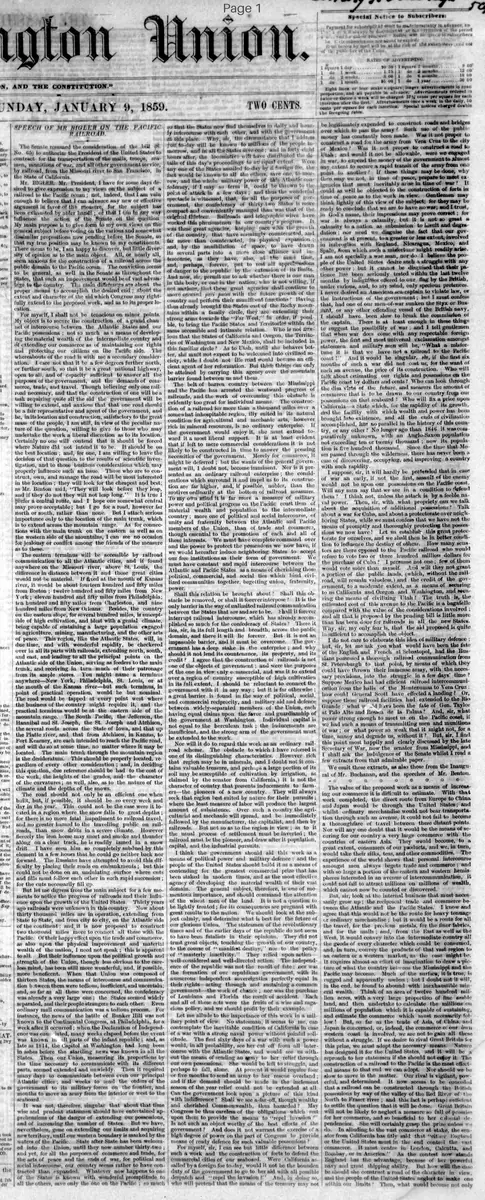
The Senate resumed the consideration of the bill (S. No. 65) to authorize the President of the United States to contract for the transportation of the mails, troops, seamen, munitions of war, and all other government service by railroad, from the Missouri river to San Francisco, in the State of California.
Mr. BIGLER. Mr. President, I have for some days desired to give expression to my views on the subject of a railroad to the Pacific ocean; not, indeed, that I am vain enough to believe that I can advance any new or effective argument in favor of the measure, for the subject has been exhausted by abler hands: of that I can in any way influence the action of the Senate on the question.
My main purpose is to give form to my own views on the general subject before voting on the various and somewhat dissimilar propositions now pending before the Senate, so that my true position may be known to my constituents.
There seems to be, I am happy to discover, but little diversity of opinion as to the main object. All, or nearly all, seem anxious for the construction of a railroad across the public domain to the Pacific ocean. The conviction seems to be general, as well in the Senate as throughout the States, that such an improvement would be of vast advantage to the country. The main differences are about the proper means to accomplish the desired end; about the extent and character of the aid which Congress may rightfully extend to the proposed work, and as to its proper location.
For myself, I shall not be tenacious on minor points. My object is to secure the construction of a grand channel of intercourse between the Atlantic States and our Pacific possessions: not so much as a means of developing the material wealth of the intermediate country and of extending our commerce as of maintaining our rights and protecting our citizens on the Pacific side. The whereabouts of the road is with me a secondary consideration. I care not that it be a few degrees further north, or further south, so that it be a great national highway, open to all, and of capacity sufficient to answer all the purposes of the government, and the demands of commerce, trade, and travel. Though believing only one railroad necessary, and that the construction of one will be a task requiring quite all the aid the government will be willing to extend, and anxious that that one road should be a fair representative and agent of the government, and be, in its location and construction, satisfactory to the great mass of the people, I am still, in view of the peculiar nature of the question, willing to give to those who may undertake the work a liberal discretion as to its location. Certainly no one will contend that it should be forced where Nature did not intend it to be. It should be on the best location: and, for one, I am willing to leave the decision of that question to the results of scientific investigation, and to those business considerations which may properly influence such an issue. Those who are to construct, own, and manage the road will be most interested in the location; they will look for the cheapest and best; as Mr. Benton said, "They will look before they leap, and if they do not they will not leap long." It is true I prefer a central route, and I hope one somewhat central may prove acceptable; but I go for a road, however far north or south, rather than none. But I attach serious importance only to the location of the main trunk, which is to extend across the mountain range. As for connections with the main trunk on the eastern as well as on the western side of the mountains, I can see no occasion for jealousy or conflict among the friends of the measure as to these.
The eastern terminus will be accessible by railroad communication to all the Atlantic cities, and if found anywhere on the Missouri river, above St. Louis, the difference in distance between it and those great cities would not be material. If fixed at the mouth of Kansas river, it would be about fourteen hundred and fifty miles from Boston: twelve hundred and fifty miles from New York: eleven hundred and fifty miles from Philadelphia; ten hundred and fifty miles from Charleston, and nine hundred miles from New Orleans. Besides, the country on the eastern slope, for several hundred miles, is susceptible of high cultivation, and blest with a genial climate, being capable of sustaining a large population engaged in agriculture, mining, manufacturing, and the other arts of peace. This region, like the Atlantic States, will, in due time, and with wonderful rapidity, be checkered over in all its parts with railroads, extending north, south, and east, and leading to all the principal points on the Atlantic side of the Union, serving as feeders to the main trunk, and receiving in turn much of their patronage from its ample stores. You might name a terminus anywhere—New York, Philadelphia, St. Louis, or at the mouth of the Kansas river—but such terminus, in point of practical operation, would be but nominal. The road would be tapped at every point west where the business of the country might require it, and the practical terminus would be at the eastern side of the mountain range. The South Pacific, the Jefferson, the Hannibal and St. Joseph, the St. Joseph and Atchison, the several roads across the State of Iowa, and that up the Platte river, and that from Atchison, in Kansas, to Fort Kearney, are each intended to reach the Pacific road, and will do so at some time, no matter where it may be located. The main trunk through the mountain region is the desideratum. This should be properly located, regardless of every other consideration; and, in deciding this question, due reference should be had to the cost of the work, the heights of the grades, and the character of the curvatures; as well, also, as to the nature of the climate and the depths of the snows.
The road should not only be an efficient one when built, but, if possible, it should be so every week and day in the year. This could not be the case were it located in a region where the snow falls to great depths; for there is no more fatal impediment to railroad travel, and no greater hazard to the travelling public on railroads, than snow drifts in a severe climate. However fiercely the iron horse may snort and smoke and thunder along on a clear track, he is readily tamed in a snow drift. I have seen him so completely subdued by this element in a few hours that he could go neither back nor forward. The Russians have attempted to avoid this difficulty by placing their roads on embankments; but this could not be done on an undulating surface where cuts and fills must follow each other in such rapid succession; for the cuts necessarily fill up.
But let me digress from the main subject for a few moments to notice the progress of railroads and their influence upon the growth of the United States. Thirty years ago railroads were unknown in this country. Now about thirty thousand miles are in operation, extending from State to State, and from city to city, on the Atlantic side of the continent; and it is now proposed to construct two thousand miles more to connect all these with the Pacific. Of their happy effect upon the trade and commerce, as also upon the physical improvement and material wealth of the nation, I need not speak: this is apparent to all. But their influence upon the political growth and strength of the Union, though less obvious to the careless mind, has been still more wonderful, and, if possible, more beneficent. When that Union was composed of thirteen States, the means of intercourse and communication between them were tedious, inefficient, and uncertain; and, so far as all these were concerned, the confederacy was already a very large one; the States seemed widely separated, and their people strangers to each other. Even ordinary mail communication was a tedious process. For instance, the news of the battle of Bunker Hill was not known to the Continental Congress, at Philadelphia, for a week after it occurred; when the Declaration of Independence was enunciated, many weeks elapsed before the event was known in all parts of the infant republic; and, as late as 1814, the Capitol at Washington had long been in ashes before the startling news was known in all the States. Then our Union, measuring its proportions by the time necessary to communicate with its different parts, seemed extended and unwieldy. Then it required many days to communicate between even our principal Atlantic cities: and weeks to send the orders of the government to its military forces on the frontier, and months to move an army from the interior or west to the seaboard.
It was not, therefore, singular that about that time wise and prudent statesmen should have entertained apprehensions of the danger of extending our possessions, and of increasing the number of States. But we have, nevertheless, gone on extending our limits and acquiring new territory, until our western boundary is marked by the waters of the Pacific. State after State has been welcomed into the Union, until they now number thirty-two; and yet, for all the purposes of commerce and trade, for the arts of peace and the ends of war, for political and social intercourse, our country seems rather to have contracted than expanded. Whatever now happens to one of the States is known with wonderful promptitude to all the others, save only the one on the Pacific; so much so that the States now find themselves in daily and hourly intercourse with each other, and with the government at this place. Why, sir, the circumstance that I address you to-day will be known to millions of the people to-morrow, and in all the States save one; and in forty-eight hours after, the locomotive will have distributed the details of this day's proceedings to all equal extent. Were any one of the States assailed to-day by a foreign foe, the fact would be known to all the others, save one, to-morrow, and the whole military power of this Atlantic confederacy, if I may so term it, could be thrown to the point of attack in a few days; and thus the wonderful spectacle is witnessed, that, for all the purposes of government, the confederacy of thirty-two States is more compact and conveniently managed than was that of the original thirteen. Railroads and telegraphic wires have worked this phenomenon in our country's progress. It was these great agencies, keeping pace with the growth of the country, that have seemingly counteracted, and far more than counteracted, its physical expansion; and, by the annihilation of space, to have drawn its several parts into a more close alliance and intercourse, as they have, also, at the same time, and, perhaps, forever, put to rest all apprehensions of danger to the republic by the extension of its limits.
And now, sir, permit me to ask whether there is one man in this body, or one in the nation, who is not willing, if not anxious, that these great agencies shall continue to move onward pari passu with the future growth of the country and perform their munificent functions? Having thus already brought the States east of the Rocky mountains within a family circle, they are extending their strong arms towards the "Far West;" in order, if possible, to bring the Pacific States and Territories within the same accessible and intimate relation. Who is not desirous that the States of California and Oregon, the Territories of Washington and New Mexico, shall be included in this familiar circle? As to Utah, until she behaves better, she must not expect to be welcomed into civilized society, while I doubt not the road would become an efficient agent of her reformation. But these things can only be attained by carrying this agency over the mountain barrier found between us and them.
The belt of barren country between the Mississippi and the Pacific has arrested the westward progress of railroads, and the work of overcoming this obstacle is evidently too great for individual means. The construction of a railroad for more than a thousand miles over a somewhat inhospitable region, ill suited in its natural condition for agricultural and mechanic arts, however rich in mineral resources, is no ordinary enterprise. If the government would enjoy it, she must extend towards it a most liberal support. It is at least evident that if left to mere commercial considerations it is not likely to be constructed in time to answer the pressing necessities of the government. Merely for commerce, it might be deferred: but the wants of the general government will, I doubt not, become imminent. Nor is it presented as an ordinary railroad enterprise; the considerations which surround it and impel us to its construction are far higher, and, if possible, nobler, than the motives ordinarily at the bottom of railroad measures.
To my own mind it is far more a measure of military power and political progress on the Pacific coast than of material wealth and population to the intermediate country; more one of political and social intercourse, of unity and fraternity between the Atlantic and Pacific members of the Union, than of trade and commerce, though essential to the promotion of each and all of these interests. We must have complete command over and the power to protect the possessions we now have, if we would hereafter induce neighboring States to accept our free institutions as their form of government. We must have constant and rapid intercourse between the Atlantic and Pacific States as a means of cherishing those political, commercial, and social ties which bind civilized communities together, begetting union, fraternity, power.
Shall this relation be brought about? Shall this obstacle be removed, or shall it forever interpose? It is the only barrier in the way of unlimited railroad communication between the States that are and are to be. Shall it forever interrupt railroad intercourse, which has already accomplished so much for the confederacy of States? There it lies, sir, in its full length and breadth, across the public domain, and there it will lie forever. But it is not an impassable barrier, and it must be overcome. The government has a deep stake in the enterprise; and why should it not lend its countenance, its property, and its credit? I agree that the construction of railroads is not one of the objects of government: and were the purposes of the one in view only commercial, and was it to extend over a region of country susceptible of high cultivation in its full extent, I should be reluctant to connect the government with it in any way; but it is far otherwise; a great barrier is found in the way of political, social, and commercial reciprocity, and military aid and defence between widely-separated members of the Union, each having equal claims upon the favor and guardianship of the government at Washington. Individual capital is not equal to the herculean task: the inducements are insufficient, and the strong arm of the government must be extended to the work.
Nor will it do to regard this work as an ordinary rail road scheme. The obstacle to which I have referred is one of its distinguishing characteristics. However rich that region may be in minerals, (and I doubt not it contains valuable treasure, and perhaps a large portion of its soil may be susceptible of cultivation by irrigation, as claimed by the senator from California,) it is not the character of country that presents inducements to farmers—the pioneers of a new country. They will always seek that region best suited by nature for their pursuits; where the least measure of labor will produce the largest amount of subsistence. Over such a country the agriculturist and mechanic will spread, and be immediately followed by the manufacturer, the capitalist, and then by railroads. But not so as to the region in view; as to it the usual process of settlement must be inverted; the railroad must be the pioneer, and draw after it population, capital, and the industrial pursuits.
I think the government should aid this work as a means of political power and military defence; and the people of the United States should build it as a means of contending for the greatest commercial prize that has been staked in modern times, and as the most effective agency of developing the material wealth of their vast domain. The general subject, therefore, is one of momentous importance, and should command the attention of the wisest men of the land. It is not a question to be lightly treated: for its consequences are pregnant with great results to the nation. We should look at the subject calmly, and determine what is best for the future of our glorious Union. The statesmen of the revolutionary times and of the earlier days of the republic do not seem to have been fatalists in their opinions. They did not trust great objects, touching the growth of our country, to the course of "manifest destiny," nor to the policy of "masterly inactivity." They relied upon action—well-considered and well-directed action. The independence of the republic was not the result of fate: nor was the formation of our republican government, with its numerous independent sovereignties perfectly equal in their rights—acting through and sustaining a common government—the work of chance: nor was the purchase of Louisiana and Florida the result of accident. Each and all of these acts were the fruits of a wise and sagacious policy, and we should profit by their example.
Let me allude to the importance of this work in a military point of view. No statesman, it seems to me, can contemplate the inevitable condition of California in case of a war with a strong naval power without painful solicitude. The first sixty days of a war with such a power would, in all probability, see her cut off from all intercourse with the Atlantic States, and would see us without the means of sending an army to her relief through our own possessions. She would be left to struggle, and perhaps to fall, alone. At present it would require four or five months to send an army to her rescue overland; and if the demand should be made in the inclement season of the year relief could not be extended at all. Can the government look upon a picture of this kind with indifference? Shall we see a far-off, though wealthy and cherished Commonwealth, thus hazarded? May Congress be thus careless of the obligations which rest upon them to provide the means to "repel invasion"? Is not such an object worthy of the best efforts of the government? And does it not warrant the exercise of a high degree of power on the part of Congress to provide means of ready defence for such valuable possessions?
For myself, sir, I can see but little difference between such a work and the construction of forts to defend the commercial cities of our seaboard. Were California assailed by a foreign foe to-day, would it not be the bounden duty of the government to go to her aid with all possible despatch and "repel the invasion"? And, in doing so, who will pretend that the means of the treasury may not be legitimately expended to construct roads and bridges over which to pass the army? Such use of the public money has constantly been made. Was it not proper to construct a road for the army from Vera Cruz to the city of Mexico? Was it not proper to construct a road to Utah; and would it not be allowable, were we engaged in war, to expend the money of the government to almost any extent to secure a rapid transit of the army from one point to another? If these things may be done, why then may we not, in time of peace, prepare to meet exigencies that must inevitably arise in time of war? It could as well be objected to the construction of forts in time of peace as to the work in view. Gentlemen may think lightly of this view of the subject; or they may be ready to conclude that we are to have no war; and I trust, in God's name, their impressions may prove correct; for war is always a calamity, but it is not so great a calamity to a nation as submission to insult and degradation; nor need we disguise the fact that our government is at present, to a greater or less extent, involved in imbroglios with England, Nicaragua, Mexico, and Spain, from which such a misfortune might readily arise.
I am not specially a war man, nor do I believe the people of the United States desire such a struggle with any other power; but it cannot be disguised that their patience has been seriously tested within the last twelve months by indignities offered to our flag by the British, under various, and, to my mind, only specious pretences. I never desired an American sea-captain to violate law, or the instructions of the government; but I must confess that, had one of our men-of-war sunken the Styx or Buzzard, or any other offending vessel of the British navy, I should have been slow to break the commission of the captain. There is at least enough in these things to suggest the possibility of war; and I tell gentlemen that when war does come with any respectable foreign power, the first and most universal exclamation amongst statesmen and military men will be, "What a misfortune it is that we have not a railroad to the Pacific coast!" And it would be singular, sir, if the first six months of such a war did not cost us, for the want of such an avenue, the price of its construction. Who will talk about estimating our rights and possessions on the Pacific coast by dollars and cents? Who can look through the dim vista of the future, and measure the amount of commerce that is to be drawn to our country from our possessions on that seaboard? Who will fix a price upon California—a State which, for the rapidity of its growth, and the facility with which wealth and power has been brought into existence, and all the ends of civilization accomplished, has no parallel in the history of this comparatively unknown, with an Anglo-Saxon population country, or any other? No longer ago than 1846 it was comparatively unknown, with an Anglo-Saxon population not exceeding ten or twenty thousand; now its population is five hundred thousand. Since the time that Moses passed through the wilderness, there has never been a case of discovering, occupying, and improving a country with such rapidity.
I suppose, sir, it will hardly be pretended that in case of war an early, if not the first, assault of the enemy would not be upon our possessions on the Pacific coast. Will any man say that we are in a condition to defend them? I think not, unless the attack is by a feeble naval power. Then, sir, with what propriety can we talk about the acquisition of additional possessions? Talk about a war for Cuba, and about a protectorate over neighboring States, while we must confess that we have not the means of promptly and thoroughly protecting the possessions we now have! Let us establish this great protectorate for ourselves, and we shall then be in better condition to influence the destiny of others. How many senators are there opposed to the Pacific railroad who would refuse to vote two or three hundred million dollars for the purchase of Cuba? I presume not one; few of them would vote more than myself. And will they not grant a portion of the public lands, (which, without the railroad, will remain valueless,) and the credit of the government, to a moderate extent, as a means of securing to us California and Oregon and Washington, and securing the means of civilizing Utah? The truth is, the estimated cost of this avenue to the Pacific is a bagatelle compared with the value of the considerations involved; and all that is proposed by the pending bill is little more than has been done for railroads in all the new States. Why, sir, my only fear is, that the aid proposed is quite insufficient to accomplish the object.
I do not care to elaborate this idea of military defence; but, sir, let me ask you what would have been the fate of the English and French at Sebastopol, had the Russians possessed a thorough railroad communication from St. Petersburgh to that point, by means of which they could have thrown their immense army, with the necessary provisions, into the struggle in a few days' time? Suppose Mexico had had efficient railroad intercommunication from the halls of the Montezumas to Vera Cruz: how could General Scott have effected a landing? Or suppose those railroad facilities had extended to the Rio Grande: what would have been the fate of Gen. Taylor at Palo Alto and Resaca de la Palma? And, sir, what power strong enough to meet us on the Pacific coast, if we had such a means of transmitting men and munitions of war; or what power so weak that it might not, for a time, annoy and degrade us, without it? But, sir, I find this point most happily and clearly discussed by the late Secretary of War, now the senator from Mississippi, and I shall ask the indulgence of the Senate whilst I read a few extracts from that admirable paper.
We omit these extracts, as also those from the Inaugural of Mr. Buchanan, and the speeches of Mr. Benton.
The value of the proposed work as a means of increasing our commerce it is difficult to estimate. With that work completed, the direct route from Europe to China and Japan would be through the United States; and whilst ordinary merchandise would not bear transportation through such an avenue, it could not fail to become a thoroughfare of travel between these distant points. Nor will any one doubt that it would be the means of securing for our country a very large commerce with the countries of eastern Asia. They would become, to a great extent, consumers of our products, and we, in turn, would take their silks, teas, and other commodities. The experience of the world shows that personal intercourse amongst men always begets trade and commerce; and with so large a portion of the eastern and western hemispheres interested in an avenue of intercommunication, it could not fail to attract millions on millions of wealth, which cannot now be counted or discovered.
But, sir, look at the internal business that must necessarily grow up; the reciprocal trade and commerce between the Atlantic and the Pacific States. I know and agree that this would not be the route for heavy tonnage or ordinary merchandise; but it would be a route for all the travel, for the precious metals, for the finer fabrics, and for the mails; and, from the East as well as the West, it would convey into the intermediate country all the goods of every character which could be consumed, and, in turn, convey the products of that vast region to an eastern or a western market, as the case might be.
It requires almost an effort of imagination to draw a picture of what the country between the Mississippi and the Pacific may become. Much of the surface, it is true, is rugged and apparently useless; but I doubt not it will, in the end, be found to abound with inexhaustible mineral wealth. Think of an area of twelve hundred million acres, with a very large proportion of fine arable land, and then undertake to calculate the millions on millions of population which it is capable of sustaining, and estimate the commerce which must necessarily follow! But, so far as the trade of Asia, of China, and Japan is concerned, or, indeed, the commerce of our own western coast is involved, we are not to gain all these without a struggle. If we desire to rival Great Britain for this prize, we must adopt the necessary means. Nature has designed it for the United States, and it will be a reproach to her statesmen if she should not enjoy it. The construction of a railroad to the Pacific is the most effectual means to that end we can adopt. Nor should we be slow to move in the matter. Our rival is vigilant, powerful, and determined. It now seems to be conceded that a railroad can be constructed through the British possessions by way of the valley of the Red River of the North to Fraser river; and this fact is perhaps sufficient to settle the question that it will be done. Great Britain will not be likely to neglect a measure so full of promise for her commerce, and so beneficial to her colonial dependencies. She will certainly grasp the prize unless we do. In alluding to the vast commerce at stake, the senator from California has fitly said that "either England or the United States must in the end control the vast commerce. It must centre in London, Calcutta, and Bombay, or in America." As the contest now stands England has the advantage, because of her powerful navy and great shipping ability. But how will the case be should she construct a road of the character in view, and the people of the United States neglect to make one within our limits? Then, what would become not only of our commerce, but of our political power and influence on the Pacific?
of our commerce, but of our political power in that region? Then, England would care but little about the right of way through Nicaragua or Mexico.
Under such circumstances, the apprehension suggested by the senator from New York as to the political consequences of neglecting this work might receive great force and plausibility. He said:
The Pacific railroad involves this question: whether this capital, endeared to us by so many attractions, and exciting so much hope, pride, and promise, shall, by the improvement of facilities for intercourse, commerce, and communication between us and the Pacific coast, remain the capital of the whole United States of America, or whether it shall dwindle and sink, and become the capital of the United States of Atlantic America only; and Mexico, invested as it is with so many ancient and heroic traditions, shall become a rival capital—the capital of the Pacific States of America?
Whilst I am not willing to anticipate consequences so momentous as the result of neglecting the proper means to protect our fellow-citizens on the Pacific coast, and to extend to them that support to which they are so justly entitled under the compacts of the constitution, I do think it a great moral and political wrong to neglect them, and to put their loyalty to the test by a well-founded cause of complaint, or to excite that measure of discontent which might by possibility lead to alienation. I am for promoting commerce and fraternal affection with them, cost what it may. What could compensate the nation for the loss of California, or for the humiliation the nation would feel at having her cut off and hemmed in by a foreign power? Gentlemen are startled at the idea of $100,000,000 to construct a railroad to protect California, Oregon, Washington, and all the other interests that are to grow up on the Pacific; and yet they would vote hundreds of millions to purchase Cuba, or, in a war, to maintain our present transit route across the isthmus of Panama. Why, sir, California is already sending fifty or sixty millions of gold, annually, to the Atlantic States; and that amount is gradually on the increase. The adoption of measures to protect fully and completely all the possessions which we now have, by railroad communication, and, if needs be, by additional naval power, is my mode of practicing the Monroe doctrine. It is the best means of influencing surrounding States, and a far better agency of gaining additional possessions than weak and lawless filibustering expeditions.
But it is argued as an objection to the proposed road that it will not only fail to pay fair dividends on the capital necessary to construct it, but that the business will not be sufficient to pay the expenses of working it when built; and it is admitted that if the estimate of its income is to be based upon the present amount of commerce and trade between the Atlantic and Pacific divisions of the country, the objection would seem to be well taken. But no reasoning could be more unfair, and at the same time futile, than this. Who maintains that the present amount of business is sufficient to fairly reward the necessary amount of capital? This is not claimed, nor need it be, by the friends of the measure. It is not necessary to establish that position in order to demonstrate the utility of the work. The great reasons in favor of it are, that it will increase not only the domestic but the foreign commerce of the country; that it will beget trade and travel; that it will develop the material wealth of the country through which it is to pass, and that population and all the operations of a civilized community will follow in its wake. Nor does any one contend that we can have a railroad immediately. Its construction, under the most favorable circumstances, will require much time—six or eight years at least. Indeed, the pending bills propose to give the contractors from ten to twelve years to complete the work; and who, among the objectors, will undertake to tell us what the condition of the country will be ten years hence? What will be the population on the Atlantic and Pacific sides, and what the demands for such a channel of commerce may be, no one can tell with accuracy; but the lessons of experience are the best index of the future. The past growth of our country is, therefore, the safest basis upon which we can rely; and any one can see that on that ratio of increase, especially when applied to the Pacific region, the result would be almost fabulous. It is easy to show that the commerce and trade between our people on the Pacific and those on the Atlantic are meagre, compared with those of the whole country; but it must be remembered that the Pacific region has been ours for only a brief period; that the American population within the last ten years has increased fifty-fold, having swelled up from about ten thousand inhabitants to over five hundred thousand. The number of passengers passing to and fro is rapidly approaching the respectable number of a hundred thousand per annum, which, at fifty dollars each, amounts to the respectable income of $5,000,000. But it must be noticed, also, that each section of the road, as it approaches the centre from the east and the west, would beget, to a great extent, its own business from a region now unoccupied and unproductive.
But the objection with which I am dealing, it will be seen, is not strictly applicable to the proposed action of Congress. It is not claimed that the road, however successful, is to be a source of revenue to the government, nor can it be a drain upon its means or property beyond a very limited extent. The objection that the road will not pay would certainly be a fair subject for capitalists to consider. It is a question for the decision of those who may weigh the question of constructing the road. If satisfied that they are to lose the money which will be required for the work, it is scarcely necessary to say that they will not undertake to construct it; and if the law we are about to pass is not executed, surely the government cannot suffer. The reasons for government aid to the work stand far above a question of dollars and cents, as I have already shown. That the road may not pay the stockholders is no reason why the government should not have the use of it to transmit its mails, its agents, its armies, and all the munitions and paraphernalia of war. But I must confess, Mr. President, the objection which I am now combatting had at one time made a strong impression on my own mind against the utility of the scheme; but fuller reflection upon all its objects and tendencies, and especially upon its political influence, and the necessities for it in a military point of view, has made me its advocate. I never have had any doubt of the practicability of the work. I always believed it possible to construct a railroad across our domain to the Pacific ocean, but had great doubts as to its successful operation when built; and we must not be astonished that there are those who doubt on one as well as the other of these points, and that there are others who resist the enterprise on the broad ground that there is no necessity for it. Railroad improvement has always encountered an inveterate fogyism, which has hung on its skirts, and industriously predicted disaster and failure at every step. Why, sir, it is but a few years since, in the senate of my own State, I found it no easy task to combat the impression that a railroad from the eastern to the western extremity of that State was a visionary and impracticable scheme. The construction of the Pennsylvania railroad was resisted distinctly and emphatically on that ground; but it is now one of the best and most successful roads in the world.
But I object entirely to this mode of ascertaining the value of railroads. It is not to be estimated by dividends to stockholders. Great as have been the benefits conferred upon the country by railroads, there are but few that could stand such a test. Their real value to the country through which they extend consists not so much in income to their owners as in their tendency to develop natural elements of wealth, to attract population, and to facilitate trade and travel. Why, sir, the time saved to the travelling public is in itself a source of great wealth to the country. If productive labor is the wealth of a nation, the time of each individual is capital to him. We all know how much time we now save by coming to the capital in railroad cars, instead of on horseback, or in coaches. I have seen it estimated that the time saved to the travelling community by railroad facilities, as against former modes, is sufficient, if well employed, to cover the entire travelling expenses; so that it is seen, if this estimate be correct, we now travel free of charge, as compared with former times. For instance: the distance from Missouri to the Pacific is about two thousand miles, and it would take a man, on foot, at least three months to make the trip; and with horses, about two months; but by railroad, at ordinary speed, the trip can be accomplished in eighty hours, thus saving time enough to earn a large proportion, if not the entire expense, of the trip. Besides this, their general influence upon the prosperity of the country is almost beyond estimate. These arteries of trade and travel seem to be as necessary to the vigorous growth and prosperity of the country as are the veins in the human system to give life and growth to the body. Their real value would be better understood and appreciated should their functions be suddenly suspended. Who can imagine the condition of the country in such an event? The shock would be terrific. It would paralyse the business operations of the country from one extremity to the other, and lead to countless sacrifices and disappointments. If they are so important to the Atlantic States, how shall the country between them and the Pacific prosper without their use? What we need to promote the welfare of, and give political and military strength to, the whole country, is a grand artery across the public domain, through which may flow and reflow the vital fluid from the heart of the republic, giving health, growth, and vigor to its Pacific extremities, now weak and paralysed. The agency it must have in developing the material wealth of the country, and giving value to the public domain, is also an important element in its real value to the nation.
Considered, Mr. President, as a mere question of economy for the government, this improvement would still have strong claims on our favorable consideration. The saving in mail service alone would be no inconsiderable item. We now pay for this service to California and our other points on the Pacific over two million one hundred and eighty thousand dollars a year. By the railroad, at the highest rate claimed in the bill, $500 per mile per annum, the cost would be but about one million dollars. It is true, sir, that a single railroad could not furnish the mail to all the points now supplied by the expenditure of which I am speaking; but it would not require a million dollars to furnish a daily through line on this road. I doubt not that in this single item we should save $1,000,000 annually, and have a far more efficient mail service. In addition, the receipts of the treasury, which are now but $300,000, would be greatly enlarged. But, sir, this income is small in comparison with what would result to the treasury from the increased population and consequent consumption of foreign goods which would follow. The treasury would secure large incomes from this quarter. What it might do as an agent of peace and civilization no man can foresee; but we all know that the expedition to Utah is likely to cost as much in money as is claimed in the credit of the government for the purposes of this road; and we shall be very fortunate indeed if we have no other occasion for similar expeditions towards the Pacific prior to the construction of the proposed work. I hope we may not, but all the probabilities are against such a conclusion. I am quite convinced that if such an agency of intercourse had been in existence years ago, we should never have had serious trouble with the Mormons. The authority of the United States government would never have been resisted had the government possessed facilities of sending an army with promptitude to the Territory, in order to sustain the assertion of its authority, and to execute the laws.
I am not the advocate of a prodigal use of the public money or of public property; but, sir, governments, like individuals, may be "penny wise and pound foolish;" and a refusal to aid in the construction of this road over the public lands on the ground of economy would be a striking illustration of the truth of the adage. By attempting to save twenty or thirty or fifty millions we may involve the government in an expenditure of a much larger sum. We may do more; we may bring upon the country the degradation of (at least for a time) losing our power and lowering our flag on the Pacific side of the Union.
Nor am I in favor of the exercise of doubtful constitutional powers. I hold the constitution sacred above everything; but I go for this measure consistently with these views, because I believe it necessary to provide the means of repelling an invasion or providing for the public defence; and, therefore, there is no room to doubt our authority to use the public property and credit, nor the money for such purpose. Nor, sir, need any statesman, it seems to me, have apprehensions as to the consequences of this measure as a precedent. It will form no precedent for this or any other country. The world has never witnessed the like before, and probably never will again—a government aiding in the construction of a railroad nearly two thousand miles, over an unoccupied region, for the purpose of uniting sovereign States and providing for their defence. We shall never have occasion for the exercise of such power under similar circumstances, and no statesman need apprehend evil consequences from the precedent.
The remainder of the speech was devoted to suggestions as to the pending bill and amendments, Mr. B. declaring that he would favor any measure connecting the government with ownership or control of the road.
What sub-type of article is it?
What themes does it cover?
What keywords are associated?
What entities or persons were involved?
Where did it happen?
Story Details
Key Persons
Location
United States Senate, From Missouri River To San Francisco, California
Story Details
Mr. Bigler delivers a speech advocating for the construction of a Pacific Railroad to connect the Atlantic and Pacific states, emphasizing its importance for military defense, political unity, commerce, and national progress, willing to provide government aid despite challenges.