Thank you for visiting SNEWPapers!
Sign up free
Literary
January 28, 1848
Daily Northern Tribune
Bath, Sagadahoc County, Maine
What is this article about?
The story follows Uncle Job and his family as they lose their prosperous farm due to poor management, children's illnesses, and a deceitful neighbor's mortgage, forcing them to relocate to a rundown fish-drying house on the Atlantic shore. Despite hardships, they persevere with hope, and son John sets sail to reclaim their home.
Merged-components note: Continuation of the serialized story 'LOST AND WON HOMESTEAD' across pages.
Clippings
1 of 2
OCR Quality
95%
Excellent
Full Text
From the Nonpareil,
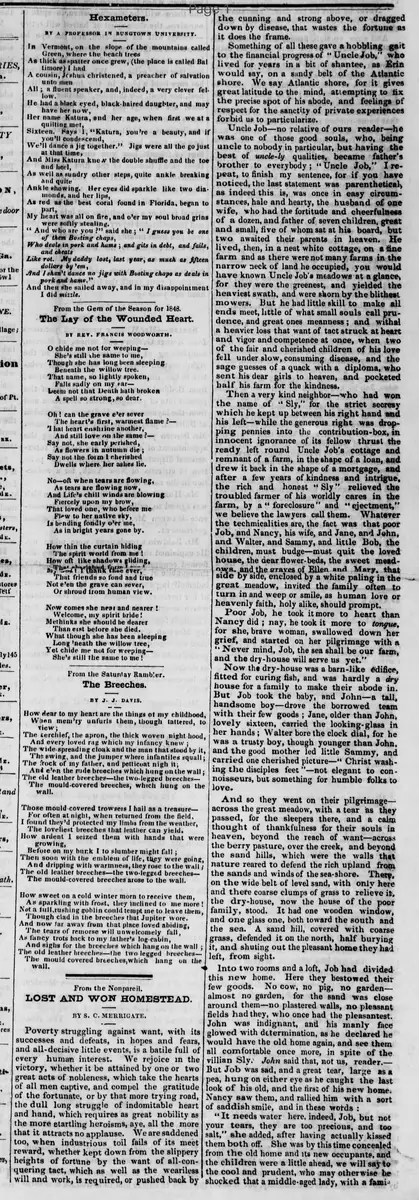
LOST AND WON HOMESTEAD.
BY S. C. MERRIGATE.
Poverty struggling against want, with its
successes and defeats, in hopes and fears,
and all-decisive little events, is a battle full of
every
human interest. We rejoice in the
victory, whether it be attained by one or two
great acts of nobleness, which take the hearts
of all men captive, and compel the gratitude
of the fortunate, or by that more trying road,
the dull long struggle of indomitable heart
and hand, which requires as great nobility as
the more startling heroisms, aye, all the more
that it attracts no applause. We are saddened
too, when industrious toil fails of its meet
reward, whether kept down from the slippery
heights of fortune by the want of all-con-
quering tact, which as well as the weariless
will and work, is required, or pushed back by
the cunning and strong above, or dragged
down by disease. that wastes the fortune as
it does the frame.
Something of all these gave a hobbling gait
to the financial progress of "Uncle Job," who
lived for years in a bit of shantee, as Erin
would say, on a sandy belt of the Atlantic
shore. We say Atlantic shore, for it gives
great latitude to the mind, attempting to fix
the precise spot of his abode, and feelings of
respect for the sanctity of private experiences
forbid us to particularize.
Uncle Job-no relative of ours reader-he
was one of those good souls, who, being
uncle to nobody in particular, but having the
best of uncle-ly qualities, became father's
brother to everybody: "Uncle Job," repeat, to finish my sentence, for if you have
noticed, the last statement was parenthetical,
as indeed this is, was once in easy circum-
stances, hale and hearty, the husband of one
wife, who had the fortitude and cheerfulness
of a dozen, and father of seven children, great
and small, five of whom sat at his board, but
two awaited their parents in heaven. He
lived, then, in a neat white cottage, on a fine
farm and as there were not many farms in the
narrow neck of land he occupied, you would
have known Uncle Job's meadows at a glance,
for they were the greenest, and yielded the
heaviest swath, and were shorn by the blithest
mowers. But he had little skill to make all
ends meet, little of what small souls call pru-
dence, and great ones meanness; and withal
a heavier loss that want of tact struck at heart
and vigor and competence at once, when two
of the fair and cherished children of his love
fell under slow, consuming disease, and the
sage guesses of a quack with a diploma, who
sent his dear girls to heaven, and pocketed
half his farm for the kindness.
Then a very kind neighbor-who had won
the name of "Sly," for the strict secrecy
which he kept up between his right hand and
his left-while the generous right was drop-
ping pennies into the contribution-box, in
innocent ignorance of its fellow thrust the
ready left round Uncle Job's cottage and
remnant of a farm, in the shape of a loan, and
drew it back in the shape of a mortgage, and
after a few years of kindness and intrigue.
the rich and honest "Sly" relieved the
troubled farmer of his worldly cares in the
farm, by a "foreclosure" and "ejectment,"
we believe the lawyers call them. Whatever
the technicalities are, the fact was that poor
Job, and Nancy, his wife, and Jane, and John,
and Walter, and Sammy, and little Bob, the
children, must budge-must quit the loved
house, the dear flower-beds, the sweet mead-
ows. and the graves of Ellen and Mary that
side by side, enclosed by a white paling in the
great meadow, invited the family often to
turn in and weep or smile, as human love or
heavenly faith, holy alike, should prompt.
Poor Job, he took it more to heart than
Nancy did; nay, he took it more to tongue,
for she, brave woman. swallowed down her
grief, and started on her pilgrimage with a
"Never mind, Job, the sea shall be our farm,
and the dry-house will serve us yet."
Now the dry-house was a barn-like edifice
fitted for curing fish, and was hardly a dry
house for a family to make their abode in.
But Job took the baby, and John-a tall,
handsome boy-drove the borrowed team
with their few goods; Jane, older than John:
lovely sixteen, carried the looking-glass in
her hands: Walter bore the clock dial, for he
was a trusty boy, though younger than John,
and the good mother led little Sammy, and
carried one cherished picture-"Christ wash-
ing the disciples feet"-not elegant to con-
noisseurs, but something for humble folks to
love.
And so they went on their pilgrimage-
across the great meadow, with a tear as they
passed, for the sleepers there, and a calm
thought of thankfulness for their souls in
heaven, beyond the reach of want-across
the berry pasture, over the creek, and beyond
the sand hills. which were the walls that
nature reared to defend the rich upland from
the sands and winds of the sea-shore. There,
on the wide belt of level sand, with only here
and there coarse clumps of grass to relieve it.
the dry-house. now the house of the poor
family, stood. It had one wooden window,
and one glass one, both toward the south and
the sea. A sand hill, covered with coarse
grass, defended it on the north, half burying
it, and shutting out the pleasant home they had
left, from sight.
Into two rooms and a loft, Job had divided
this new home. Here they bestowed their
few goods. No cow, no pig, no garden-
almost no garden, or the sand was close
around them-no plastered walls, no pleasant
fields had they, who once had the pleasantest.
John was indignant, and his manly face
glowed with determination, as he declared he
would have the old home again, and see them
all comfortable once more, in spite of the
villian Sly. John said that, not us, reader.-
But Job was sad, and a great tear, large as a
pea, hung on either eye as he caught the last
look of his old, and the first of his new home:
Nancy saw them, and rallied him with a sort
of saddish smile, and in these words:
"It needs water here, indeed, Job. but not
your tears, they are too precious, and too
salt." she added, after having actually kissed
them both off. She was by this time concealed
from the old home and its new occupants, and
the children were a little ahead, we will say to
the cool and prudent, who may otherwise be
shocked that a middle-aged lady, with a fami-
lv, should kiss her husband in the open day!
But Nancy meant well, and Job smiled; and then grew sad again as he said :
" It's bringing you and the little ones to such a place, that makes me a fool."
None the more a fool for your tears, Job, say we, but beg pardon, we have interrupted Nancy.
" Never be hurt for me, dear," she answered, "or the little ones, for look, they make themselves at home already."
And sure enough, Sammy had slipped his mother's finger, and got "Bub" from his father's arms before the pre-occupied parents knew it, and away they tumbled into the sand with a chirp and a whoop.
" Hilloa, mother. ar'n't this a nice place to play, for bubby and me? I'm glad we're going to live down here."
They made themselves a house in the sand, that home-robbed family, and the father's fishing boat and lines, and Jane's needle, and Sammy's fun, with little Robert-that was Bub. and when he grew a little, was Bob—made the house at least not wretched, if not very comfortable, and Nancy's everlasting good heart and cheerfulness kept a sunbeam plowed straight through the clouds that poverty and want threw over them. But John—he threw the line a while but his purpose was fixed to a higher aim than just to live; he would redeem the old home. So they must part with him for a while. He wanted to go to sea. Poverty decreed that he must go, and the good parents acquiesced at last, though the mother had her tears now, and yet a faithful word in spite of grief.
" John," she said, "you've been a good boy. and will be a good man. Be true to yourself, and you will be true to your employers, and to everybody. God be with you, John, my boy."
" Get-up, Dobbin," said Job, with a cluck, for he began to be nervous, and show signs of more salt water for his sand-bank. "Get-up," and old Dobbin carried John for the sea-port and away from the place of love, which, be it sand-hill or garden, is yet home.
As they passed by the graves of their lost ones, Job looked up and smiled--not a smile any wise akin to mirth, but as if he said.
"Thank God, we are happy and at home"- and John looked down and sighed, as if he would have said-"I have power to conquer fortune for you all, and a heart that would not miss any of you dear ones from its circle of love." and then he looked up hopeful again, as though it meant : "Nor shall it miss you, ever-present and glorified ones.'"
When Job turned his horse for its home, and his thoughts to his own. his son was waving a farewell signal with his hand, from the deck of the Dancing Belle, now a common sailor. embarked for three years. to the Indies.
Leaving his beast awhile, when he had lost sight of the wharf, he did such errands as he had to do, and was preparing for a final start, when a fearful circumstance gave him an opportunity to show his nature, and gives us a proper opening for a new chapter
(TO BE CONTINUED.)
LOST AND WON HOMESTEAD.
BY S. C. MERRIGATE.
Poverty struggling against want, with its
successes and defeats, in hopes and fears,
and all-decisive little events, is a battle full of
every
human interest. We rejoice in the
victory, whether it be attained by one or two
great acts of nobleness, which take the hearts
of all men captive, and compel the gratitude
of the fortunate, or by that more trying road,
the dull long struggle of indomitable heart
and hand, which requires as great nobility as
the more startling heroisms, aye, all the more
that it attracts no applause. We are saddened
too, when industrious toil fails of its meet
reward, whether kept down from the slippery
heights of fortune by the want of all-con-
quering tact, which as well as the weariless
will and work, is required, or pushed back by
the cunning and strong above, or dragged
down by disease. that wastes the fortune as
it does the frame.
Something of all these gave a hobbling gait
to the financial progress of "Uncle Job," who
lived for years in a bit of shantee, as Erin
would say, on a sandy belt of the Atlantic
shore. We say Atlantic shore, for it gives
great latitude to the mind, attempting to fix
the precise spot of his abode, and feelings of
respect for the sanctity of private experiences
forbid us to particularize.
Uncle Job-no relative of ours reader-he
was one of those good souls, who, being
uncle to nobody in particular, but having the
best of uncle-ly qualities, became father's
brother to everybody: "Uncle Job," repeat, to finish my sentence, for if you have
noticed, the last statement was parenthetical,
as indeed this is, was once in easy circum-
stances, hale and hearty, the husband of one
wife, who had the fortitude and cheerfulness
of a dozen, and father of seven children, great
and small, five of whom sat at his board, but
two awaited their parents in heaven. He
lived, then, in a neat white cottage, on a fine
farm and as there were not many farms in the
narrow neck of land he occupied, you would
have known Uncle Job's meadows at a glance,
for they were the greenest, and yielded the
heaviest swath, and were shorn by the blithest
mowers. But he had little skill to make all
ends meet, little of what small souls call pru-
dence, and great ones meanness; and withal
a heavier loss that want of tact struck at heart
and vigor and competence at once, when two
of the fair and cherished children of his love
fell under slow, consuming disease, and the
sage guesses of a quack with a diploma, who
sent his dear girls to heaven, and pocketed
half his farm for the kindness.
Then a very kind neighbor-who had won
the name of "Sly," for the strict secrecy
which he kept up between his right hand and
his left-while the generous right was drop-
ping pennies into the contribution-box, in
innocent ignorance of its fellow thrust the
ready left round Uncle Job's cottage and
remnant of a farm, in the shape of a loan, and
drew it back in the shape of a mortgage, and
after a few years of kindness and intrigue.
the rich and honest "Sly" relieved the
troubled farmer of his worldly cares in the
farm, by a "foreclosure" and "ejectment,"
we believe the lawyers call them. Whatever
the technicalities are, the fact was that poor
Job, and Nancy, his wife, and Jane, and John,
and Walter, and Sammy, and little Bob, the
children, must budge-must quit the loved
house, the dear flower-beds, the sweet mead-
ows. and the graves of Ellen and Mary that
side by side, enclosed by a white paling in the
great meadow, invited the family often to
turn in and weep or smile, as human love or
heavenly faith, holy alike, should prompt.
Poor Job, he took it more to heart than
Nancy did; nay, he took it more to tongue,
for she, brave woman. swallowed down her
grief, and started on her pilgrimage with a
"Never mind, Job, the sea shall be our farm,
and the dry-house will serve us yet."
Now the dry-house was a barn-like edifice
fitted for curing fish, and was hardly a dry
house for a family to make their abode in.
But Job took the baby, and John-a tall,
handsome boy-drove the borrowed team
with their few goods; Jane, older than John:
lovely sixteen, carried the looking-glass in
her hands: Walter bore the clock dial, for he
was a trusty boy, though younger than John,
and the good mother led little Sammy, and
carried one cherished picture-"Christ wash-
ing the disciples feet"-not elegant to con-
noisseurs, but something for humble folks to
love.
And so they went on their pilgrimage-
across the great meadow, with a tear as they
passed, for the sleepers there, and a calm
thought of thankfulness for their souls in
heaven, beyond the reach of want-across
the berry pasture, over the creek, and beyond
the sand hills. which were the walls that
nature reared to defend the rich upland from
the sands and winds of the sea-shore. There,
on the wide belt of level sand, with only here
and there coarse clumps of grass to relieve it.
the dry-house. now the house of the poor
family, stood. It had one wooden window,
and one glass one, both toward the south and
the sea. A sand hill, covered with coarse
grass, defended it on the north, half burying
it, and shutting out the pleasant home they had
left, from sight.
Into two rooms and a loft, Job had divided
this new home. Here they bestowed their
few goods. No cow, no pig, no garden-
almost no garden, or the sand was close
around them-no plastered walls, no pleasant
fields had they, who once had the pleasantest.
John was indignant, and his manly face
glowed with determination, as he declared he
would have the old home again, and see them
all comfortable once more, in spite of the
villian Sly. John said that, not us, reader.-
But Job was sad, and a great tear, large as a
pea, hung on either eye as he caught the last
look of his old, and the first of his new home:
Nancy saw them, and rallied him with a sort
of saddish smile, and in these words:
"It needs water here, indeed, Job. but not
your tears, they are too precious, and too
salt." she added, after having actually kissed
them both off. She was by this time concealed
from the old home and its new occupants, and
the children were a little ahead, we will say to
the cool and prudent, who may otherwise be
shocked that a middle-aged lady, with a fami-
lv, should kiss her husband in the open day!
But Nancy meant well, and Job smiled; and then grew sad again as he said :
" It's bringing you and the little ones to such a place, that makes me a fool."
None the more a fool for your tears, Job, say we, but beg pardon, we have interrupted Nancy.
" Never be hurt for me, dear," she answered, "or the little ones, for look, they make themselves at home already."
And sure enough, Sammy had slipped his mother's finger, and got "Bub" from his father's arms before the pre-occupied parents knew it, and away they tumbled into the sand with a chirp and a whoop.
" Hilloa, mother. ar'n't this a nice place to play, for bubby and me? I'm glad we're going to live down here."
They made themselves a house in the sand, that home-robbed family, and the father's fishing boat and lines, and Jane's needle, and Sammy's fun, with little Robert-that was Bub. and when he grew a little, was Bob—made the house at least not wretched, if not very comfortable, and Nancy's everlasting good heart and cheerfulness kept a sunbeam plowed straight through the clouds that poverty and want threw over them. But John—he threw the line a while but his purpose was fixed to a higher aim than just to live; he would redeem the old home. So they must part with him for a while. He wanted to go to sea. Poverty decreed that he must go, and the good parents acquiesced at last, though the mother had her tears now, and yet a faithful word in spite of grief.
" John," she said, "you've been a good boy. and will be a good man. Be true to yourself, and you will be true to your employers, and to everybody. God be with you, John, my boy."
" Get-up, Dobbin," said Job, with a cluck, for he began to be nervous, and show signs of more salt water for his sand-bank. "Get-up," and old Dobbin carried John for the sea-port and away from the place of love, which, be it sand-hill or garden, is yet home.
As they passed by the graves of their lost ones, Job looked up and smiled--not a smile any wise akin to mirth, but as if he said.
"Thank God, we are happy and at home"- and John looked down and sighed, as if he would have said-"I have power to conquer fortune for you all, and a heart that would not miss any of you dear ones from its circle of love." and then he looked up hopeful again, as though it meant : "Nor shall it miss you, ever-present and glorified ones.'"
When Job turned his horse for its home, and his thoughts to his own. his son was waving a farewell signal with his hand, from the deck of the Dancing Belle, now a common sailor. embarked for three years. to the Indies.
Leaving his beast awhile, when he had lost sight of the wharf, he did such errands as he had to do, and was preparing for a final start, when a fearful circumstance gave him an opportunity to show his nature, and gives us a proper opening for a new chapter
(TO BE CONTINUED.)
What sub-type of article is it?
Prose Fiction
What themes does it cover?
Agriculture Rural
Moral Virtue
Taxation Oppression
What keywords are associated?
Poverty Struggle
Family Homestead
Farm Foreclosure
Atlantic Shore
Moral Perseverance
Deceitful Neighbor
Sea Voyage
What entities or persons were involved?
By S. C. Merrigate.
Literary Details
Title
Lost And Won Homestead
Author
By S. C. Merrigate.
Key Lines
"Never Mind, Job, The Sea Shall Be Our Farm, And The Dry House Will Serve Us Yet."
"It Needs Water Here, Indeed, Job. But Not Your Tears, They Are Too Precious, And Too Salt."
" John," She Said, "You've Been A Good Boy. And Will Be A Good Man. Be True To Yourself, And You Will Be True To Your Employers, And To Everybody. God Be With You, John, My Boy."
"Thank God, We Are Happy And At Home"
"I Have Power To Conquer Fortune For You All, And A Heart That Would Not Miss Any Of You Dear Ones From Its Circle Of Love."