Thank you for visiting SNEWPapers!
Sign up free
Story
September 9, 1891
The Durham Daily Globe
Durham, Durham County, North Carolina
What is this article about?
Essay on how food choices and eating manners reveal personal and national character, illustrated by an English anecdote where a waiter distinguishes church party affiliations by dinner orders: more wine for high church, more food for low church.
Clipping
OCR Quality
95%
Excellent
Full Text
Character in Eating.
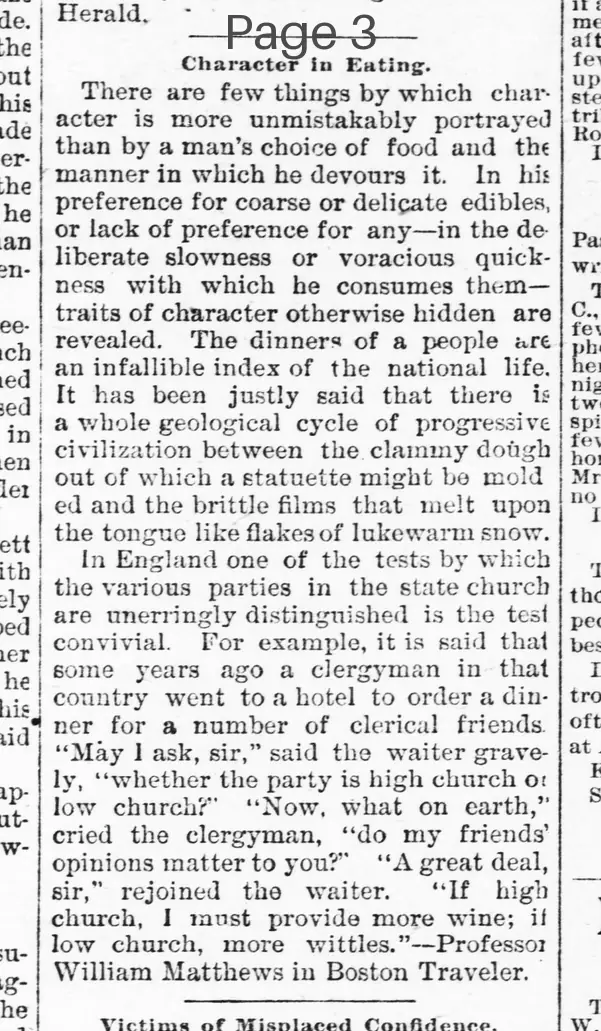
There are few things by which character is more unmistakably portrayed than by a man's choice of food and the manner in which he devours it. In his preference for coarse or delicate edibles, or lack of preference for any—in the deliberate slowness or voracious quickness with which he consumes them—traits of character otherwise hidden are revealed. The dinners of a people are an infallible index of the national life.
It has been justly said that there is a whole geological cycle of progressive civilization between the clammy dough out of which a statuette might be molded and the brittle films that melt upon the tongue like flakes of lukewarm snow.
In England one of the tests by which the various parties in the state church are unerringly distinguished is the test convivial. For example, it is said that some years ago a clergyman in that country went to a hotel to order a dinner for a number of clerical friends.
"May I ask, sir," said the waiter gravely, "whether the party is high church or low church?" "Now, what on earth," cried the clergyman, "do my friends' opinions matter to you?" "A great deal, sir," rejoined the waiter. "If high church, I must provide more wine; if low church, more vittles."—Professor William Matthews in Boston Traveler.
There are few things by which character is more unmistakably portrayed than by a man's choice of food and the manner in which he devours it. In his preference for coarse or delicate edibles, or lack of preference for any—in the deliberate slowness or voracious quickness with which he consumes them—traits of character otherwise hidden are revealed. The dinners of a people are an infallible index of the national life.
It has been justly said that there is a whole geological cycle of progressive civilization between the clammy dough out of which a statuette might be molded and the brittle films that melt upon the tongue like flakes of lukewarm snow.
In England one of the tests by which the various parties in the state church are unerringly distinguished is the test convivial. For example, it is said that some years ago a clergyman in that country went to a hotel to order a dinner for a number of clerical friends.
"May I ask, sir," said the waiter gravely, "whether the party is high church or low church?" "Now, what on earth," cried the clergyman, "do my friends' opinions matter to you?" "A great deal, sir," rejoined the waiter. "If high church, I must provide more wine; if low church, more vittles."—Professor William Matthews in Boston Traveler.
What sub-type of article is it?
Curiosity
Biography
Historical Event
What themes does it cover?
Social Manners
Moral Virtue
What keywords are associated?
Eating Habits
Character Revelation
High Church
Low Church
Convivial Test
What entities or persons were involved?
Professor William Matthews
Where did it happen?
England
Story Details
Key Persons
Professor William Matthews
Location
England
Event Date
Some Years Ago
Story Details
Eating habits reveal character; anecdote of a hotel waiter distinguishing high church from low church guests by ordering more wine or more food for their dinner.