Thank you for visiting SNEWPapers!
Sign up free
Literary
December 6, 1877
The Bossier Banner
Benton, Bellevue, Bossier County, Louisiana
What is this article about?
Young Patty Bright, living comfortably with her wealthy Aunt Patience, witnesses poverty at the Brewer home and pleads to share Thanksgiving bounty. After reflecting on her past with the Brewers' father, Aunt Patience anonymously provides food and essentials, bringing joy to the needy family.
Clipping
OCR Quality
98%
Excellent
Full Text
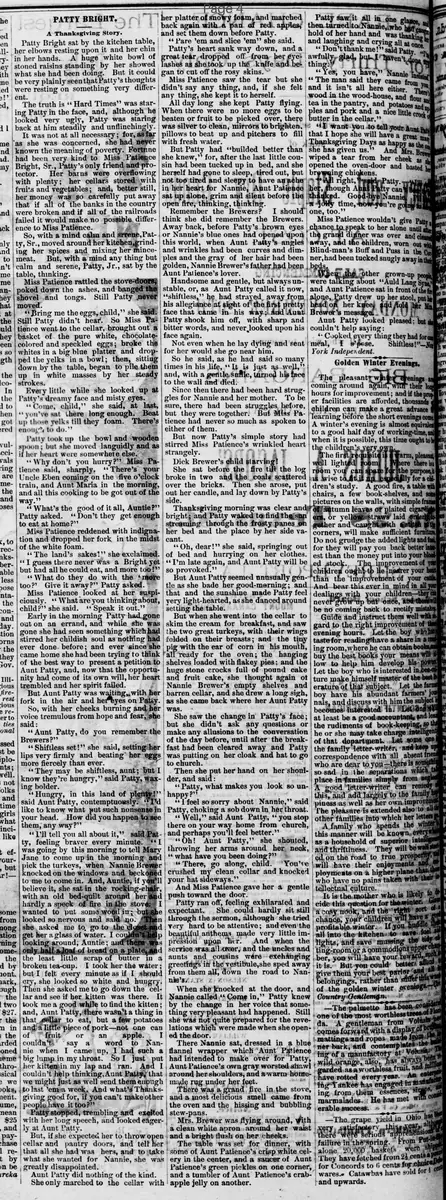
Patty Bright sat by the kitchen table, her elbows resting upon it and her chin in her hands. A huge white bowl of stoned raisins standing by her showed what she had been doing. But it could be very plainly seen that Patty's thoughts were resting on something very different.
The truth is "Hard Times" was staring Patty in the face, and, although he looked very ugly, Patty was staring back at him steadily and unflinchingly. It was not at all necessary; for, as far as she was concerned, she had never known the meaning of poverty. Fortune had been very kind to Miss Patience Bright, Sr., Patty's only friend and protector. Her barns were overflowing with plenty; her cellars stored with fruits and vegetables; and, better still, her money was so carefully put away that if all of the banks in the country were broken and if all of the railroads failed it would make no possible difference to Miss Patience.
So, with a mind calm and serene, Patty, Sr., moved around her kitchen, grinding her spices and mixing her mince-meat. But, with a mind any thing but calm and serene, Patty, Jr., sat by the table, thinking.
Miss Patience rattled the stove-doors, poked down the ashes, and banged the shovel and tongs. Still Patty never moved.
"Bring me the eggs, child," she said.
Still Patty didn't hear. So Miss Patience went to the cellar, brought out a basket of the pure white, chocolate colored and speckled eggs; broke the whites in a big blue platter and dropped the yelks in a bowl; then, sitting down by the table, began to pile them up in white masses by her steady strokes.
Every little while she looked up at Patty's dreamy face and misty eyes.
"Come, child," she said, at last, "you've sat there long enough. Beat up those yelks till they foam. There's enough to do."
Patty took up the bowl and wooden spoon; but she moved languidly and as if her heart were somewhere else.
"Why don't you hurry?" Miss Patience said, sharply. "There's your Uncle Eben coming on the five o'clock train, and Aunt Maria in the morning, and all this cooking to be got out of the way."
"What's the good of it all, Auntie?" Patty asked. "Don't they get enough to eat at home?"
Miss Patience reddened with indignation and dropped her fork in the midst of the white foam.
"The land's sakes!" she exclaimed. "I guess there never was a Bright yet but had all he could eat, and more too!"
"What do they do with the more too? Give it away?" Patty asked.
Miss Patience looked at her suspiciously. "What are you thinking about, child?" she said. "Speak it out."
Early in the morning Patty had gone out on an errand, and while she was gone she had seen something which had stirred her childish soul as nothing had ever done before; and ever since she came home she had been trying to think of the best way to present a petition to Aunt Patty, and, now that the opportunity had come of its own will, her heart trembled and her spirit failed.
But Aunt Patty was waiting, with her fork in the air and her eyes on Patty. So, with her cheeks burning and her voice tremulous from hope and fear, she said:
"Aunt Patty, do you remember the Brewers?"
"Shiftless set!" she said, setting her lips very firmly and beating her eggs more fiercely than ever.
"They may be shiftless, aunt; but I know they're hungry," said Patty, waxing bolder.
"Hungry, in this land of plenty!" said Aunt Patty, contemptuously. "I'd like to know what put such nonsense in your head. How did you happen to see them, any way?"
"I'll tell you all about it," said Patty, feeling braver every minute. "I was going by this morning to tell Mary Jane to come up in the morning and pick the turkeys, when Nannie Brewer knocked on the windows and beckoned to me to come in. And, Auntie, if you believe it, she sat in the rocking-chair, with an old bed-quilt around her and hardly a speck of fire in the stove. I wanted to put some wood in; but she looked so nervous and said no. Then she asked me to go to the closet and get her a glass of water. I couldn't help looking around; Auntie; and there was only half a loaf of bread on a plate, and the least little scrap of butter in a broken tea-cup. I took her the water but I felt every minute as if I should cry, she looked so white and hungry. Then she asked me to go down the cellar and see if her kitten was there. It took me a good while to find the kitten; and, Aunt Patty, there wasn't a thing in that cellar to eat, but a few potatoes and a little piece of pork—not one can of fruit or an apple. I couldn't say a word to Nannie when I came up, I had such a big lump in my throat. So I just put her kitten in my lap and ran. And I couldn't help thinking, Aunt Patty, that we might just as well send them enough to last 'em a week. And what's Thanksgiving good for, if you can't make other people have it too?"
Patty stopped, trembling and excited with her long speech, and looked eagerly at Aunt Patty.
But, if she expected her to throw open cellar and pantry doors, and tell her that all she had was hers, and to take what she wanted for Nannie, she was greatly disappointed.
Aunt Patty did nothing of the kind. She only marched to the cellar with her platter of snowy foam, and marched back again with a pan of red apples, and set them down before Patty.
"Pare 'em and slice 'em," she said.
Patty's heart sank way down, and a great tear dropped off from her eye-lashes as she took up the knife and began to cut off the rosy skins.
Miss Patience saw the tear but she didn't say any thing, and, if she felt any thing, she kept it to herself.
All day long she kept Patty flying. When there were no more eggs to be beaten or fruit to be picked over, there was silver to clean, mirrors to brighten, pillows to beat up and pitchers to fill with fresh water.
But Patty had "builded better than she knew," for, after the last little cousin had been tucked up in bed, and she herself had gone to sleep, tired out, but not too tired and sleepy to have an ache in her heart for Nannie. Aunt Patience sat up alone, grim and silent before the open fire, thinking, thinking.
Remember the Brewers? I should think she did remember the Brewers.
Away back, before Patty's brown eyes or Nannie's blue ones had opened upon this world, when Aunt Patty's angles and wrinkles had been curves and dimples and the gray of her hair had been golden, Nannie Brewer's father had been Aunt Patience's lover.
Handsome and gentle, but always unstable, or, as Aunt Patty called it now, "shiftless," he had strayed away from his allegiance at sight of the first pretty face that came in his way: Land Aunt Patty shook him off, with sharp and bitter words, and never looked upon his face again.
Not even when he lay dying and sent for her would she go near him.
So he said, as he had said so many times in his life, "It is just as well," and, with a gentle smile, turned his face to the wall and died.
Since then there had been hard struggles for Nannie and her mother. To be sure, there had been struggles before, but they were together. But Miss Patience had never so much as spoken to either of them.
But now Patty's simple story had stirred Miss Patience's wrinkled heart strangely.
Dick Brewer's child starving!
She sat before the fire til the log broke in two and the coals scattered over the bricks. Then she arose, put out her candle, and lay down by Patty's side.
Thanksgiving morning was clear and bright; and Patty waked to find the sun streaming through the frosty panes on her bed and the place by her side vacant.
"Oh, dear!" she said, springing out of bed and hurrying on her clothes. "I'm late again, and Aunt Patty will be so provoked."
But Aunt Patty seemed unusually gentle as she bade her good-morning; and that and the sunshine made Patty feel very light-hearted, as she danced around setting the table.
But when she went into the cellar to skim the cream for breakfast, and saw the two great turkeys, with their wings folded on their breasts; and the tiny pig with the ear of corn in his mouth, all ready for the oven; the hanging shelves loaded with flaky pies: and the huge stone crocks full of pound cake and fruit cake. she thought again of Nannie's empty shelves and barren cellar, and she drew a long sigh, as she came back where her Aunt Patty was.
She saw the change in Patty's face; but she didn't ask any questions or make any allusions to the conversation of the day before, until after the breakfast had been cleared away and Patty was putting on her cloak and hat to go to church.
Then she put her hand on her shoulder, and said:
"Patty, what makes you look so unhappy?"
"I feel so sorry about Nannie," said Patty, choking a sob down in her throat.
"Well," said Aunt Patty, "you stop there on your way home from church, and perhaps you'll feel better."
"Oh! Aunt Patty," she shouted, throwing her arms around her neck, "what have you been doing?"
"There, go along, child." You're crushed my clean collar and knocked your hat sideways."
And Miss Patience gave her a gentle push toward the door.
Patty ran off, feeling exhilarated and expectant. She could hardly sit still through the sermon, although she tried very hard to be attentive; and even the beautiful anthems made very little impression upon her.
And when the service was all over, and the uncles and aunts and cousins were exchanging greetings in the vestibule, she sped away from them all, down the road to Nannie's.
When she knocked at the door, and Nannie called "Come in," Patty knew by the change in her voice that something very pleasant had happened. Still she was not quite prepared for the revelations which were made when she opened the door.
There Nannie sat, dressed in a blue flannel wrapper which "Aunt Patience had intended to make over for Patty, Aunt Patience's own gray worsted shawl around her shoulders, and a warm home made rug under her feet.
There was a grand, fire in the stove, and a most delicious smell came from the oven and the hissing and bubbling stew-pans.
Mrs. Brewer was flying around, with a clean white apron around her waist and a bright flush on her cheeks.
The table was set for dinner, with some of Aunt Patience's crisp white celery in the center, and a saucer of Aunt Patience's green pickles on one corner, and a tumbler of Aunt Patience's crab-apple jelly on another.
Patty saw it all in one glance, and then turned to Nannie, who had caught hold of her hand and was thanking and laughing and crying all at once.
"Don't thank me!" said Patty. "I'm awfully glad, but I haven't done a thing."
"Yes, you have," Nannie insisted. "The man said they came from you and it isn't all here either. There's wood in the wood-house, and flour and tea in the pantry, and potatoes and apples and pork and a nice little crock of butter in the cellar."
"I want you to tell your Aunt Patience that I hope she will have many Thanksgiving Days as happy as the one she has given us."
And Mrs. Brewer wiped a tear from her cheek as she opened the oven-door and basted the browning chickens.
"All right," said Patty. "Good-bye Nannie. Have a jolly time, now you're going to have one, too."
Miss Patience wouldn't give Patty any chance to speak to her alone until after the grand dinner was over and cleared away, and the children, worn out with Blind-man's Buff and Puss in the Corner, had been tucked snugly away in the beds.
When the other grown-up people were talking about "Auld Lang Syne," and Aunt Patience sat in front of the fire alone, Patty drew up her stool, put her head on her knee, and told her Mrs. Brewer's message.
Aunt Patty looked pleased; but she couldn't help saying:
"Cooked every thing they had for one meal, I s'pose. Shiftless!"
—New York Independent.
The truth is "Hard Times" was staring Patty in the face, and, although he looked very ugly, Patty was staring back at him steadily and unflinchingly. It was not at all necessary; for, as far as she was concerned, she had never known the meaning of poverty. Fortune had been very kind to Miss Patience Bright, Sr., Patty's only friend and protector. Her barns were overflowing with plenty; her cellars stored with fruits and vegetables; and, better still, her money was so carefully put away that if all of the banks in the country were broken and if all of the railroads failed it would make no possible difference to Miss Patience.
So, with a mind calm and serene, Patty, Sr., moved around her kitchen, grinding her spices and mixing her mince-meat. But, with a mind any thing but calm and serene, Patty, Jr., sat by the table, thinking.
Miss Patience rattled the stove-doors, poked down the ashes, and banged the shovel and tongs. Still Patty never moved.
"Bring me the eggs, child," she said.
Still Patty didn't hear. So Miss Patience went to the cellar, brought out a basket of the pure white, chocolate colored and speckled eggs; broke the whites in a big blue platter and dropped the yelks in a bowl; then, sitting down by the table, began to pile them up in white masses by her steady strokes.
Every little while she looked up at Patty's dreamy face and misty eyes.
"Come, child," she said, at last, "you've sat there long enough. Beat up those yelks till they foam. There's enough to do."
Patty took up the bowl and wooden spoon; but she moved languidly and as if her heart were somewhere else.
"Why don't you hurry?" Miss Patience said, sharply. "There's your Uncle Eben coming on the five o'clock train, and Aunt Maria in the morning, and all this cooking to be got out of the way."
"What's the good of it all, Auntie?" Patty asked. "Don't they get enough to eat at home?"
Miss Patience reddened with indignation and dropped her fork in the midst of the white foam.
"The land's sakes!" she exclaimed. "I guess there never was a Bright yet but had all he could eat, and more too!"
"What do they do with the more too? Give it away?" Patty asked.
Miss Patience looked at her suspiciously. "What are you thinking about, child?" she said. "Speak it out."
Early in the morning Patty had gone out on an errand, and while she was gone she had seen something which had stirred her childish soul as nothing had ever done before; and ever since she came home she had been trying to think of the best way to present a petition to Aunt Patty, and, now that the opportunity had come of its own will, her heart trembled and her spirit failed.
But Aunt Patty was waiting, with her fork in the air and her eyes on Patty. So, with her cheeks burning and her voice tremulous from hope and fear, she said:
"Aunt Patty, do you remember the Brewers?"
"Shiftless set!" she said, setting her lips very firmly and beating her eggs more fiercely than ever.
"They may be shiftless, aunt; but I know they're hungry," said Patty, waxing bolder.
"Hungry, in this land of plenty!" said Aunt Patty, contemptuously. "I'd like to know what put such nonsense in your head. How did you happen to see them, any way?"
"I'll tell you all about it," said Patty, feeling braver every minute. "I was going by this morning to tell Mary Jane to come up in the morning and pick the turkeys, when Nannie Brewer knocked on the windows and beckoned to me to come in. And, Auntie, if you believe it, she sat in the rocking-chair, with an old bed-quilt around her and hardly a speck of fire in the stove. I wanted to put some wood in; but she looked so nervous and said no. Then she asked me to go to the closet and get her a glass of water. I couldn't help looking around; Auntie; and there was only half a loaf of bread on a plate, and the least little scrap of butter in a broken tea-cup. I took her the water but I felt every minute as if I should cry, she looked so white and hungry. Then she asked me to go down the cellar and see if her kitten was there. It took me a good while to find the kitten; and, Aunt Patty, there wasn't a thing in that cellar to eat, but a few potatoes and a little piece of pork—not one can of fruit or an apple. I couldn't say a word to Nannie when I came up, I had such a big lump in my throat. So I just put her kitten in my lap and ran. And I couldn't help thinking, Aunt Patty, that we might just as well send them enough to last 'em a week. And what's Thanksgiving good for, if you can't make other people have it too?"
Patty stopped, trembling and excited with her long speech, and looked eagerly at Aunt Patty.
But, if she expected her to throw open cellar and pantry doors, and tell her that all she had was hers, and to take what she wanted for Nannie, she was greatly disappointed.
Aunt Patty did nothing of the kind. She only marched to the cellar with her platter of snowy foam, and marched back again with a pan of red apples, and set them down before Patty.
"Pare 'em and slice 'em," she said.
Patty's heart sank way down, and a great tear dropped off from her eye-lashes as she took up the knife and began to cut off the rosy skins.
Miss Patience saw the tear but she didn't say any thing, and, if she felt any thing, she kept it to herself.
All day long she kept Patty flying. When there were no more eggs to be beaten or fruit to be picked over, there was silver to clean, mirrors to brighten, pillows to beat up and pitchers to fill with fresh water.
But Patty had "builded better than she knew," for, after the last little cousin had been tucked up in bed, and she herself had gone to sleep, tired out, but not too tired and sleepy to have an ache in her heart for Nannie. Aunt Patience sat up alone, grim and silent before the open fire, thinking, thinking.
Remember the Brewers? I should think she did remember the Brewers.
Away back, before Patty's brown eyes or Nannie's blue ones had opened upon this world, when Aunt Patty's angles and wrinkles had been curves and dimples and the gray of her hair had been golden, Nannie Brewer's father had been Aunt Patience's lover.
Handsome and gentle, but always unstable, or, as Aunt Patty called it now, "shiftless," he had strayed away from his allegiance at sight of the first pretty face that came in his way: Land Aunt Patty shook him off, with sharp and bitter words, and never looked upon his face again.
Not even when he lay dying and sent for her would she go near him.
So he said, as he had said so many times in his life, "It is just as well," and, with a gentle smile, turned his face to the wall and died.
Since then there had been hard struggles for Nannie and her mother. To be sure, there had been struggles before, but they were together. But Miss Patience had never so much as spoken to either of them.
But now Patty's simple story had stirred Miss Patience's wrinkled heart strangely.
Dick Brewer's child starving!
She sat before the fire til the log broke in two and the coals scattered over the bricks. Then she arose, put out her candle, and lay down by Patty's side.
Thanksgiving morning was clear and bright; and Patty waked to find the sun streaming through the frosty panes on her bed and the place by her side vacant.
"Oh, dear!" she said, springing out of bed and hurrying on her clothes. "I'm late again, and Aunt Patty will be so provoked."
But Aunt Patty seemed unusually gentle as she bade her good-morning; and that and the sunshine made Patty feel very light-hearted, as she danced around setting the table.
But when she went into the cellar to skim the cream for breakfast, and saw the two great turkeys, with their wings folded on their breasts; and the tiny pig with the ear of corn in his mouth, all ready for the oven; the hanging shelves loaded with flaky pies: and the huge stone crocks full of pound cake and fruit cake. she thought again of Nannie's empty shelves and barren cellar, and she drew a long sigh, as she came back where her Aunt Patty was.
She saw the change in Patty's face; but she didn't ask any questions or make any allusions to the conversation of the day before, until after the breakfast had been cleared away and Patty was putting on her cloak and hat to go to church.
Then she put her hand on her shoulder, and said:
"Patty, what makes you look so unhappy?"
"I feel so sorry about Nannie," said Patty, choking a sob down in her throat.
"Well," said Aunt Patty, "you stop there on your way home from church, and perhaps you'll feel better."
"Oh! Aunt Patty," she shouted, throwing her arms around her neck, "what have you been doing?"
"There, go along, child." You're crushed my clean collar and knocked your hat sideways."
And Miss Patience gave her a gentle push toward the door.
Patty ran off, feeling exhilarated and expectant. She could hardly sit still through the sermon, although she tried very hard to be attentive; and even the beautiful anthems made very little impression upon her.
And when the service was all over, and the uncles and aunts and cousins were exchanging greetings in the vestibule, she sped away from them all, down the road to Nannie's.
When she knocked at the door, and Nannie called "Come in," Patty knew by the change in her voice that something very pleasant had happened. Still she was not quite prepared for the revelations which were made when she opened the door.
There Nannie sat, dressed in a blue flannel wrapper which "Aunt Patience had intended to make over for Patty, Aunt Patience's own gray worsted shawl around her shoulders, and a warm home made rug under her feet.
There was a grand, fire in the stove, and a most delicious smell came from the oven and the hissing and bubbling stew-pans.
Mrs. Brewer was flying around, with a clean white apron around her waist and a bright flush on her cheeks.
The table was set for dinner, with some of Aunt Patience's crisp white celery in the center, and a saucer of Aunt Patience's green pickles on one corner, and a tumbler of Aunt Patience's crab-apple jelly on another.
Patty saw it all in one glance, and then turned to Nannie, who had caught hold of her hand and was thanking and laughing and crying all at once.
"Don't thank me!" said Patty. "I'm awfully glad, but I haven't done a thing."
"Yes, you have," Nannie insisted. "The man said they came from you and it isn't all here either. There's wood in the wood-house, and flour and tea in the pantry, and potatoes and apples and pork and a nice little crock of butter in the cellar."
"I want you to tell your Aunt Patience that I hope she will have many Thanksgiving Days as happy as the one she has given us."
And Mrs. Brewer wiped a tear from her cheek as she opened the oven-door and basted the browning chickens.
"All right," said Patty. "Good-bye Nannie. Have a jolly time, now you're going to have one, too."
Miss Patience wouldn't give Patty any chance to speak to her alone until after the grand dinner was over and cleared away, and the children, worn out with Blind-man's Buff and Puss in the Corner, had been tucked snugly away in the beds.
When the other grown-up people were talking about "Auld Lang Syne," and Aunt Patience sat in front of the fire alone, Patty drew up her stool, put her head on her knee, and told her Mrs. Brewer's message.
Aunt Patty looked pleased; but she couldn't help saying:
"Cooked every thing they had for one meal, I s'pose. Shiftless!"
—New York Independent.
What sub-type of article is it?
Prose Fiction
What themes does it cover?
Moral Virtue
Agriculture Rural
Social Manners
What keywords are associated?
Thanksgiving
Charity
Poverty
Aunt Patience
Patty Bright
Brewers
Rural Life
Moral Lesson
Literary Details
Subject
Thanksgiving Charity To The Poor
Key Lines
And What's Thanksgiving Good For, If You Can't Make Other People Have It Too?
Dick Brewer's Child Starving!
I Want You To Tell Your Aunt Patience That I Hope She Will Have Many Thanksgiving Days As Happy As The One She Has Given Us.