Thank you for visiting SNEWPapers!
Sign up free
Story
June 9, 1820
Richmond Enquirer
Richmond, Richmond County, Virginia
What is this article about?
A letter describes Elizabeth Fry's visit to female prisoners in Glasgow's Bridewell jail on June 9, 1819, where she spoke, read Bible parables, and prayed, moving the women to tears and inspiring reform efforts similar to her Newgate work.
Clipping
OCR Quality
95%
Excellent
Full Text
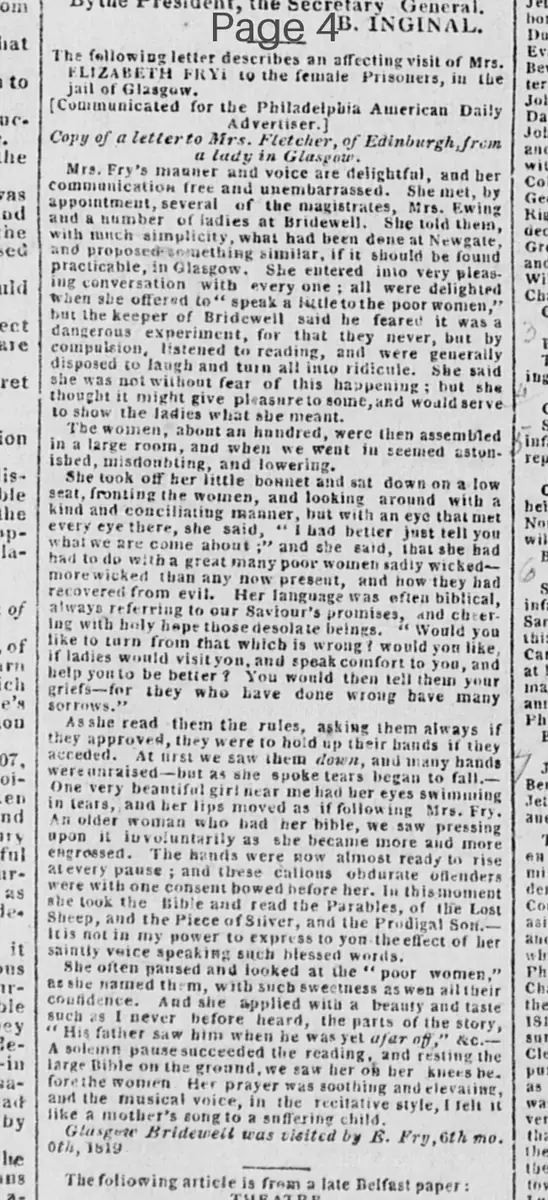
The following letter describes an affecting visit of Mrs. ELIZABETH FRY to the female Prisoners, in the jail of Glasgow.
[Communicated for the Philadelphia American Daily Advertiser.]
Copy of a letter to Mrs. Fletcher, of Edinburgh, from a lady in Glasgow.
Mrs. Fry's manner and voice are delightful, and her communication free and unembarrassed. She met, by appointment, several of the magistrates, Mrs. Ewing and a number of ladies at Bridewell. She told them, with much simplicity, what had been done at Newgate. and proposed something similar, if it should be found practicable, in Glasgow. She entered into very pleasing conversation with every one; all were delighted when she offered to speak a little to the poor women," but the keeper of Bridewell said he feared it was a dangerous experiment, for that they never, but by compulsion, listened to reading, and were generally disposed to laugh and turn all into ridicule. She said she was not without fear of this happening; but she thought it might give pleasure to some, and would serve to show the ladies what she meant.
The women, about an hundred, were then assembled in a large room, and when we went in seemed astonished, misdoubting, and lowering. She took off her little bonnet and sat down on a low seat, fronting the women, and looking around with a kind and conciliating manner, but with an eye that met every eye there, she said, "I had better just tell you what we are come about " and she said, that she had had to do with a great many poor women sadly wicked--more wicked than any now present, and how they had recovered from evil. Her language was often biblical, always referring to our Saviour's promises, and cheering with holy hope those desolate beings. " Would you like to turn from that which is wrong? would you like if ladies would visit you, and speak comfort to you, and help you to be better? You would then tell them your griefs--for they who have done wrong have many sorrows"
As she read them the rules, asking them always if they approved, they were to hold up their hands if they acceded. At first we saw them down, and many hands were raised--but as she spoke tears began to fall.--One very beautiful girl near me had her eyes swimming in tears, and her lips moved as if following Mrs. Fry. An older woman who had her bible, we saw pressing upon it involuntarily as she became more and more engrossed. The hands were now almost ready to rise at every pause; and these callous obdurate offenders were with one consent bowed before her. In this moment she took the Bible and read the Parables, of the Lost Sheep, and the Piece of Silver, and the Prodigal Son.--It is not in my power to express to you the effect of her saintly voice speaking such blessed words. She often paused and looked at the "poor women," as she named them, with such sweetness as won all their confidence. And she applied with a beauty and taste such as I never before heard, the parts of the story, "His father saw him when he was yet afar off," &c.--A solemn pause succeeded the reading, and resting the large Bible on the ground, we saw her on her knees before the women Her prayer was soothing and elevating, and the musical voice, in the recitative style, I felt it like a mother's going to a suffering child.
Glasgow Bridewell was visited by E. Fry, 6th mo. 9th, 1819
[Communicated for the Philadelphia American Daily Advertiser.]
Copy of a letter to Mrs. Fletcher, of Edinburgh, from a lady in Glasgow.
Mrs. Fry's manner and voice are delightful, and her communication free and unembarrassed. She met, by appointment, several of the magistrates, Mrs. Ewing and a number of ladies at Bridewell. She told them, with much simplicity, what had been done at Newgate. and proposed something similar, if it should be found practicable, in Glasgow. She entered into very pleasing conversation with every one; all were delighted when she offered to speak a little to the poor women," but the keeper of Bridewell said he feared it was a dangerous experiment, for that they never, but by compulsion, listened to reading, and were generally disposed to laugh and turn all into ridicule. She said she was not without fear of this happening; but she thought it might give pleasure to some, and would serve to show the ladies what she meant.
The women, about an hundred, were then assembled in a large room, and when we went in seemed astonished, misdoubting, and lowering. She took off her little bonnet and sat down on a low seat, fronting the women, and looking around with a kind and conciliating manner, but with an eye that met every eye there, she said, "I had better just tell you what we are come about " and she said, that she had had to do with a great many poor women sadly wicked--more wicked than any now present, and how they had recovered from evil. Her language was often biblical, always referring to our Saviour's promises, and cheering with holy hope those desolate beings. " Would you like to turn from that which is wrong? would you like if ladies would visit you, and speak comfort to you, and help you to be better? You would then tell them your griefs--for they who have done wrong have many sorrows"
As she read them the rules, asking them always if they approved, they were to hold up their hands if they acceded. At first we saw them down, and many hands were raised--but as she spoke tears began to fall.--One very beautiful girl near me had her eyes swimming in tears, and her lips moved as if following Mrs. Fry. An older woman who had her bible, we saw pressing upon it involuntarily as she became more and more engrossed. The hands were now almost ready to rise at every pause; and these callous obdurate offenders were with one consent bowed before her. In this moment she took the Bible and read the Parables, of the Lost Sheep, and the Piece of Silver, and the Prodigal Son.--It is not in my power to express to you the effect of her saintly voice speaking such blessed words. She often paused and looked at the "poor women," as she named them, with such sweetness as won all their confidence. And she applied with a beauty and taste such as I never before heard, the parts of the story, "His father saw him when he was yet afar off," &c.--A solemn pause succeeded the reading, and resting the large Bible on the ground, we saw her on her knees before the women Her prayer was soothing and elevating, and the musical voice, in the recitative style, I felt it like a mother's going to a suffering child.
Glasgow Bridewell was visited by E. Fry, 6th mo. 9th, 1819
What sub-type of article is it?
Biography
Historical Event
Heroic Act
What themes does it cover?
Moral Virtue
Recovery
Providence Divine
What keywords are associated?
Elizabeth Fry
Prison Reform
Glasgow Bridewell
Female Prisoners
Bible Reading
Redemption
Quaker Visit
What entities or persons were involved?
Elizabeth Fry
Mrs. Fletcher
Mrs. Ewing
Female Prisoners
Where did it happen?
Glasgow Bridewell
Story Details
Key Persons
Elizabeth Fry
Mrs. Fletcher
Mrs. Ewing
Female Prisoners
Location
Glasgow Bridewell
Event Date
6th Mo. 9th, 1819
Story Details
Elizabeth Fry visits female prisoners in Glasgow Bridewell, shares her Newgate experiences, proposes reforms, speaks biblically to inspire change, reads parables of redemption, and prays, moving the women to tears and gaining their consent.