Thank you for visiting SNEWPapers!
Sign up free
The Liberator
Boston, Suffolk County, Massachusetts
What is this article about?
John G. Whittier writes from Harrisburg on January 30, 1837, and February 1, reporting on the Pennsylvania Anti-Slavery Convention: delegates gathering, successful anti-slavery efforts, legislative debates, speeches praising women's roles, and optimism for emancipation amid opposition.
Clipping
OCR Quality
Full Text
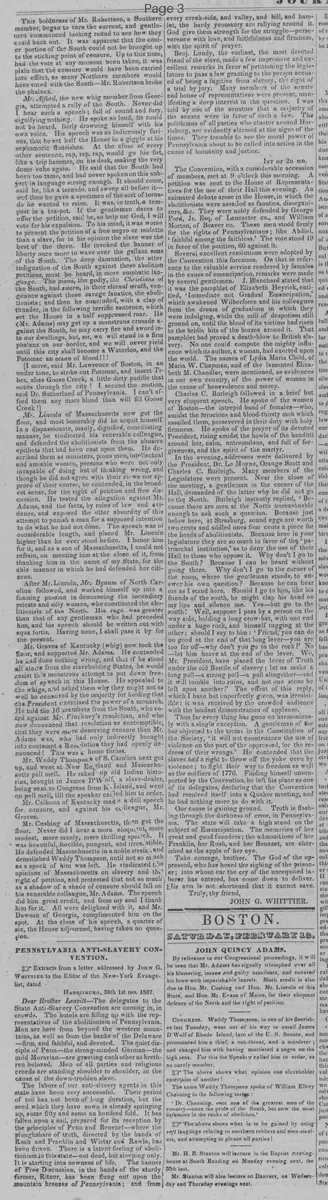
Extracts from a letter addressed by John G. Whittier to the Editor of the New York Evangelist, dated
HARRISBURG, 30th 1st mo. 1837.
Dear Brother Leavitt—The delegates to the State Anti-Slavery Convention are coming in, in crowds. The hotels are filling up with the representatives of the abolitionism of Pennsylvania. Men are here from beyond the western mountains, as well as from the banks of the Delaware—firm, and faithful, and devoted. The quiet disciple of Penn—the strong-minded German—the mild Moravian—are greeting each other as brethren beloved. Men of all parties and religious creeds are standing shoulder to shoulder, in the cause of the down-trodden slave.
The labors of our anti-slavery agents in this state have been very successful. Their period of toil has not been of long duration, but the seed which they have sown is already springing up, some fifty and some an hundred fold. It has fallen upon a soil, prepared for its reception by the principles of Penn and Benezet—where the ploughshare of truth, directed by the hands of Rush and Franklin and Wistar and Rawle, has been driven. There is a latent feeling of abolitionism in this state—not dead, but sleeping only. It is starting into newness of life. The banner of Free Discussion, in the hands of the sturdy farmer, Ritner, has been flung out upon the mountain breezes of Pennsylvania; and from every creek-side, and valley, and hill, and hamlet, the hardy yeomanry are rallying around it. God give them strength for the struggle—perseverance with love, and faithfulness and firmness, with the spirit of prayer.
Benj. Lundy, the earliest, the most devoted friend of the slave, made a few impressive and excellent remarks in favor of petitioning the legislature to pass a law granting to the person accused of being a fugitive from slavery, the right of a trial by jury. Many members of the senate and house of representatives were present, manifesting a deep interest in the question. I was told by one of the senators that a majority of the senate were in favor of such a law. The politicians of all parties who cluster around Harrisburg, are evidently alarmed at the signs of the times. They tremble to see the moral power of Pennsylvania about to be called into action in the cause of humanity and justice.
1st of 2d Mo.
The Convention, with a considerable accession of members, met at 9 o'clock this morning. A petition was sent to the House of Representatives for the use of their Hall this evening. An animated debate arose in the House, in which the abolitionists were assailed as fanatics, disorganizers, &c. They were nobly defended by George Ford, Jr. Esq. of Lancaster co., and William Morton, of Beaver co. These men stood firmly for the rights of Pennylvanians; like Abdiel, 'faithful among the faithless.' The vote stood 19 in favor of the petition, 66 against it.
Several excellent resolutions were adopted by the Convention this forenoon. On that in reference to the valuable service rendered by females in the cause of emancipation, remarks were made by several gentlemen. J. Blanchard stated that it was the pamphlet of Elizabeth Heyrick, entitled, 'Immediate not Gradual Emancipation,' which awakened Wilberforce and his colleagues from the dream of gradualism in which they were indulging, while the mill of despotism still ground on, until the blood of its victims had risen to the bridle bits of the horses around it. That pamphlet had proved a death-blow to British slavery. No one could compute the mighty influence which its author, a woman, had exerted upon the world. The names of Lydia Maria Child, of Maria W. Chapman, and of the lamented Elizabeth M. Chandler, were mentioned, as evidences in our own country, of the power of woman in the cause of benevolence and mercy.
Charles C. Burleigh followed in a brief but very eloquent speech. He spoke of the women of Boston—the intrepid band of females—who, amidst the ferocious and blood-thirsty mob which assailed them, persevered in their duty with holy firmness. He spoke of the prayer of its devoted President, rising amidst the howls of the banditti around her, calm, untremulous, and full of forgiveness, and the spirit of the martyr.
In the evening, addresses were delivered by the President, Dr. Le Moyne, Orange Scott and Charles C. Burleigh. Many members of the Legislature were present. Near the close of the meeting, a gentleman in the corner of the Hall, demanded of the latter why he did not go to the South. Burleigh instantly replied, Because there are men at the North unreasonable enough to ask such a question. Because just below here, at Strasburg, sound eggs are worth two cents and addled ones four cents a piece for the heads of abolitionists. Because here in your legislature they are so much in favor of the 'patriarchal institution,' as to deny the use of their Hall to those who oppose it. Why don't I go to the South? Because I can be heard without going there. Why don't I go to the corner of the room, where the gentleman stands, to answer his own question? Because he can hear me as I stand here. Should I go to him, like his friends of the south, he might clap his hand on my lips and silence me. Yes—but go to the south! Well, suppose I pass by a person on the way side, holding a long crow-bar, with one end under a huge rock, and himself tugging at the other; should I say to him: 'Friend, you can do no good at the end of that long lever—you are too far off—why don't you go to the rock?' No—let him heave at the end of the lever. We, Mr. President, have placed the lever of Truth under the old Bastile of slavery; let us make a long pull—a strong pull—a pull altogether—and it will tumble into ruins, and not one stone be left upon another!' The effect of this reply, which I have but imperfectly given, was irresistible: it was received by the crowded audience with the loudest demonstration of applause.
Thus far every thing has gone on harmoniously with a single exception. A gentleman of the bar objected to the terms in the Constitution of the Society, 'it will not countenance the use of violence on the part of the oppressed, for the redress of their wrongs.' He contended that the slaves had a right to throw off the yoke even by violence; to fight their way to freedom as well as the soldiers of 1776. Finding himself unsupported by the Convention, he left his place as one of its delegates, declaring that the Convention had resolved itself into a Quaker meeting, and he had nothing more to do with it.
Our cause is gaining ground. Truth is flashing through the darkness of error, in Pennsylvania. The state will take a high stand on the subject of Emancipation. The memories of her great and good founders; the admonitions of her Franklin, her Rush, and her Benezet, are cherished as the apple of her eye.
Take courage, brother. The God of the oppressed, who has heard the sighing of the prisoner; into whose ear the cry of the unrequited laborer has entered, has come down to deliver. His arm is not shortened that it cannot save.
Truly, thy friend,
JOHN G. WHITTIER.
What sub-type of article is it?
What themes does it cover?
What keywords are associated?
What entities or persons were involved?
Letter to Editor Details
Author
John G. Whittier
Recipient
Brother Leavitt, Editor Of The New York Evangelist
Main Argument
the pennsylvania anti-slavery convention is gathering strong support from diverse delegates and is successfully advancing the cause of abolition, with calls for legislative protections for fugitive slaves and recognition of women's contributions, despite opposition from politicians and some dissenters.
Notable Details