Thank you for visiting SNEWPapers!
Sign up free
Alexandria Daily Gazette, Commercial & Political
Alexandria, Virginia
What is this article about?
In early June, a marine volcanic eruption occurred off the coast of St. Michael's Island, Azores, producing smoke, fire, and a new island about one mile in circumference. Earthquakes damaged seven houses, but no lives lost. Three gentlemen nearly perished visiting the site.
Merged-components note: Continuation of the marine eruption story across pages, as indicated by the text flow.
Clippings
1 of 2
OCR Quality
Full Text
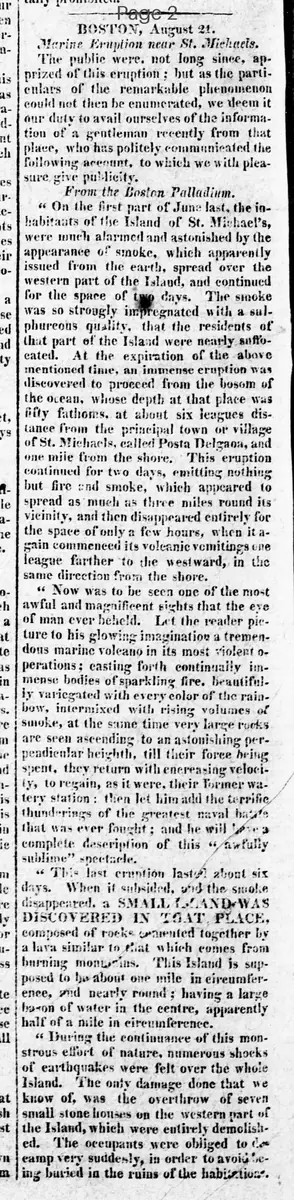
Marine Eruption near St. Michaels.
The public were not long since, apprised of this eruption; but as the parti-
culars of the remarkable phenomenon could not then be enumerated, we deem it
our duty to avail ourselves of the information of a gentleman recently from that
place, who has politely communicated the following account, to which we with plea-
sure give publicity.
From the Boston Palladium.
"On the first part of June last, the inhabitants of the Island of St. Michael's,
were much alarmed and astonished by the appearance of smoke, which apparently
issued from the earth, spread over the western part of the Island, and continued
for the space of two days. The smoke was so strongly impregnated with a sul-
phureous quality, that the residents of that part of the Island were nearly suffo-
cated. At the expiration of the above mentioned time, an immense eruption was
discovered to proceed from the bosom of the ocean, whose depth at that place was
fifty fathoms, at about six leagues distance from the principal town or village
of St. Michaels, called Ponta Delgada, and one mile from the shore. This eruption
continued for two days, emitting nothing but fire and smoke, which appeared to
spread as much as three miles round its vicinity, and then disappeared entirely for
the space of only a few hours, when it a-
gain commenced its volcanic vomitings one
league farther to the westward, in the same direction from the shore.
"Now was to be seen one of the most awful and magnificent sights that the eye
of man ever beheld. Let the reader picture to his glowing imagination a tremen-
dous marine volcano in its most violent operations; casting forth continually im-
mense bodies of sparkling fire, beautifully variegated with every color of the rain-
bow, intermixed with rising volumes of smoke, at the same time very large rocks
are seen ascending to an astonishing perpendicular height, till their force being
spent, they return with increasing velocity, to regain, as it were, their former wa-
tery station: then let him add the terrific thunderings of the greatest naval battle
that was ever fought: and he will have a complete description of this "awfully
sublime" spectacle.
"This last eruption lasted about six days. When it subsided, and the smoke
disappeared, a SMALL ISLAND was discovered in that place, composed of rocks
cemented together by a lava similar to that which comes from burning mountains.
This Island is supposed to be about one mile in circumference, and nearly round; having
a large basin of water in the centre, apparently half a mile in circumference.
"During the continuance of this monstrous effort of nature, numerous shocks
of earthquakes were felt over the whole Island. The only damage done that we
know of, was the overthrow of seven small stone houses on the western part of
the Island, which were entirely demolished. The occupants were obliged to de-
camp very suddenly, in order to avoid being buried in the ruins of the habitations."
A visit to the new Island was contemplated to be made immediately. The result of this visit will no doubt prove highly interesting to the philosopher, as well as important to the navigator.
The impatient curiosity of three gentlemen was very near being paid with the loss of their lives. In attempting a visit previous to the termination of the eruption, they were, notwithstanding their greatest efforts, drawn by an overpowering suction of air about half a mile, as they supposed, into the immense body of surrounding smoke. They remained one hour and a half, much frightened by their perilous situation. When, at length, the glorious light of Heaven again shone upon them, they were much surprised to find their faces, hands, clothes, and sails, quite blackened, and the deck of their vessel entirely covered more than an inch thick with a coarse black cinder like those found in a blacksmith's shop. This new Island is in lat. 37.46, long. 25.58.
It is not yet ascertained whether a vessel can or cannot pass through between this new island and the old land. This and many other particulars will be the fruits of the expected investigation of this wonderful gift of old Neptune.
What sub-type of article is it?
What keywords are associated?
Where did it happen?
Foreign News Details
Primary Location
Island Of St. Michael's
Event Date
First Part Of June Last
Outcome
seven small stone houses demolished on western part of the island; no known fatalities; new island formed approximately one mile in circumference with central basin half a mile around, at lat. 37.46, long. 25.58.
Event Details
Smoke issued from earth over western part of St. Michael's Island for two days, nearly suffocating residents with sulfurous quality. Eruption from ocean at fifty fathoms depth, six leagues from Ponta Delgada and one mile from shore, lasted two days emitting fire and smoke spreading three miles. Resumed one league westward for six days, with fire, multicolored sparks, smoke, ascending rocks, and thunder-like sounds. Earthquakes felt island-wide. Three gentlemen nearly lost in smoke during visit, covered in black cinder.