Thank you for visiting SNEWPapers!
Sign up free
Editorial
October 1, 1856
The Star Of The North
Bloomsburg, Columbia County, Pennsylvania
What is this article about?
Editorial from the Ohio Statesman refutes Democratic misrepresentations of the Constitution's three-fifths clause, arguing it disadvantages the South by counting slaves as only three-fifths for representation, contrary to claims of extra votes for slaveholders. Quotes Chicago Times to illustrate the point using 1850 census data.
Clipping
OCR Quality
95%
Excellent
Full Text
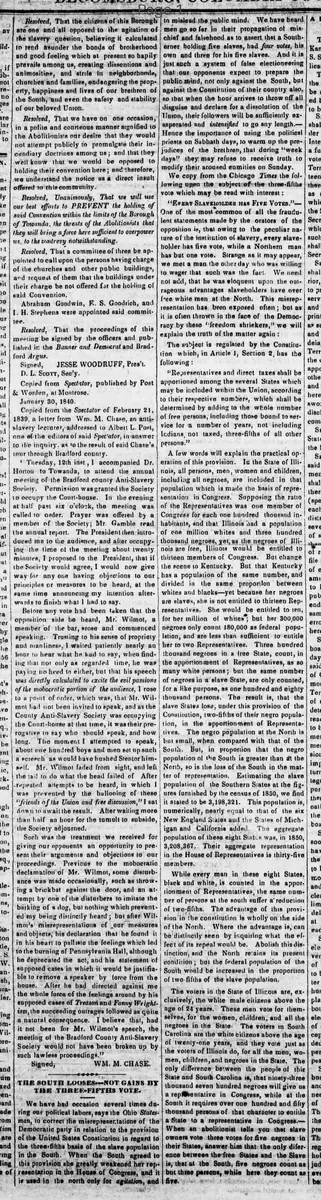
THE SOUTH LOSES—NOT GAINS BY
THE THREE-FIFTHS VOTE.
We have had occasion several times during our political labors, says the Ohio Statesman, to correct the misrepresentations of the Democratic party in relation to the provision of the United States Constitution in regard to the three-fifths basis of the slave population in the South. When the South agreed to this provision she greatly weakened her representation in the House of Congress, and it is used in the north only for agitation, and to mislead the public mind. We have heard men go so far in their propagation of mischief and falsehood as to assert that a Southerner holding five slaves, had four votes, his own and three for his five slaves. And it is just such a system of false electioneering that our opponents expect to prepare the public mind, not only against the South, but against the Constitution of their country also. So that when the hour arrives to throw off all disguise and declare for a dissolution of the Union, their followers will be sufficiently exasperated and intensified to go any length.—Hence the importance of using the political priests on Sabbath days, to warm up the prejudices of the brethren, that during "week days" they may refuse to receive truth to modify their aroused enmities on Sunday.
We copy from the Chicago Times the following upon the subject of the three-fifths vote which may be read with interest:
"Every Slaveholder Has Five Votes."
One of the most common of all the rancorous statements made by the orators of the opposition is, that owing to the peculiar nature of the institution of slavery, every slave holder has five votes, while a Northern man has but one vote. Strange as it may appear, we met a man the other day who was willing to wager that such was the fact. We need not add, that he was eloquent upon the outrageous advantages slaveholders have over free white men at the North. This misrepresentation has been exposed often; but as it is often thrown in the face of the Democracy by these "freedom shriekers," we will explain the truth of the matter again:
The subject is regulated by the Constitution which, in Article 1, Section 2, has the following:
"Representatives and direct taxes shall be apportioned among the several States which may be included within the Union, according to their respective numbers, which shall be determined by adding to the whole number of free persons, including those bound to service for a number of years, not including Indians not taxed, three-fifths of all other Persons."
A few words will explain the practical operation of this provision. In the State of Illinois, all persons, men, women and children, including all negroes, are included in that population which is made the basis of representation in Congress. Supposing the ratio of the Representatives was one member of Congress for each one hundred thousand inhabitants, and that Illinois had a population of one million whites and three hundred thousand negroes, yet, as the negroes of Illinois are free, Illinois would be entitled to thirteen members of Congress. But change the scene to Kentucky. Suppose that Kentucky has a population of the same number, and divided in the same proportion between whites and blacks—yet because her negroes are slaves, she is not entitled to thirteen Representatives. She would be entitled to ten. for her million of whites; but her 300,000 negroes only count 180,000 as federal population, and are less than sufficient to entitle her to two Representatives. Three hundred thousand negroes in a free State, count, in the apportionment of Representatives, as so many white persons; but the same number of negroes in a slave State, are only counted, for a like purpose, as one hundred and eighty thousand persons. The result is, that the slave States lose, under this provision of the Constitution, two-fifths of their negro population, in the apportionment of Representatives. The negro population at the North is but small, when compared with that of the South. But, in proportion that the negro population of the South is greater than at the North, so is the loss of the South in the matter of representation. Estimating the slave population of the Southern States at the figures furnished by the census of 1850, we find it stated to be 3,198,321. This population is, numerically, nearly equal to that of the six New England States and the States of Michigan and California added. The aggregate population of these eight States was, in 1850, 3,208,367. Their aggregate representation in the House of Representatives is thirty-five members.
While every man in these eight States, black and white, is counted in the apportionment of Representatives, the same number of persons at the south suffer a reduction of two-fifths. The advantage of this provision in the constitution is wholly on the side of the North. Where the advantage is, can be distinctly seen by inquiring what the effect of its repeal would be. Abolish this distinction, and the North retains its present condition: but the federal population of the South would be increased in the proportion of two-fifths of the slave population.
The voters in the State of Illinois are, exclusively, the white male citizens above the age of 21 years. These men vote for themselves, for the women, children, and all the negroes in the State. The voters in South Carolina are the white citizens above the age of twenty-one years, and they vote just as the voters of Illinois do, for all the men, women, children, and negroes in the State. The only difference between the people of this State and South Carolina is, that ninety-three thousand seven hundred negroes will give us a representative in Congress, while at the South it requires over one hundred and fifty thousand persons of that character to entitle a State to a representative in Congress.—When an abolitionist tells you that slave owners vote three votes for five negroes in their States, answer him that the only difference between the free States and the Slave States is, that at the South, five negroes count as but three persons, while here they count as five. A rational man
THE THREE-FIFTHS VOTE.
We have had occasion several times during our political labors, says the Ohio Statesman, to correct the misrepresentations of the Democratic party in relation to the provision of the United States Constitution in regard to the three-fifths basis of the slave population in the South. When the South agreed to this provision she greatly weakened her representation in the House of Congress, and it is used in the north only for agitation, and to mislead the public mind. We have heard men go so far in their propagation of mischief and falsehood as to assert that a Southerner holding five slaves, had four votes, his own and three for his five slaves. And it is just such a system of false electioneering that our opponents expect to prepare the public mind, not only against the South, but against the Constitution of their country also. So that when the hour arrives to throw off all disguise and declare for a dissolution of the Union, their followers will be sufficiently exasperated and intensified to go any length.—Hence the importance of using the political priests on Sabbath days, to warm up the prejudices of the brethren, that during "week days" they may refuse to receive truth to modify their aroused enmities on Sunday.
We copy from the Chicago Times the following upon the subject of the three-fifths vote which may be read with interest:
"Every Slaveholder Has Five Votes."
One of the most common of all the rancorous statements made by the orators of the opposition is, that owing to the peculiar nature of the institution of slavery, every slave holder has five votes, while a Northern man has but one vote. Strange as it may appear, we met a man the other day who was willing to wager that such was the fact. We need not add, that he was eloquent upon the outrageous advantages slaveholders have over free white men at the North. This misrepresentation has been exposed often; but as it is often thrown in the face of the Democracy by these "freedom shriekers," we will explain the truth of the matter again:
The subject is regulated by the Constitution which, in Article 1, Section 2, has the following:
"Representatives and direct taxes shall be apportioned among the several States which may be included within the Union, according to their respective numbers, which shall be determined by adding to the whole number of free persons, including those bound to service for a number of years, not including Indians not taxed, three-fifths of all other Persons."
A few words will explain the practical operation of this provision. In the State of Illinois, all persons, men, women and children, including all negroes, are included in that population which is made the basis of representation in Congress. Supposing the ratio of the Representatives was one member of Congress for each one hundred thousand inhabitants, and that Illinois had a population of one million whites and three hundred thousand negroes, yet, as the negroes of Illinois are free, Illinois would be entitled to thirteen members of Congress. But change the scene to Kentucky. Suppose that Kentucky has a population of the same number, and divided in the same proportion between whites and blacks—yet because her negroes are slaves, she is not entitled to thirteen Representatives. She would be entitled to ten. for her million of whites; but her 300,000 negroes only count 180,000 as federal population, and are less than sufficient to entitle her to two Representatives. Three hundred thousand negroes in a free State, count, in the apportionment of Representatives, as so many white persons; but the same number of negroes in a slave State, are only counted, for a like purpose, as one hundred and eighty thousand persons. The result is, that the slave States lose, under this provision of the Constitution, two-fifths of their negro population, in the apportionment of Representatives. The negro population at the North is but small, when compared with that of the South. But, in proportion that the negro population of the South is greater than at the North, so is the loss of the South in the matter of representation. Estimating the slave population of the Southern States at the figures furnished by the census of 1850, we find it stated to be 3,198,321. This population is, numerically, nearly equal to that of the six New England States and the States of Michigan and California added. The aggregate population of these eight States was, in 1850, 3,208,367. Their aggregate representation in the House of Representatives is thirty-five members.
While every man in these eight States, black and white, is counted in the apportionment of Representatives, the same number of persons at the south suffer a reduction of two-fifths. The advantage of this provision in the constitution is wholly on the side of the North. Where the advantage is, can be distinctly seen by inquiring what the effect of its repeal would be. Abolish this distinction, and the North retains its present condition: but the federal population of the South would be increased in the proportion of two-fifths of the slave population.
The voters in the State of Illinois are, exclusively, the white male citizens above the age of 21 years. These men vote for themselves, for the women, children, and all the negroes in the State. The voters in South Carolina are the white citizens above the age of twenty-one years, and they vote just as the voters of Illinois do, for all the men, women, children, and negroes in the State. The only difference between the people of this State and South Carolina is, that ninety-three thousand seven hundred negroes will give us a representative in Congress, while at the South it requires over one hundred and fifty thousand persons of that character to entitle a State to a representative in Congress.—When an abolitionist tells you that slave owners vote three votes for five negroes in their States, answer him that the only difference between the free States and the Slave States is, that at the South, five negroes count as but three persons, while here they count as five. A rational man
What sub-type of article is it?
Constitutional
Slavery Abolition
Partisan Politics
What keywords are associated?
Three Fifths Clause
Slave Representation
Constitutional Provision
Southern Disadvantage
Northern Agitation
1850 Census
What entities or persons were involved?
Democratic Party
Ohio Statesman
Chicago Times
South
North
Slaveholders
Editorial Details
Primary Topic
Misrepresentations Of The Three Fifths Clause Disadvantaging The South
Stance / Tone
Defensive Of Southern Representation And Corrective Of Northern Agitation
Key Figures
Democratic Party
Ohio Statesman
Chicago Times
South
North
Slaveholders
Key Arguments
The Three Fifths Clause Weakens Southern Representation By Counting Slaves As Only Three Fifths
Misrepresentation Claims Slaveholders Get Extra Votes Are False
Northern Free States Count All Persons Fully For Representation
Southern States Lose Two Fifths Of Slave Population In Apportionment
1850 Census Shows Southern Slaves Nearly Equal To Northern States' Full Population But Undercounted
Repeal Would Increase Southern Representation Without Affecting North
Voters In Both Regions Represent All Population, But South Needs More To Gain Seats