Thank you for visiting SNEWPapers!
Sign up free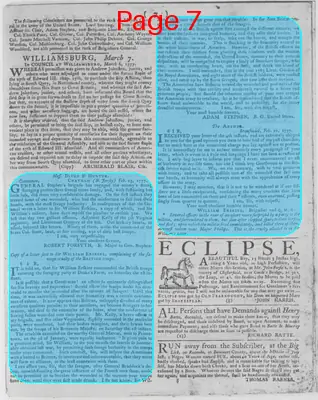
The Virginia Gazette
Richmond, Williamsburg, Richmond County, Virginia
What is this article about?
In February 1777 near Chatham, New Jersey, General Stephen's brigade engaged British foraging parties multiple times, inflicting damage with minimal losses. American wounded were barbarously murdered by British troops on Feb. 1, prompting a protest letter from Gen. Stephen to Sir William Erskine, who denied authorizing cruelty and cited retaliatory incidents.
Clipping
OCR Quality
Full Text
Gentlemen,
CHATHAM (N.Jersey) Feb. 15, 1777.
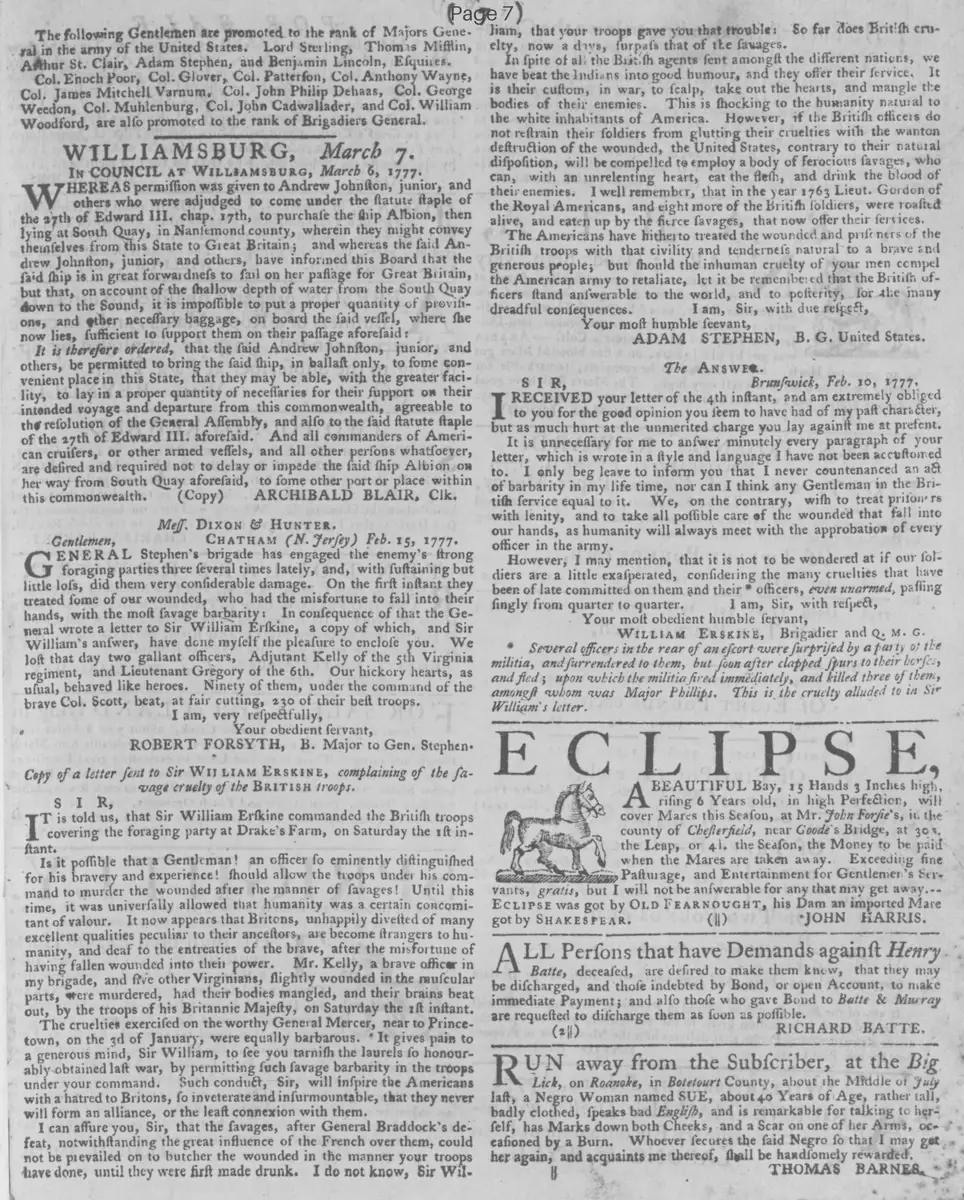
GENERAL Stephen's brigade has engaged the enemy's strong foraging parties three several times lately, and, with sustaining but little loss, did them very considerable damage. On the first instant they treated some of our wounded, who had the misfortune to fall into their hands, with the most savage barbarity: In consequence of that the General wrote a letter to Sir William Erskine, a copy of which, and Sir William's answer, have done myself the pleasure to enclose you. We lost that day two gallant officers, Adjutant Kelly of the 5th Virginia regiment, and Lieutenant Gregory of the 6th. Our hickory hearts, as usual, behaved like heroes. Ninety of them, under the command of the brave Col. Scott, beat, at fair cutting, 230 of their best troops.
I am, very respectfully,
Your obedient servant,
ROBERT FORSYTH, B. Major to Gen. Stephen
Copy of a letter sent to Sir WILLIAM ERSKINE, complaining of the savage cruelty of the BRITISH troops.
SIR,
IT is told us, that Sir William Erskine commanded the British troops covering the foraging party at Drake's Farm, on Saturday the 1st instant.
Is it possible that a Gentleman! an officer so eminently distinguished for his bravery and experience! should allow the troops under his command to murder the wounded after the manner of savages! Until this time, it was universally allowed that humanity was a certain concomitant of valour. It now appears that Britons, unhappily divested of many excellent qualities peculiar to their ancestors, are become strangers to humanity, and deaf to the entreaties of the brave, after the misfortune of having fallen wounded into their power. Mr. Kelly, a brave officer in my brigade, and five other Virginians, slightly wounded in the muscular parts, were murdered, had their bodies mangled, and their brains beat out, by the troops of his Britannic Majesty, on Saturday the 1st instant.
The cruelties exercised on the worthy General Mercer, near to Princeton, on the 3d of January, were equally barbarous. It gives pain to a generous mind, Sir William, to see you tarnish the laurels so honourably obtained last war, by permitting such savage barbarity in the troops under your command. Such conduct, Sir, will inspire the Americans with a hatred to Britons, so inveterate and insurmountable, that they never will form an alliance, or the least connexion with them.
I can assure you, Sir, that the savages, after General Braddock's defeat, notwithstanding the great influence of the French over them, could not be prevailed on to butcher the wounded in the manner your troops have done, until they were first made drunk. I do not know, Sir William, that your troops gave you that trouble: So far does British cruelty, now a days, surpass that of the savages.
In spite of all the British agents sent amongst the different nations, we have beat the Indians into good humour, and they offer their service. It is their custom, in war, to scalp, take out the hearts, and mangle the bodies of their enemies. This is shocking to the humanity natural to the white inhabitants of America. However, if the British officers do not restrain their soldiers from glutting their cruelties with the wanton destruction of the wounded, the United States, contrary to their natural disposition, will be compelled to employ a body of ferocious savages, who can, with an unrelenting heart, eat the flesh, and drink the blood of their enemies. I well remember, that in the year 1763 Lieut. Gordon of the Royal Americans, and eight more of the British soldiers, were roasted alive, and eaten up by the fierce savages, that now offer their services.
The Americans have hitherto treated the wounded and prisoners of the British troops with that civility and tenderness natural to a brave and generous people; but should the inhuman cruelty of your men compel the American army to retaliate, let it be remembered that the British officers stand answerable to the world, and to posterity, for the many dreadful consequences.
I am, Sir, with due respect,
Your most humble servant,
ADAM STEPHEN, B.G. United States.
The ANSWER.
SIR,
Brunswick, Feb. 10, 1777
I RECEIVED your letter of the 4th instant, and am extremely obliged to you for the good opinion you seem to have had of my past character, but as much hurt at the unmerited charge you lay against me at present.
It is unnecessary for me to answer minutely every paragraph of your letter, which is wrote in a style and language I have not been accustomed to.
I only beg leave to inform you that I never countenanced an act of barbarity in my life time, nor can I think any Gentleman in the British service equal to it. We, on the contrary, wish to treat prisoners with lenity, and to take all possible care of the wounded that fall into our hands, as humanity will always meet with the approbation of every officer in the army.
However, I may mention, that it is not to be wondered at if our soldiers are a little exasperated, considering the many cruelties that have been of late committed on them and their officers, even unarmed, passing singly from quarter to quarter.
I am, Sir, with respect,
Your most obedient humble servant,
WILLIAM ERSKINE, Brigadier and Q. M. G.
Several officers in the rear of an escort were surprised by a party of the militia, and surrendered to them, but soon after clapped spurs to their horses, and fled; upon which the militia fired immediately, and killed three of them, amongst whom was Major Phillips. This is the cruelty alluded to in Sir William's letter.
What sub-type of article is it?
What keywords are associated?
What entities or persons were involved?
Where did it happen?
Domestic News Details
Primary Location
Chatham (N.Jersey)
Event Date
Feb. 15, 1777
Key Persons
Outcome
american losses: adjutant kelly and lieutenant gregory killed; mr. kelly and five other virginians wounded and murdered by british troops. british: considerable damage in engagements; three officers killed by militia including major phillips.
Event Details
General Stephen's brigade engaged British foraging parties three times lately near Chatham, NJ, inflicting damage with little loss. On Feb. 1, British troops murdered and mangled American wounded at Drake's Farm. Gen. Stephen protested to Sir William Erskine, who denied barbarity and cited militia killings of British officers.