Thank you for visiting SNEWPapers!
Sign up free
Editorial
August 8, 1883
Smyrna Times
Smyrna, Kent County, Delaware
What is this article about?
The editorial examines the evolving role of the modern clergyman, noting a shift from revered authority to equality with other professionals like lawyers and teachers. It praises this change as a healthy sign of societal moral progress and endorses President Eliot's advocacy for less sectarian, more broadly Christian clerical education to foster freedom of thought.
Clipping
OCR Quality
95%
Excellent
Full Text
WHOLE NO. 1.465.
The Modern Clergyman.
President Eliot's recent article in The North American Review, and the answer to it which appears in the present number of that periodical, call attention to the status of the modern clergyman.
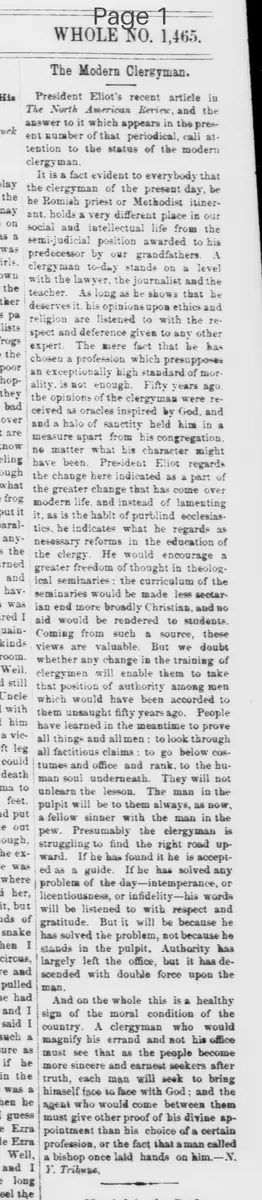
It is a fact evident to everybody that the clergyman of the present day, be he Romish priest or Methodist itinerant, holds a very different place in our social and intellectual life from the semi-judicial position awarded to his predecessor by our grandfathers. A clergyman to-day stands on a level with the lawyer, the journalist and the teacher. As long as he shows that he deserves it, his opinions upon ethics and religion are listened to with the respect and deference given to any other expert. The mere fact that he has chosen a profession which presupposes an exceptionally high standard of morality, is not enough. Fifty years ago the opinions of the clergyman were received as oracles inspired by God, and a halo of sanctity held him in a measure apart from his congregation, no matter what his character might have been. President Eliot regards the change here indicated as a part of the greater change that has come over modern life, and instead of lamenting it, as is the habit of purblind ecclesiastics, he indicates what he regards as necessary reforms in the education of the clergy. He would encourage a greater freedom of thought in theological seminaries: the curriculum of the seminaries would be made less sectarian and more broadly Christian, and on the whole this is a healthy sign of the moral condition of the country. A clergyman who would magnify his errand and not his office must see that as the people become more sincere and earnest seekers after truth, each man will seek to bring himself face to face with God: and the agent who would come between them must give other proof of his divine appointment than his choice of a certain profession, or the fact that a man called a bishop once laid hands on him.-N. Y. Tribune.
The Modern Clergyman.
President Eliot's recent article in The North American Review, and the answer to it which appears in the present number of that periodical, call attention to the status of the modern clergyman.
It is a fact evident to everybody that the clergyman of the present day, be he Romish priest or Methodist itinerant, holds a very different place in our social and intellectual life from the semi-judicial position awarded to his predecessor by our grandfathers. A clergyman to-day stands on a level with the lawyer, the journalist and the teacher. As long as he shows that he deserves it, his opinions upon ethics and religion are listened to with the respect and deference given to any other expert. The mere fact that he has chosen a profession which presupposes an exceptionally high standard of morality, is not enough. Fifty years ago the opinions of the clergyman were received as oracles inspired by God, and a halo of sanctity held him in a measure apart from his congregation, no matter what his character might have been. President Eliot regards the change here indicated as a part of the greater change that has come over modern life, and instead of lamenting it, as is the habit of purblind ecclesiastics, he indicates what he regards as necessary reforms in the education of the clergy. He would encourage a greater freedom of thought in theological seminaries: the curriculum of the seminaries would be made less sectarian and more broadly Christian, and on the whole this is a healthy sign of the moral condition of the country. A clergyman who would magnify his errand and not his office must see that as the people become more sincere and earnest seekers after truth, each man will seek to bring himself face to face with God: and the agent who would come between them must give other proof of his divine appointment than his choice of a certain profession, or the fact that a man called a bishop once laid hands on him.-N. Y. Tribune.
What sub-type of article is it?
Moral Or Religious
Education
Social Reform
What keywords are associated?
Modern Clergyman
Clerical Status
Theological Education
Moral Progress
Religious Reform
President Eliot
What entities or persons were involved?
President Eliot
North American Review
N. Y. Tribune
Editorial Details
Primary Topic
Status And Education Of The Modern Clergyman
Stance / Tone
Supportive Of Societal Changes And Clerical Reforms
Key Figures
President Eliot
North American Review
N. Y. Tribune
Key Arguments
Modern Clergymen Hold Less Authoritative Positions Than In The Past, Equal To Lawyers And Teachers.
Clerical Opinions Are Respected Only If Deserved, Not Automatically Due To Profession.
Change Reflects Broader Moral Progress In Society.
Advocates For Less Sectarian, More Broadly Christian Theological Education.
Encourages Freedom Of Thought In Seminaries.
Clergy Must Prove Divine Appointment Beyond Ordination.