Thank you for visiting SNEWPapers!
Sign up free
Editorial
July 14, 1838
The Native American
Washington, District Of Columbia
What is this article about?
The editorial condemns the high rate of assassinations in the US South and West, where respected figures commit murders with impunity due to societal tolerance and weak public opinion. It calls for reform through condemnation and exemplary executions of prominent offenders to curb 'chivalrous' violence.
Clipping
OCR Quality
98%
Excellent
Full Text
ASSASSINATION IN AMERICA.
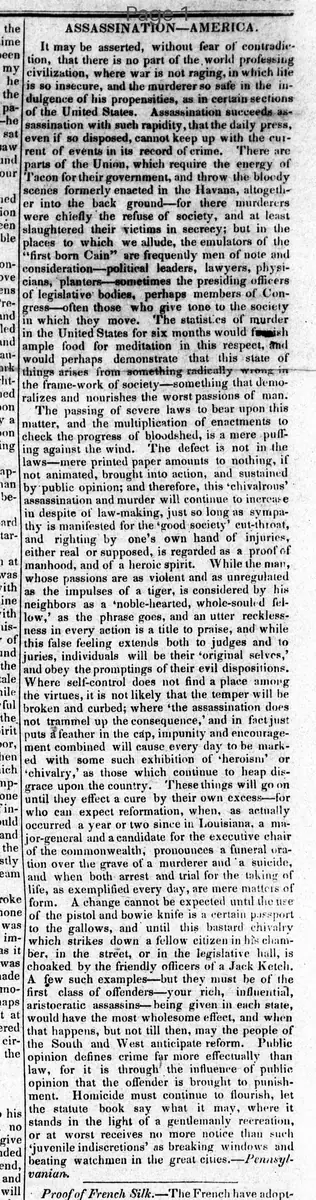
It may be asserted, without fear of contradiction, that there is no part of the world possessing civilization, where war is not raging, in which life is so insecure, and the murderer so safe in the indulgence of his propensities, as in certain sections of the United States. Assassination succeeds assassination with such rapidity, that the daily press, even if so disposed, cannot keep up with the current of events in its record of crime. There are parts of the Union, which require the energy of Tacitus for their government, and throw the bloody scenes formerly enacted in the Havana, altogether into the back ground—for there murderers were chiefly the refuse of society, and at least slaughtered their victims in secrecy; but in the places to which we allude, the emulators of the "first born Cain" are frequently men of note and consideration—political leaders, lawyers, physicians, planters—sometimes the presiding officers of legislative bodies, perhaps members of Congress—often those who give tone to the society in which they move. The statistics of murder in the United States for six months would furnish ample food for meditation in this respect, and would perhaps demonstrate that this state of things arises from something radically wrong in the frame-work of society—something that demoralizes and nourishes the worst passions of man.
The passing of severe laws to bear upon this matter, and the multiplication of enactments to check the progress of bloodshed, is a mere puffing against the wind. The defect is not in the laws—mere printed paper amounts to nothing, if not animated, brought into action, and sustained by public opinion; and therefore, this 'chivalrous' assassination and murder will continue to increase in despite of law-making, just so long as sympathy is manifested for the 'good society' cut-throat, and righting by one's own hand of injuries, either real or supposed, is regarded as a proof of manhood, and of a heroic spirit. While the man, whose passions are as violent and as unregulated as the impulses of a tiger, is considered by his neighbors as a 'noble-hearted, whole-souled fellow,' as the phrase goes, and an utter recklessness in every action is a title to praise, and while this false feeling extends both to judges and to juries, individuals will be their 'original selves,' and obey the promptings of their evil dispositions.
Where self-control does not find a place among the virtues, it is not likely that the temper will be broken and curbed; where 'the assassination does not trammel up the consequence,' and in fact just puts a feather in the cap, impunity and encouragement combined will cause every day to be marked with some such exhibition of 'heroism' or 'chivalry,' as those which continue to heap disgrace upon the country. These things will go on until they effect a cure by their own excess—for who can expect reformation, when, as actually occurred a year or two since in Louisiana, a major-general and a candidate for the executive chair of the commonwealth, pronounces a funeral oration over the grave of a murderer and 'a suicide,' and when both arrest and trial for the taking of life, as exemplified every day, are mere matters of form. A change cannot be expected until the use of the pistol and bowie knife is a certain passport to the gallows, and until this bastard chivalry which strikes down a fellow citizen in his chamber, in the street, or in the legislative hall, is choked by the friendly officers of a Jack Ketch.
A few such examples—but they must be of the first class of offenders—your rich, influential, aristocratic assassins—being given in each state, would have the most wholesome effect, and when that happens, but not till then, may the people of the South and West anticipate reform. Public opinion defines crime far more effectually than law, for it is through the influence of public opinion that the offender is brought to punishment. Homicide must continue to flourish, let the statute book say what it may, where it stands in the light of a gentlemanly recreation, or at worst receives no more notice than such 'juvenile indiscretions' as breaking windows and beating watchmen in the great cities.—Pennsylvania.
It may be asserted, without fear of contradiction, that there is no part of the world possessing civilization, where war is not raging, in which life is so insecure, and the murderer so safe in the indulgence of his propensities, as in certain sections of the United States. Assassination succeeds assassination with such rapidity, that the daily press, even if so disposed, cannot keep up with the current of events in its record of crime. There are parts of the Union, which require the energy of Tacitus for their government, and throw the bloody scenes formerly enacted in the Havana, altogether into the back ground—for there murderers were chiefly the refuse of society, and at least slaughtered their victims in secrecy; but in the places to which we allude, the emulators of the "first born Cain" are frequently men of note and consideration—political leaders, lawyers, physicians, planters—sometimes the presiding officers of legislative bodies, perhaps members of Congress—often those who give tone to the society in which they move. The statistics of murder in the United States for six months would furnish ample food for meditation in this respect, and would perhaps demonstrate that this state of things arises from something radically wrong in the frame-work of society—something that demoralizes and nourishes the worst passions of man.
The passing of severe laws to bear upon this matter, and the multiplication of enactments to check the progress of bloodshed, is a mere puffing against the wind. The defect is not in the laws—mere printed paper amounts to nothing, if not animated, brought into action, and sustained by public opinion; and therefore, this 'chivalrous' assassination and murder will continue to increase in despite of law-making, just so long as sympathy is manifested for the 'good society' cut-throat, and righting by one's own hand of injuries, either real or supposed, is regarded as a proof of manhood, and of a heroic spirit. While the man, whose passions are as violent and as unregulated as the impulses of a tiger, is considered by his neighbors as a 'noble-hearted, whole-souled fellow,' as the phrase goes, and an utter recklessness in every action is a title to praise, and while this false feeling extends both to judges and to juries, individuals will be their 'original selves,' and obey the promptings of their evil dispositions.
Where self-control does not find a place among the virtues, it is not likely that the temper will be broken and curbed; where 'the assassination does not trammel up the consequence,' and in fact just puts a feather in the cap, impunity and encouragement combined will cause every day to be marked with some such exhibition of 'heroism' or 'chivalry,' as those which continue to heap disgrace upon the country. These things will go on until they effect a cure by their own excess—for who can expect reformation, when, as actually occurred a year or two since in Louisiana, a major-general and a candidate for the executive chair of the commonwealth, pronounces a funeral oration over the grave of a murderer and 'a suicide,' and when both arrest and trial for the taking of life, as exemplified every day, are mere matters of form. A change cannot be expected until the use of the pistol and bowie knife is a certain passport to the gallows, and until this bastard chivalry which strikes down a fellow citizen in his chamber, in the street, or in the legislative hall, is choked by the friendly officers of a Jack Ketch.
A few such examples—but they must be of the first class of offenders—your rich, influential, aristocratic assassins—being given in each state, would have the most wholesome effect, and when that happens, but not till then, may the people of the South and West anticipate reform. Public opinion defines crime far more effectually than law, for it is through the influence of public opinion that the offender is brought to punishment. Homicide must continue to flourish, let the statute book say what it may, where it stands in the light of a gentlemanly recreation, or at worst receives no more notice than such 'juvenile indiscretions' as breaking windows and beating watchmen in the great cities.—Pennsylvania.
What sub-type of article is it?
Crime Or Punishment
Social Reform
Moral Or Religious
What keywords are associated?
Assassination
Murder Statistics
Chivalrous Violence
Public Opinion
Societal Reform
Impunity For Killers
Southern Violence
What entities or persons were involved?
Political Leaders
Lawyers
Physicians
Planters
Members Of Congress
Major General In Louisiana
Editorial Details
Primary Topic
Critique Of Assassination And Violence In The United States
Stance / Tone
Strongly Critical Of Societal Tolerance For Murder And Calling For Reform Via Public Opinion
Key Figures
Political Leaders
Lawyers
Physicians
Planters
Members Of Congress
Major General In Louisiana
Key Arguments
Life Is Insecure In Certain Us Sections Due To Frequent Assassinations
Murderers Are Often Respected Figures Like Political Leaders And Professionals
Severe Laws Are Ineffective Without Supporting Public Opinion
Societal Sympathy For 'Chivalrous' Killers Encourages Violence
Self Control And Curbing Violent Passions Are Absent Virtues
Impunity For Homicide Disgraces The Country
Reform Requires Exemplary Punishments For Influential Offenders
Public Opinion Defines And Punishes Crime More Than Laws