Thank you for visiting SNEWPapers!
Sign up free
Richmond Enquirer
Richmond, Richmond County, Virginia
What is this article about?
Court martial proceedings against Marshal Ney in France, November 1815, detailing witness testimonies on his actions and decisions during Napoleon's return in March 1815, his defense claiming he was carried away by events, and arguments on the tribunal's competency.
Clipping
OCR Quality
Full Text
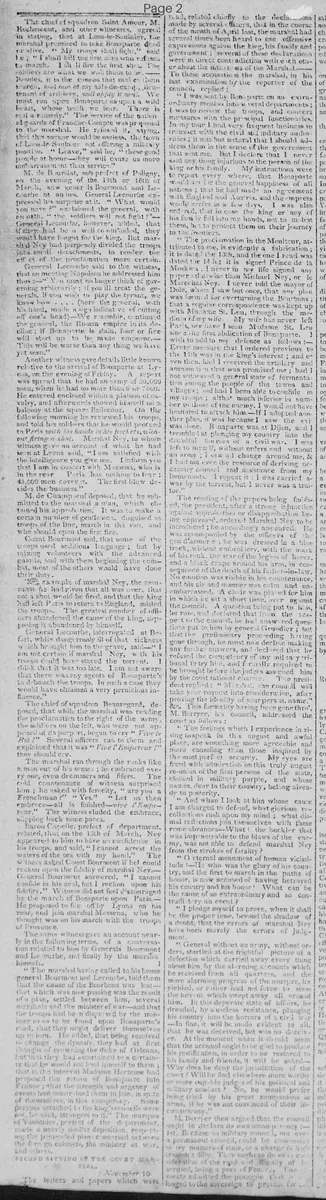
M. de Bourmont, sub-prefect of Poligny, on the evening of the 15th or 16th of March, saw generals Bourmont and Lecourbe at an inn. General Lecourbe expressed his surprise at it. "What would you have?" exclaimed the general, with an oath, "the soldiers will not fight!" General Lecourbe, however, added, that if they had been "well commanded, they would have fought for the king. But marshal Ney had purposely divided the troops into small detachments, to render the effect of the proclamation more certain."
General Lecourbe said to the witness, that on meeting Napoleon he addressed him thus: "You must no longer think of governing arbitrarily; if you ill treat the generals, if you wish to play the tyrant, we know how..." (here the general, with his hand, made a sign indicative of cutting off one's head)--"We resemble, continued the general, the Roman empire in its decline: if Bonaparte is slain, four or five will start up to be made emperor.--This will be worse than any thing we have yet seen."
Another witness gave details little known relative to the arrival of Bonaparte at Lyons, on the evening of Friday. A report was spread that he had an army of 30,000 men, when he had no more than 6 or 7000. He entered enclosed within a squadron of cavalry, and afterwards showed himself on a balcony at the square Bellecour. On the following morning he reviewed his troops, and told his soldiers that he would proceed to Paris with his hands in his pockets, without firing a shot. Marshal Ney, to whom witness gave an account of what he had seen at Lyons said, "I am satisfied with the intelligence you give me. I inform you that I am in concert with Massena, who is in the rear. Paris has nothing to fear: 45,000 men cover it. The first blow decides the business."
M. de Champigneul deposed, that he submitted to the marshal a plan, which obtained his approbation. It was to make a certain number of gentlemen, disguised as troops of the line, march in the van, and who should open the first fire.
Count Bourmont said, that some of the troops used seditious language; but by mixing volunteers with the advanced guard, and with them beginning the combat, most of the others would have done their duty.
The example of marshal Ney, the arsenal, he had given that all was over, that not a shot would be fired, and that the king had left Paris to return to England, misled the troops. The greatest number of officers abandoned the cause of the king, supposing it abandoned by himself.
General Lecourbe, interrogated at Besancon, while dangerously ill of that sickness which brought him to the grave, said--"I am not certain if marshal Ney, with his troops could have stayed the torrent. I think that it was too late. I am not aware that there was any agents of Bonaparte's to debauch the troops. In such a case they would have obtained a very pernicious influence."
The chief of squadron Beauregard deposed, that while the marshal was reading the proclamation to the right of the army, the soldiers on the left, who were not apprised of its purport, began to cry "Vive le Roi!" Several officers ran to them and explained that it was "Vive l'Empereur!" they should cry.
The marshal ran through the ranks like a man out of his senses; he embraced every one, even drummers and fifers. The cold countenance of witness surprised him; he asked with ferocity, "are you a Frenchman?" "Yes." "Let us then embrace--all is finished--vive l'Empereur." The witness eluded the embrace, slipping back some paces.
Baron Capelle, prefect of department, related, that on the 13th of March, Ney appeared to him to have no confidence in his troops, and said, "I cannot arrest the waters of the sea with my hand." The witness asked Count Bourmont if he could reckon upon the fidelity of marshal Ney.--Gen. Bourmont answered, "I cannot confide in his zeal, but I reckon upon his fidelity." Witness did not feel discouraged by the march of Bonaparte upon Paris.--He proposed to file off by Lyons on his rear, and join marshal Massena, who he thought was on his march with the troops of Provence.
The same witness gave an account nearly in the following terms, of a conversation related to him by Generals Bourmont and Lecourbe, and finally by the marshal himself,
"The marshal having called to his house general Bourmont and Lecourbe, told them that the cause of the Bourbons was lost--that which was now passing was the result of a plan, settled between him, several marshals and the minister of war--and that the troops had been dispersed by the minister so as to be found upon Bonaparte's road, that they might deliver themselves up to him. He added, that being resolved to change the dynasty, they had at first thought of crowning the duke of Orleans, but that they had ascertained to a certainty that he would not lend himself to them; that in the interval Madame Hortense had proposed the return of Bonaparte into France; that the strength and urgency of events had constrained them to join, in spite of themselves, in this conspiracy. Some persons attached to the king's council were, he said, strangers to it." The marquis of Vaulchier, prefect of the department, made a nearly similar deposition, respecting the pretended plan concerted between the foreign cabinets, the minister at war, and others.
SECOND SITTING OF THE COURT MARTIAL.
November 10
The letters and papers which were read, related chiefly to the declarations made by several officers, that in the course of the month of April last, the marshal had several times been heard to use offensive expressions against the king, his family and government; several of these declarations were in direct contradiction with each other about the intentions of the Marshal.---
To these accusations the marshal, in his last examination by the reporter of the council, replied:
"I was sent by Bonaparte on an extraordinary mission into several departments; I was to review the troops, and concert measures with the principal functionaries. In my tour I had very frequent business to transact with the civil and military authorities: it was but natural that I should address them in the sense of the government that sent me. But I declare that I never said any thing injurious to the person of the king or his family. My instructions were to report every where, that Bonaparte would act for the general happiness of all nations; that he had made an agreement with England and Austria, and the empress would arrive in a few days. I was also ordered, that in case the king or any of his family fell into my hands, not to molest them, but to protect them on their journey to the frontiers."
"The proclamation in the Moniteur, attributed to me, is evidently a fabrication; it is dated the 13th, and the one I read was dated the 14th; it is signed Prince de la Moskwa, I never in my life signed any paper otherwise than Michael Ney, or Marechal Ney. I never told the mayor of Dole, whom I saw but once, that any plan was formed for overturning the Bourbons; that a regular correspondence was kept up with Madame St. Leu, through the medium of my wife. My wife has never left Paris, nor have I seen Madame St. Leu since the first abdication of Bonaparte. I wish to add to my defence as follows:--
Every measure that I ordered previous to the 15th was in the king's interest; and even then, had I received the artillery and ammunition that was promised me; had I not witnessed a general state of fermentation among the people of the towns and villages: and had I been able to confide in my troops; altho' much inferior in number to those of the enemy, I would not have hesitated to attack him. If I adopted another plan, it was because I saw the evil was done. Bonaparte was at Dijon, and I tremble at plunging my country into the dreadful horrors of a civil war. I was left to myself, without orders and without an army; I saw a total change around me, & I had not even the resource of deriving necessary counsel and assistance from my lieutenants. I repeat it; I was carried away by the torrent, but I never was a traitor."
The reading of the papers being finished, the president, after a strong injunction against approbation or disapprobation being expressed, ordered Marshal Ney to be introduced; he accordingly appeared. He was accompanied by the officers of the gendarmerie; he was dressed in a blue frock, without embroidery, with the mark of his rank, the star of the legion of honor, and a black crape around his arm, in consequence of the death of his father-in-law. No emotion was visible in his countenance, and his air and manner was calm and unembarrassed. A chair was placed for him in which he sat a short time, over against the council. A question being put to him, he rose, and declared that from the respect to the council, he had answered questions put to him by general Grundler; but that the preliminary proceeding having gone through, he must now decline making any further answers, and declared that he refused the competency of any military tribunal to try him, and finally required to be brought before the judges assigned him by the constitutional charter. The president replied: "Marshal, the council will take your request into consideration, after proving the identity of your person, name," &c. This formality having been gone through, M. Berryer, his counsel, addressed the Court as follows:
The feelings which I experience in rising to speak in this august and awful place, are something more agreeable and more consoling than those inspired by the most perfect security. My eyes are fixed with admiration on this truly august re-union of the first persons of the state, clothed in military purple, and whose names, dear to their country, belong already to posterity.
"And when I look at him whose cause I am charged to defend, what glorious recollections rush upon my mind; what dismal reflections join themselves with these remembrances--What! the buckler that was impenetrable to the blows of the enemy, was not able to defend marshal Ney from the strokes of fatality?
"O eternal monument of human vicissitude!--He who was the glory of his country, and the first to march in the paths of honor, is now accused of having betrayed his country and his honor! What can be the cause of so extraordinary and so contradictory an event?
"I pledge myself to prove, when it shall be the proper time, beyond the shadow of a doubt, that the errors of marshal Ney have been merely the errors of judgment.
"General without an army, without orders, startled at the frightful picture of a defection which carried away every thing about him, by the alarming accounts which he received from all quarters, and the more alarming progress of the usurper, he yielded, or rather had not force to stem the torrent which swept away all around him. In this desperate state of affairs, he dreaded, by a useless resistance, plunging his country into the horrors of a civil war--In fine, it will be made evident to all, that he was deceived, but was no deceiver. At the moment when it should seem that the accused ought to be glad to produce his justification, in order to be restored to his family and friends, it will be asked--Why does he deny the jurisdiction of the court? Will he find elsewhere more worthy or more capable judges of his political and military conduct? No. he would prefer being tried by his great companions in arms, if he was not convinced of their incompetency."
M. Berryer then argued that the council ought to declare its own incompetency:--1st. Because no military council, not even a permanent council, could be competent to try matters of state, or a charge of high treason: 2dly. They ought to do so in consideration of the rank and dignity of the accused, being a peer of France. The advocate added that the principle belonged to the sovereign to exercise for the safety of the state: but argued that it did not thence follow that he was at liberty to change the fixed order of jurisdiction, to create especial judges, and pervert the powers of military tribunals. He concluded an elegant defence in the following words:
"You have, in order to fix your opinions on the questions, only to open the holy book of our liberties, the charter, where are engraved the titles of marshal Ney. Your noble and generous minds will appreciate the deposit which is confided to you. Pronounce."
Gen. Grundler, the reporter, addressed the court as follows:
"The nation, in tears, beholds this day one of its most glorious defenders seated in the temple of justice, in the place reserved for the accused. Unhappy result of our political dissensions. Fatal error, which brings the sword of the law upon him who ought to have been its firmest supporter.--In times of revolution, the faults and crimes which they occasion, are not always punished with impartiality and justice.--You have given the noble example of a military tribunal calmly deliberating on the fate of an illustrious prisoner, in the midst of effervescence of conflicting parties and passions. France, nay all Europe, have their eyes fixed upon us. We have not yielded to any influence contrary to our duties. We shall leave this place with the happiness of an irreproachable conscience, without fearing the opinion of the world or of posterity."
The reporter here entered into a learned discussion on the origin and privileges of the peerage, and of the dignity of marshal of France; he thence concluded, that the chamber of peers could alone be competent to try a peer:
"It has been advanced," said he, "that a person accused ought to be tried according to the rank he held at the moment of his being taken into custody; and, therefore, marshal Ney, being no longer a peer of France, from the simple cause of his having accepted a place among the peers named by Bonaparte, has no longer any right to be tried by the chamber of Peers. This opinion does not seem to us to be at all founded. We daily see persons brought before courts martial for crimes committed while they belonged to the army, although they may have since quitted the military service."
After having made several other observations, in order to prove the incompetency of the council, he brought forward a final and powerful objection:
"The sentences of courts martial may be, with respect to forms, &c. referred to a council of revision: this council, whatever may be the rank of the prisoner, is to be in all cases composed of the camp martial, two colonels, two lieutenant colonels, and a captain. Would it be becoming to submit a sentence pronounced by four marshals, and three generals, to the revision of a council thus composed? A tribunal which is to pronounce definitively, ought always to be composed of persons of superior rank."
What sub-type of article is it?
What keywords are associated?
What entities or persons were involved?
Where did it happen?
Foreign News Details
Primary Location
France
Event Date
November 10
Key Persons
Outcome
proceedings ongoing; ney refuses military tribunal competency, demands trial by peers; arguments on jurisdiction presented.
Event Details
Witness testimonies describe Ney's promises to fight Bonaparte, doubts about troops, conversations on switching sides, and plans during March 1815 events. Ney defends actions as non-traitorous, influenced by circumstances. Counsel and reporter argue tribunal's incompetency for high treason and peer trial.