Thank you for visiting SNEWPapers!
Sign up free
Literary
September 14, 1764
The New Hampshire Gazette And Historical Chronicle
Portsmouth, Greenland, Rockingham County, New Hampshire
What is this article about?
A series of rhetorical questions attributed to the Bishop of Cloyne, critiquing societal vanity, excessive foreign trade, luxury imports, poor legislation, and lack of education, while advocating frugality, industry, domestic production, and learning to improve the nation's wealth and morals.
Clipping
OCR Quality
98%
Excellent
Full Text
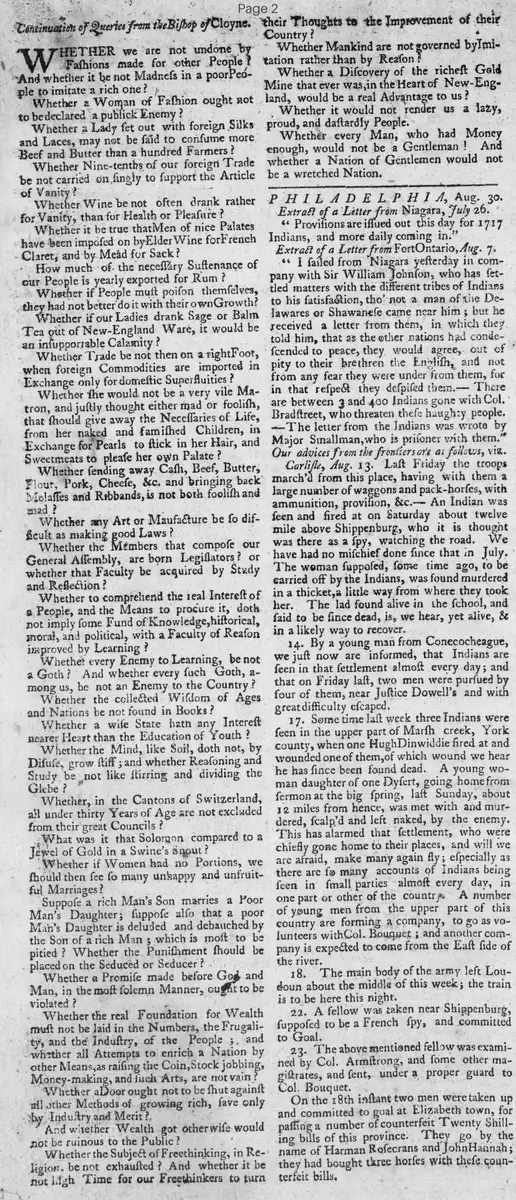
Continuation of Queries from the Bishop of Cloyne.
Whether we are not undone by Fashions made for other People?
Whether it be not Madness in a poor People to imitate a rich one?
Whether a Woman of Fashion ought not to be declared a publick Enemy?
Whether a Lady set out with foreign Silks and Laces, may not be said to consume more Beef and Butter than a hundred Farmers?
Whether Nine-tenths of our foreign Trade be not carried on only to support the Article of Vanity?
Whether Wine be not often drank rather for Vanity, than for Health or Pleasure?
Whether it be true that Men of nice Palates have been imposed on by Elder Wine for French Claret, and by Mead for Sack?
How much of the necessary Sustenance of our People is yearly exported for Rum?
Whether if People must poison themselves, they had not better do it with their own Growth?
Whether if our Ladies drank Sage or Balm Tea out of New-England Ware, it would be an insupportable Calamity?
Whether Trade be not then on a right Foot, when foreign Commodities are imported in Exchange only for domestic Superfluities?
Whether she would not be a very vile Matron, and justly thought either mad or foolish, that should give away the Necessaries of Life from her naked and famished Children, in Exchange for Pearls to stick in her Hair, and Sweetmeats to please her own Palate?
Whether sending away Cash, Beef, Butter, Flour, Pork, Cheese, &c. and bringing back Molasses and Ribbands, is not both foolish and mad?
Whether any Art or Manufacture be so difficult as making good Laws?
Whether the Members that compose our General Assembly, are born Legislators? or whether that Faculty be acquired by Study and Reflection?
Whether to comprehend the real Interest of a People, and the Means to procure it, doth not imply some Fund of Knowledge, historical, moral, and political, with a Faculty of Reason improved by Learning?
Whether every Enemy to Learning, be not a Goth? And whether every such Goth, among us, be not an Enemy to the Country?
Whether the collected Wisdom of Ages and Nations be not found in Books?
Whether a wise State hath any Interest nearer Heart than the Education of Youth?
Whether the Mind, like Soil, doth not, by Disuse, grow stiff; and whether Reasoning and Study be not like stirring and dividing the Glebe?
Whether, in the Cantons of Switzerland, all under thirty Years of Age are not excluded from their great Councils?
What was it that Solomon compared to a Jewel of Gold in a Swine's Snout?
Whether if Women had no Portions, we should then see so many unhappy and unfruitful Marriages?
Suppose a rich Man's Son marries a Poor Man's Daughter; suppose also that a poor Man's Daughter is deluded and debauched by the Son of a rich Man: which is most to be pitied? Whether the Punishment should be placed on the Seduced or Seducer?
Whether a Promise made before God and Man, in the most solemn Manner, ought to be violated?
Whether the real Foundation for Wealth must not be laid in the Numbers, the Frugality, and the Industry, of the People: and whether all Attempts to enrich a Nation by other Means; as raising the Coin, Stock jobbing, Money-making, and such Arts, are not vain?
Whether a Door ought not to be shut against all other Methods of growing rich, save only by Industry and Merit?
And whether Wealth got otherwise would not be ruinous to the Public?
Whether the Subject of Freethinking, in Religion, be not exhausted? And whether it be not high Time for our Freethinkers to turn their Thoughts to the Improvement of their Country?
Whether Mankind are not governed by Imitation rather than by Reason?
Whether a Discovery of the richest Gold Mine that ever was, in the Heart of New-England, would be a real Advantage to us?
Whether it would not render us a lazy, proud, and dastardly People.
Whether every Man, who had Money enough, would not be a Gentleman! And whether a Nation of Gentlemen would not be a wretched Nation.
Whether we are not undone by Fashions made for other People?
Whether it be not Madness in a poor People to imitate a rich one?
Whether a Woman of Fashion ought not to be declared a publick Enemy?
Whether a Lady set out with foreign Silks and Laces, may not be said to consume more Beef and Butter than a hundred Farmers?
Whether Nine-tenths of our foreign Trade be not carried on only to support the Article of Vanity?
Whether Wine be not often drank rather for Vanity, than for Health or Pleasure?
Whether it be true that Men of nice Palates have been imposed on by Elder Wine for French Claret, and by Mead for Sack?
How much of the necessary Sustenance of our People is yearly exported for Rum?
Whether if People must poison themselves, they had not better do it with their own Growth?
Whether if our Ladies drank Sage or Balm Tea out of New-England Ware, it would be an insupportable Calamity?
Whether Trade be not then on a right Foot, when foreign Commodities are imported in Exchange only for domestic Superfluities?
Whether she would not be a very vile Matron, and justly thought either mad or foolish, that should give away the Necessaries of Life from her naked and famished Children, in Exchange for Pearls to stick in her Hair, and Sweetmeats to please her own Palate?
Whether sending away Cash, Beef, Butter, Flour, Pork, Cheese, &c. and bringing back Molasses and Ribbands, is not both foolish and mad?
Whether any Art or Manufacture be so difficult as making good Laws?
Whether the Members that compose our General Assembly, are born Legislators? or whether that Faculty be acquired by Study and Reflection?
Whether to comprehend the real Interest of a People, and the Means to procure it, doth not imply some Fund of Knowledge, historical, moral, and political, with a Faculty of Reason improved by Learning?
Whether every Enemy to Learning, be not a Goth? And whether every such Goth, among us, be not an Enemy to the Country?
Whether the collected Wisdom of Ages and Nations be not found in Books?
Whether a wise State hath any Interest nearer Heart than the Education of Youth?
Whether the Mind, like Soil, doth not, by Disuse, grow stiff; and whether Reasoning and Study be not like stirring and dividing the Glebe?
Whether, in the Cantons of Switzerland, all under thirty Years of Age are not excluded from their great Councils?
What was it that Solomon compared to a Jewel of Gold in a Swine's Snout?
Whether if Women had no Portions, we should then see so many unhappy and unfruitful Marriages?
Suppose a rich Man's Son marries a Poor Man's Daughter; suppose also that a poor Man's Daughter is deluded and debauched by the Son of a rich Man: which is most to be pitied? Whether the Punishment should be placed on the Seduced or Seducer?
Whether a Promise made before God and Man, in the most solemn Manner, ought to be violated?
Whether the real Foundation for Wealth must not be laid in the Numbers, the Frugality, and the Industry, of the People: and whether all Attempts to enrich a Nation by other Means; as raising the Coin, Stock jobbing, Money-making, and such Arts, are not vain?
Whether a Door ought not to be shut against all other Methods of growing rich, save only by Industry and Merit?
And whether Wealth got otherwise would not be ruinous to the Public?
Whether the Subject of Freethinking, in Religion, be not exhausted? And whether it be not high Time for our Freethinkers to turn their Thoughts to the Improvement of their Country?
Whether Mankind are not governed by Imitation rather than by Reason?
Whether a Discovery of the richest Gold Mine that ever was, in the Heart of New-England, would be a real Advantage to us?
Whether it would not render us a lazy, proud, and dastardly People.
Whether every Man, who had Money enough, would not be a Gentleman! And whether a Nation of Gentlemen would not be a wretched Nation.
What sub-type of article is it?
Essay
Satire
What themes does it cover?
Commerce Trade
Moral Virtue
Political
What keywords are associated?
Rhetorical Queries
Economic Critique
Social Vanity
Frugality
Industry
Education
Legislation
Foreign Trade
What entities or persons were involved?
The Bishop Of Cloyne
Literary Details
Title
Continuation Of Queries From The Bishop Of Cloyne.
Author
The Bishop Of Cloyne
Form / Style
Series Of Rhetorical Questions
Key Lines
Whether We Are Not Undone By Fashions Made For Other People?
Whether A Woman Of Fashion Ought Not To Be Declared A Publick Enemy?
Whether The Real Foundation For Wealth Must Not Be Laid In The Numbers, The Frugality, And The Industry, Of The People
Whether A Wise State Hath Any Interest Nearer Heart Than The Education Of Youth?
Whether A Nation Of Gentlemen Would Not Be A Wretched Nation.