Thank you for visiting SNEWPapers!
Sign up free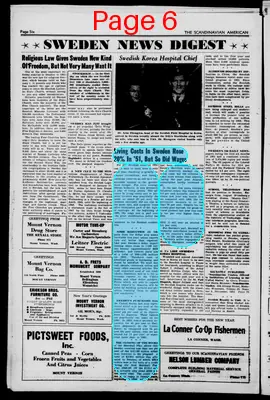
Scandinavian American
Seattle, King County, Washington
What is this article about?
Sweden's 1951 economy boomed with 20% rises in living costs and wages, 5% industrial growth, and 10% GNP increase despite inflation; plans to cut dollar imports while boosting US exports; received $106M usable Marshall aid for dollar relief and European cooperation.
Clipping
OCR Quality
Full Text
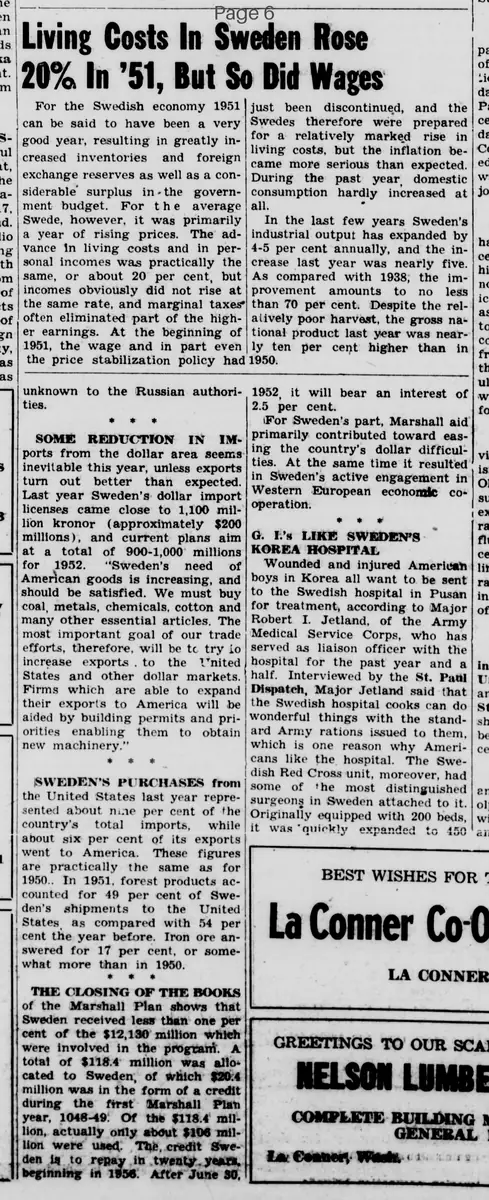
For the Swedish economy 1951 can be said to have been a very good year, resulting in greatly increased inventories and foreign exchange reserves as well as a considerable surplus in the government budget. For the average Swede, however, it was primarily a year of rising prices. The advance in living costs and in personal incomes was practically the same, or about 20 per cent, but incomes obviously did not rise at the same rate, and marginal taxes often eliminated part of the higher earnings. At the beginning of 1951, the wage and in part even the price stabilization policy had just been discontinued, and the Swedes therefore were prepared for a relatively marked rise in living costs, but the inflation became more serious than expected. During the past year domestic consumption hardly increased at all.
In the last few years Sweden's industrial output has expanded by 4-5 per cent annually, and the increase last year was nearly five. As compared with 1938, the improvement amounts to no less than 70 per cent. Despite the relatively poor harvest, the gross national product last year was nearly ten per cent higher than in 1950.
SOME REDUCTION IN IMPORTS from the dollar area seems inevitable this year, unless exports turn out better than expected. Last year Sweden's dollar import licenses came close to 1,100 million kronor (approximately $200 millions), and current plans aim at a total of 900-1,000 millions for 1952.
"Sweden's need of American goods is increasing, and should be satisfied. We must buy coal, metals, chemicals, cotton and many other essential articles. The most important goal of our trade efforts, therefore, will be to try to increase exports to the United States and other dollar markets. Firms which are able to expand their exports to America will be aided by building permits and priorities enabling them to obtain new machinery."
SWEDEN'S PURCHASES from the United States last year represented about nine per cent of the country's total imports, while about six per cent of its exports went to America. These figures are practically the same as for 1950. In 1951, forest products accounted for 49 per cent of Sweden's shipments to the United States, as compared with 54 per cent the year before. Iron ore answered for 17 per cent, or somewhat more than in 1950.
THE CLOSING OF THE BOOKS of the Marshall Plan shows that Sweden received less than one per cent of the $12,130 million which were involved in the program. A total of $118.4 million was allocated to Sweden, of which $20.4 million was in the form of a credit during the first Marshall Plan year, 1948-49. Of the $118.4 million, actually only about $106 million were used. The credit Sweden is to repay in twenty years, beginning in 1956. After June 30, 1952, it will bear an interest of 2.5 per cent.
For Sweden's part, Marshall aid primarily contributed toward easing the country's dollar difficulties. At the same time it resulted in Sweden's active engagement in Western European economic co-operation.
What sub-type of article is it?
What keywords are associated?
Where did it happen?
Foreign News Details
Primary Location
Sweden
Event Date
1951
Outcome
living costs and wages rose about 20%; industrial output increased nearly 5%; gross national product up nearly 10% from 1950; dollar imports planned to reduce to 900-1,000 million kronor in 1952; sweden received $118.4 million in marshall plan aid, using $106 million.
Event Details
In 1951, Sweden's economy grew with increased inventories, foreign exchange reserves, and government budget surplus, but living costs rose 20%, matching wage increases though unevenly distributed due to taxes. Price stabilization ended early 1951, leading to unexpected inflation; domestic consumption stagnant. Industrial output rose nearly 5% annually, 70% since 1938; poor harvest but GNP up 10% from 1950. Imports from dollar area to decrease; exports to US emphasized, with aid for expanding firms. US trade: 9% imports, 6% exports; forest products 49%, iron ore 17%. Marshall Plan: Sweden got <1% of total, $118.4M allocated ($106M used), $20.4M credit repayable from 1956 at 2.5% interest post-1952, aiding dollar issues and Western European cooperation.