Thank you for visiting SNEWPapers!
Sign up free
Atlanta Daily World
Atlanta, Fulton County, Georgia
What is this article about?
The Pardon and Parole Board commuted 23-year-old Freddie Parks' 1946 death sentence for slaying a white woman in Floyd County to life imprisonment by a 2-1 vote, after multiple appeals, citing circumstantial evidence and doubt of guilt.
Clipping
OCR Quality
Full Text
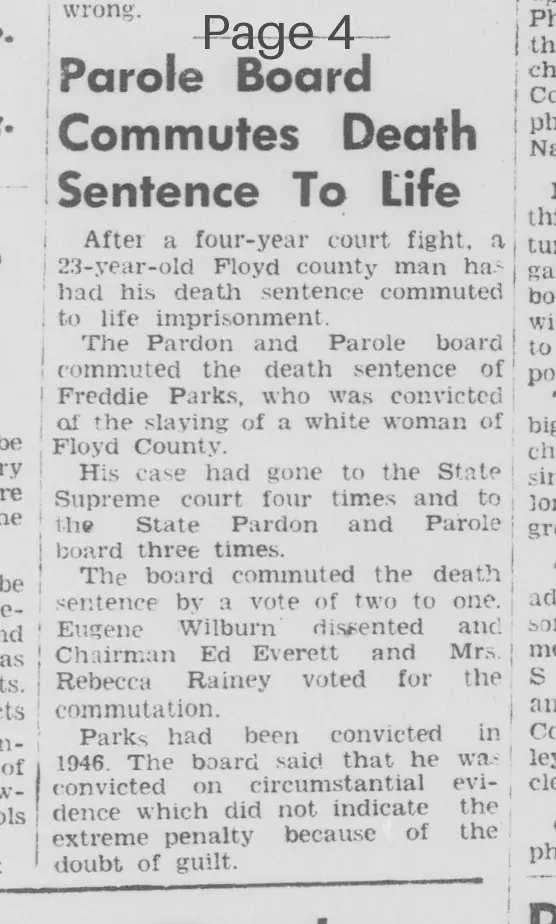
After a four-year court fight, a 23-year-old Floyd county man had his death sentence commuted to life imprisonment.
The Pardon and Parole board commuted the death sentence of Freddie Parks, who was convicted of the slaying of a white woman of Floyd County.
His case had gone to the State Supreme court four times and to the State Pardon and Parole board three times.
The board commuted the death sentence by a vote of two to one. Eugene Wilburn dissented and Chairman Ed Everett and Mrs. Rebecca Rainey voted for the commutation.
Parks had been convicted in 1946. The board said that he was convicted on circumstantial evidence which did not indicate the extreme penalty because of the doubt of guilt.
What sub-type of article is it?
What keywords are associated?
What entities or persons were involved?
Where did it happen?
Domestic News Details
Primary Location
Floyd County
Event Date
1946
Key Persons
Outcome
death sentence commuted to life imprisonment by a vote of two to one
Event Details
After a four-year court fight, the Pardon and Parole board commuted the death sentence of Freddie Parks, a 23-year-old Floyd County man convicted in 1946 of the slaying of a white woman. His case went to the State Supreme Court four times and to the board three times. The board cited conviction on circumstantial evidence with doubt of guilt, not warranting the extreme penalty.