Thank you for visiting SNEWPapers!

Sign up free
Page thumbnail for The Massachusetts Spy, Or, Thomas's Boston Journal
Letter to Editor December 1, 1774

The Massachusetts Spy, Or, Thomas's Boston Journal

Boston, Suffolk County, Massachusetts

What is this article about?

Correspondent argues General G-- cannot legally halt provincial Congress meetings, as K-- and P-- lack authority to empower him thus, violating their legitimacy. Draws parallel to English Commons as people's delegates, advocating similar American representative bodies like Congress or assemblies.

Clipping
OCR Quality

98% Excellent

Full Text

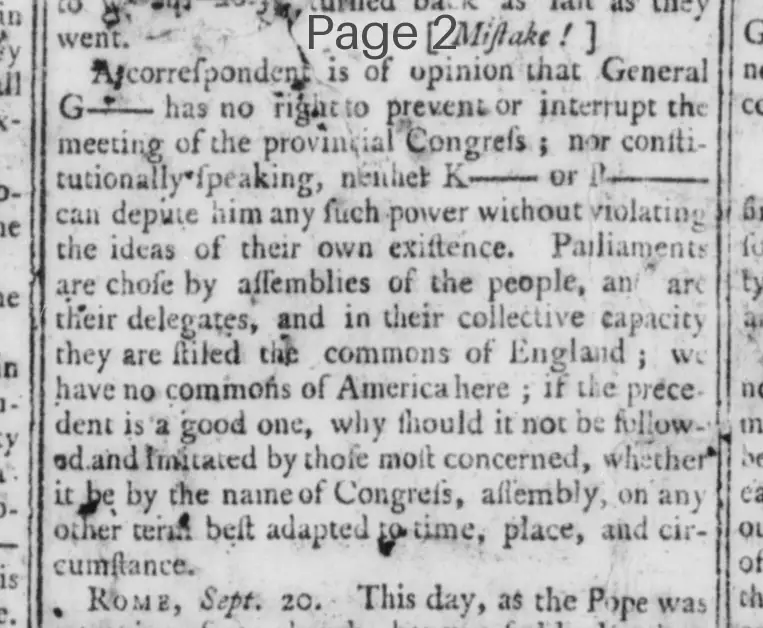
A correspondent is of opinion that General G-- has no right to prevent or interrupt the meeting of the provincial Congress; nor constitutionally speaking, neither K-- or P-- can depute him any such power without violating the ideas of their own existence. Parliaments are chose by assemblies of the people, and are their delegates, and in their collective capacity they are styled the commons of England; we have no commons of America here; if the precedent is a good one, why should it not be followed and imitated by those most concerned, whether it be by the name of Congress, assembly, or any other term best adapted to time, place, and circumstance.

What sub-type of article is it?

Persuasive Political

What themes does it cover?

Constitutional Rights Politics

What keywords are associated?

Provincial Congress Constitutional Rights General G Parliament Delegates American Assemblies

Letter to Editor Details

Main Argument

general g-- has no right to prevent or interrupt the provincial congress, and neither k-- nor p-- can constitutionally delegate such power without violating their own basis of existence. parliaments are delegates of the people, so america should similarly form assemblies, congresses, or other representative bodies adapted to circumstances.

Notable Details

References To General G , K , And P Analogy To English Commons And Parliamentary Representation

Are you sure?