Thank you for visiting SNEWPapers!
Sign up free
Gazette Of The United States, & Philadelphia Daily Advertiser
Philadelphia, Philadelphia County, Pennsylvania
What is this article about?
On Tuesday, the U.S. House of Representatives debated and amended a report on aliens, then discussed amendments to a Senate bill authorizing a provisional army of 10,000 men, including provisions for militia and volunteers. Debate on striking the bill's first section, led by Mr. Gallatin, continued until adjournment without resolution.
Clipping
OCR Quality
Full Text
PHILADELPHIA,
THURSDAY EVENING, May 10.
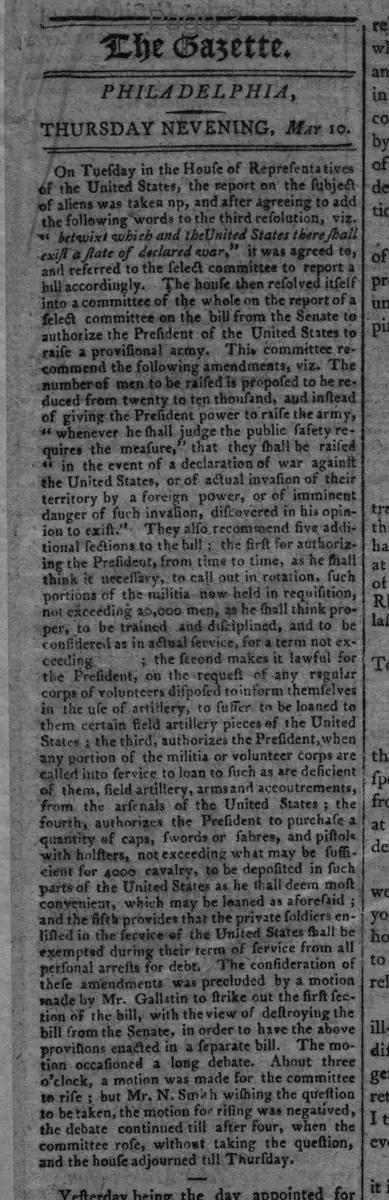
On Tuesday in the House of Representatives of the United States, the report on the subject of aliens was taken up, and after agreeing to add the following words to the third resolution, viz. "or betwixt which and the United States there shall exist a state of declared war." it was agreed to, and referred to the select committee to report a bill accordingly. The house then resolved itself into a committee of the whole on the report of a select committee on the bill from the Senate to authorize the President of the United States to raise a provisional army. This committee recommend the following amendments, viz. The number of men to be raised is proposed to be reduced from twenty to ten thousand, and instead of giving the President power to raise the army, "whenever he shall judge the public safety requires the measure," that they shall be raised in the event of a declaration of war against the United States, or of actual invasion of their territory by a foreign power, or of imminent danger of such invasion, discovered in his opinion to exist. They also recommend five additional sections to the bill; the first for authorizing the President, from time to time, as he shall think it necessary, to call out in rotation, such portions of the militia now held in requisition, not exceeding 20,000 men, as he shall think proper, to be trained and disciplined, and to be considered as in actual service, for a term not exceeding ; the second makes it lawful for the President, on the request of any regular corps of volunteers disposed to inform themselves in the use of artillery, to suffer to be loaned to them certain field artillery pieces of the United States; the third, authorizes the President, when any portion of the militia or volunteer corps are called into service to loan to such as are deficient of them, field artillery, arms and accoutrements, from the arsenals of the United States; the fourth, authorizes the President to purchase a quantity of caps, swords or sabres, and pistols with holsters, not exceeding what may be sufficient for 4000 cavalry, to be deposited in such parts of the United States as he shall deem most convenient, which may be loaned as aforesaid; and the fifth provides that the private soldiers enlisted in the service of the United States shall be exempted during their term of service from all personal arrests for debt. The consideration of these amendments was precluded by a motion made by Mr. Gallatin to strike out the first section of the bill, with the view of destroying the bill from the Senate, in order to have the above provisions enacted in a separate bill. The motion occasioned a long debate. About three o'clock, a motion was made for the committee to rise; but Mr. N. Smith wishing the question to be taken, the motion for rising was negatived, the debate continued till after four, when the committee rose, without taking the question, and the house adjourned till Thursday.
What sub-type of article is it?
What keywords are associated?
What entities or persons were involved?
Where did it happen?
Domestic News Details
Primary Location
Philadelphia
Event Date
On Tuesday
Key Persons
Outcome
debate continued without resolution; house adjourned till thursday.
Event Details
The House took up the report on aliens, added wording about declared war to the third resolution, and referred it to committee for a bill. Then, in committee of the whole, they recommended amendments to the Senate's provisional army bill: reducing troops to 10,000, conditioning raises on war or invasion, and adding five sections on militia training, loaning artillery to volunteers, providing arms, purchasing cavalry equipment, and exempting soldiers from debt arrests. Mr. Gallatin's motion to strike the first section led to prolonged debate.