Thank you for visiting SNEWPapers!
Sign up free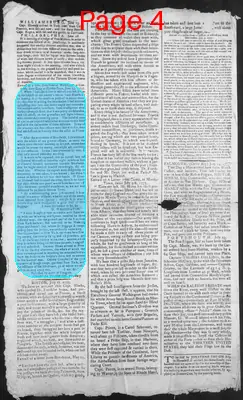
The Freeman's Journal, Or, New Hampshire Gazette
Portsmouth, Rockingham County, New Hampshire
What is this article about?
General Washington's letter to Congress from Camp at Quibbletown on June 25, 1777, details the British retreat from Brunswick to Amboy, significant enemy losses among grenadiers and light infantry, failed attempt to cut off their rear guard due to a lost express to General Maxwell, and intelligence on British fleet and troop movements from New York.
Clipping
OCR Quality
Full Text
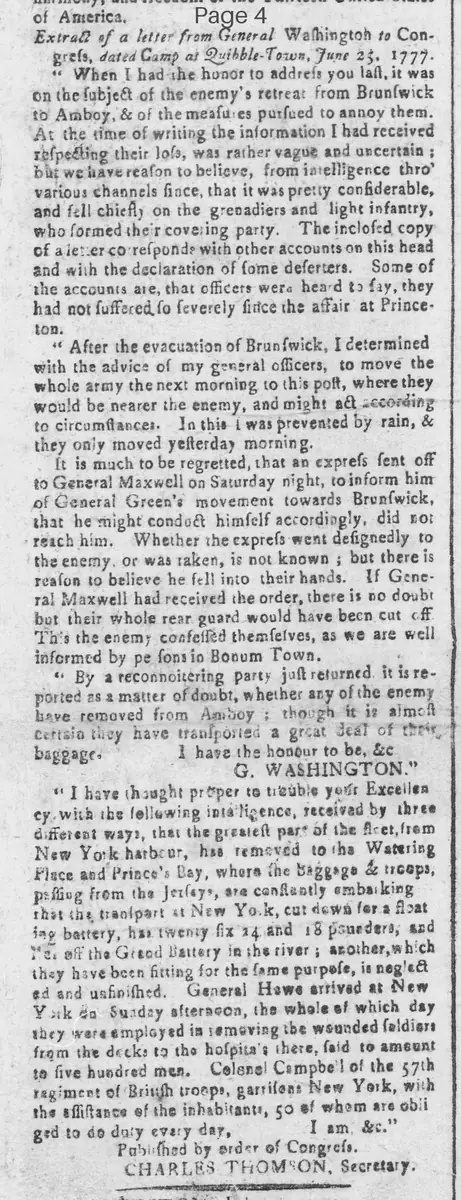
"When I had the honor to address you last, it was on the subject of the enemy's retreat from Brunswick to Amboy, & of the measures pursued to annoy them. At the time of writing the information I had received respecting their loss, was rather vague and uncertain; but we have reason to believe, from intelligence thro' various channels since, that it was pretty considerable, and fell chiefly on the grenadiers and light infantry, who formed their covering party. The enclosed copy of a letter corresponds with other accounts on this head and with the declaration of some deserters. Some of the accounts say, that officers were heard to say, they had not suffered so severely since the affair at Princeton."
"After the evacuation of Brunswick, I determined with the advice of my general officers, to move the whole army the next morning to this post, where they would be nearer the enemy, and might act according to circumstances. In this I was prevented by rain, & they only moved yesterday morning."
It is much to be regretted, that an express sent off to General Maxwell on Saturday night, to inform him of General Green's movement towards Brunswick, that he might conduct himself accordingly, did not reach him. Whether the express went designedly to the enemy, or was taken, is not known; but there is reason to believe he fell into their hands. If General Maxwell had received the order, there is no doubt but their whole rear guard would have been cut off. This the enemy confessed themselves, as we are well informed by persons from Bonum Town.
"By a reconnoitering party just returned, it is reported as a matter of doubt, whether any of the enemy have removed from Amboy: though it is almost certain they have transported a great deal of their baggage."
I have the honour to be, &c.
G. WASHINGTON.
"I have thought proper to trouble your Excellency with the following intelligence, received by three different ways, that the greatest part of the fleet, from New York harbour, has removed to the Watering Place and Prince's Bay, where the baggage & troops, passing from the Jerseys, are constantly embarking; that the transport at New York, cut down for a floating battery, has twenty-six 24 and 18 pounders, and lies off the Grand Battery in the river; another, which they have been fitting for the same purpose, is neglected and unfinished. General Howe arrived at New York on Sunday afternoon, the whole of which day they were employed in removing the wounded soldiers from the decks to the hospitals there, said to amount to five hundred men. Colonel Campbell of the 57th regiment of British troops, garrisoning New York, with the assistance of the inhabitants, 50 of whom are obliged to do duty every day,
I am, &c."
Published by order of Congress.
CHARLES THOMSON, Secretary.
What sub-type of article is it?
What keywords are associated?
What entities or persons were involved?
Where did it happen?
Domestic News Details
Primary Location
Quibbletown
Event Date
June 25, 1777
Key Persons
Outcome
british suffered considerable losses among grenadiers and light infantry; 500 wounded soldiers removed to new york hospitals; rear guard cutoff prevented due to lost express.
Event Details
Washington reports on British retreat from Brunswick to Amboy, enemy losses confirmed by multiple sources, American army movement to Quibbletown delayed by rain, failed coordination with Maxwell to attack rear guard, intelligence on British fleet relocation to Watering Place and Prince's Bay, embarkation of troops and baggage, arrival of General Howe, and status of floating batteries in New York.