Thank you for visiting SNEWPapers!
Sign up free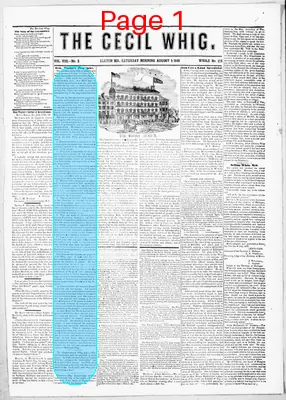
Editorial
August 5, 1848
The Cecil Whig
Elkton, Cecil County, Maryland
What is this article about?
Editorial defends Gen. Taylor's adherence to core Whig principles of representative government, limited executive power, and restrained veto use, criticizing Democrats for violations. Dismisses worries over his views on Bank, Tariff as mere measures for Congress. Includes pro-Whig quips on opponents and election date.
Clipping

OCR Quality
95%
Excellent
Full Text
Gen. Taylor's Principles.
The Locofoco press, with an amiable generosity, profess to be very solicitous lest the Whigs may be deceived about Gen. Taylor's principles' They say he has not declared himself a Bank man, or a Tariff man, or an Internal improvement man, &c., and that for all he has yet said on these subjects, he may be a thorough-going locofoco--he may rat like John Tyler; and make up a Cabinet exclusively of the progressive democracy.
We pass by the very obvious suggestion. that if the old General were not a Whig, he would most probably have been nominated by our opponents; and that if they really thought him a disguised democrat, they would be very unlikely to rouse our suspicions about it-and we proceed to consider the truth of the allegations.
What do we mean by political principles! we mean the rules of morality, the dictates of justice, honesty and good faith applied to the affairs of government, and the conduct of public business. We know the others seem by their conduct to mean a different thing.
But to return to General Taylor and the Whig Principles. Accordingly to our definition, we hold Whig principles to be these.
1. That Government is instituted for the common good-emanates from the common authority--and exists by the common consent-of the people.
2. That as it is impossible for the people to legislate in person, by reason of the numbers, they must make laws, through the representatives, elected by themselves for a limited time, and responsible to them for their conduct.
3. That, an executive head being necessary for the administration of the government this unavoidable delegation of power to one man, shall be limited and confined by every restriction, consistent with an efficient discharge of the executive functions
4. That the will of the people, as expressed in the laws passed by their representatives in Congress ought to be carried into effect in almost every conceivable case. for the simple reason that it is their will. expressed through their representatives in the mode provided by the Constitution.
5. That the power of the veto confided to the President, is intended only for extreme and exigent cases-for cases in which the legislature might attempt to break down and destroy the executive department or might pass improper laws through inadvertent haste or corrupt design.
6. That the abuse of the veto, for the purpose of arresting legislation, not of this character of legislation, deliberately entered into, after mature consideration--warranted by numerous precedents. approved by the practice of former Presidents and legislatures and sanctioned by the solemn judgement of the Supreme Court of the United States-is a dangerous and alarming usurpation.
7. That to sustain such practice, is to defeat the great end and aim of Republican Government; and, under the specious pretext of a check upon hasty legislation, virtually to transfer the power of making laws from the Representatives of the people to the President alone.
Now these are the fundamental principles of the Whig party: to these Gen. Taylor has unequivocally given his assent, and declared his intention to adhere. He has proclaimed that he would have no friends to reward, and no enemies to punish -that he would leave the duty of legislation to the Representatives of the people, not interposing his veto, unless in case of manifest necessity-and that he would administer the government on the principles respected and observed by the earlier Presidents of the Republic.
To these principles. the so-called Democracy of this day are opposed. For nearly twenty years, their administrations have been progressing further and further in disregarding and violating them; until they have, as we trust attained their climax, in the recent assumptions of the power to make war --to annex territory by conquest-and to establish territorial governments, without the knowledge, of the people's representatives.
As to the Bank, the Tariff, and the other questions alluded to, these are not principles-they are measures. It is true that no measure ought to be adopted; unless it be constitutional. But admitting it to be constitutional, it may or may not be expedient: it may or may not consist with the dictates of sound policy. What is expedient and proper at one time, may not be so at another.-It is for the representatives of the people to consider: and decide on these questions. In their hands, where the people have reposed the trust, Gen. Taylor declares his intention to leave it- and with that declaration for our own part, we are entirely content.-Richmond Whig
The Chambersburg Whig says-"The Administration folks are peculiar in their tastes. In 1840, we gave them a General who had whipped the "red coats," but they called him granny. In 1848, they bring forward a General who has surrendered to the "red coats" and they pronounce him a hero."
Ominous.—The Presidential election comes on the 7th of November-the anniversary of the battle of Tippecanoe an unlucky day for locofocoism
The Locofoco press, with an amiable generosity, profess to be very solicitous lest the Whigs may be deceived about Gen. Taylor's principles' They say he has not declared himself a Bank man, or a Tariff man, or an Internal improvement man, &c., and that for all he has yet said on these subjects, he may be a thorough-going locofoco--he may rat like John Tyler; and make up a Cabinet exclusively of the progressive democracy.
We pass by the very obvious suggestion. that if the old General were not a Whig, he would most probably have been nominated by our opponents; and that if they really thought him a disguised democrat, they would be very unlikely to rouse our suspicions about it-and we proceed to consider the truth of the allegations.
What do we mean by political principles! we mean the rules of morality, the dictates of justice, honesty and good faith applied to the affairs of government, and the conduct of public business. We know the others seem by their conduct to mean a different thing.
But to return to General Taylor and the Whig Principles. Accordingly to our definition, we hold Whig principles to be these.
1. That Government is instituted for the common good-emanates from the common authority--and exists by the common consent-of the people.
2. That as it is impossible for the people to legislate in person, by reason of the numbers, they must make laws, through the representatives, elected by themselves for a limited time, and responsible to them for their conduct.
3. That, an executive head being necessary for the administration of the government this unavoidable delegation of power to one man, shall be limited and confined by every restriction, consistent with an efficient discharge of the executive functions
4. That the will of the people, as expressed in the laws passed by their representatives in Congress ought to be carried into effect in almost every conceivable case. for the simple reason that it is their will. expressed through their representatives in the mode provided by the Constitution.
5. That the power of the veto confided to the President, is intended only for extreme and exigent cases-for cases in which the legislature might attempt to break down and destroy the executive department or might pass improper laws through inadvertent haste or corrupt design.
6. That the abuse of the veto, for the purpose of arresting legislation, not of this character of legislation, deliberately entered into, after mature consideration--warranted by numerous precedents. approved by the practice of former Presidents and legislatures and sanctioned by the solemn judgement of the Supreme Court of the United States-is a dangerous and alarming usurpation.
7. That to sustain such practice, is to defeat the great end and aim of Republican Government; and, under the specious pretext of a check upon hasty legislation, virtually to transfer the power of making laws from the Representatives of the people to the President alone.
Now these are the fundamental principles of the Whig party: to these Gen. Taylor has unequivocally given his assent, and declared his intention to adhere. He has proclaimed that he would have no friends to reward, and no enemies to punish -that he would leave the duty of legislation to the Representatives of the people, not interposing his veto, unless in case of manifest necessity-and that he would administer the government on the principles respected and observed by the earlier Presidents of the Republic.
To these principles. the so-called Democracy of this day are opposed. For nearly twenty years, their administrations have been progressing further and further in disregarding and violating them; until they have, as we trust attained their climax, in the recent assumptions of the power to make war --to annex territory by conquest-and to establish territorial governments, without the knowledge, of the people's representatives.
As to the Bank, the Tariff, and the other questions alluded to, these are not principles-they are measures. It is true that no measure ought to be adopted; unless it be constitutional. But admitting it to be constitutional, it may or may not be expedient: it may or may not consist with the dictates of sound policy. What is expedient and proper at one time, may not be so at another.-It is for the representatives of the people to consider: and decide on these questions. In their hands, where the people have reposed the trust, Gen. Taylor declares his intention to leave it- and with that declaration for our own part, we are entirely content.-Richmond Whig
The Chambersburg Whig says-"The Administration folks are peculiar in their tastes. In 1840, we gave them a General who had whipped the "red coats," but they called him granny. In 1848, they bring forward a General who has surrendered to the "red coats" and they pronounce him a hero."
Ominous.—The Presidential election comes on the 7th of November-the anniversary of the battle of Tippecanoe an unlucky day for locofocoism
What sub-type of article is it?
Partisan Politics
Constitutional
What keywords are associated?
Whig Principles
General Taylor
Veto Power
Partisan Politics
Presidential Election
Locofoco Democracy
What entities or persons were involved?
Gen. Taylor
Whig Party
Locofoco Press
John Tyler
Democracy
Editorial Details
Primary Topic
Defense Of General Taylor's Whig Principles
Stance / Tone
Supportive Of Taylor And Whigs, Critical Of Democrats
Key Figures
Gen. Taylor
Whig Party
Locofoco Press
John Tyler
Democracy
Key Arguments
Government For Common Good By Consent Of People
Legislation Through Elected Representatives
Limited Executive Power With Restrictions
Execute Laws As People's Will Unless Extreme Cases
Veto Only For Emergencies, Not Routine Legislation
Abuse Of Veto Usurps Legislative Power
Taylor Assents To Whig Principles, Leaves Measures To Congress
Democrats Violate Principles Through Executive Overreach