Thank you for visiting SNEWPapers!
Sign up free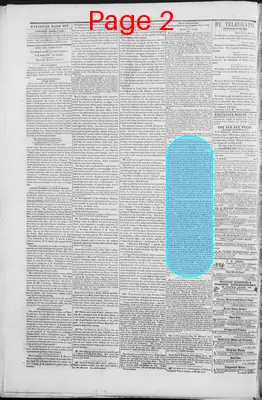
Editorial
April 5, 1851
Worcester Daily Spy
Worcester, Worcester County, Massachusetts
What is this article about?
Editorial critiques the notion of separating public and private morals, arguing that personal irresponsibility and extravagance lead to corruption in public office, including misuse of patronage and risks of bribery in foreign policy.
Clipping
OCR Quality
98%
Excellent
Full Text
The following article, from a late Washington paper, though abstract in form, and free from any personal application, is not altogether a fancy-piece.—If nobody was aimed at, somebody was hit.
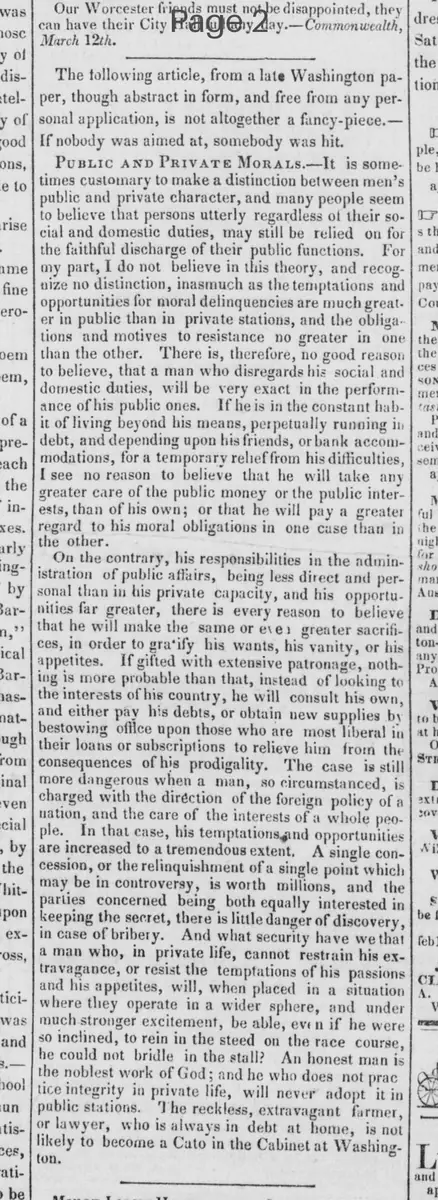
Public And Private Morals.—It is sometimes customary to make a distinction between men's public and private character, and many people seem to believe that persons utterly regardless of their social and domestic duties, may still be relied on for the faithful discharge of their public functions. For my part, I do not believe in this theory, and recognize no distinction, inasmuch as the temptations and opportunities for moral delinquencies are much greater in public than in private stations, and the obligations and motives to resistance no greater in one than the other. There is, therefore, no good reason to believe, that a man who disregards his social and domestic duties, will be very exact in the performance of his public ones. If he is in the constant habit of living beyond his means, perpetually running in debt, and depending upon his friends, or bank accommodations, for a temporary relief from his difficulties, I see no reason to believe that he will take any greater care of the public money or the public interests, than of his own; or that he will pay a greater regard to his moral obligations in one case than in the other.
On the contrary, his responsibilities in the administration of public affairs, being less direct and personal than in his private capacity, and his opportunities far greater, there is every reason to believe that he will make the same or even greater sacrifices, in order to gratify his wants, his vanity, or his appetites. If gifted with extensive patronage, nothing is more probable than that, instead of looking to the interests of his country, he will consult his own, and either pay his debts, or obtain new supplies by bestowing office upon those who are most liberal in their loans or subscriptions to relieve him from the consequences of his prodigality. The case is still more dangerous when a man, so circumstanced, is charged with the direction of the foreign policy of a nation, and the care of the interests of a whole people. In that case, his temptations and opportunities are increased to a tremendous extent. A single concession, or the relinquishment of a single point which may be in controversy, is worth millions, and the parties concerned being both equally interested in keeping the secret, there is little danger of discovery, in case of bribery. And what security have we that a man who, in private life, cannot restrain his extravagance, or resist the temptations of his passions and his appetites, will, when placed in a situation where they operate in a wider sphere, and under much stronger excitement, be able, even if he were so inclined, to rein in the steed on the race course, he could not bridle in the stall? An honest man is the noblest work of God; and he who does not practice integrity in private life, will never adopt it in public stations. The reckless, extravagant farmer, or lawyer, who is always in debt at home, is not likely to become a Cato in the Cabinet at Washington.
Public And Private Morals.—It is sometimes customary to make a distinction between men's public and private character, and many people seem to believe that persons utterly regardless of their social and domestic duties, may still be relied on for the faithful discharge of their public functions. For my part, I do not believe in this theory, and recognize no distinction, inasmuch as the temptations and opportunities for moral delinquencies are much greater in public than in private stations, and the obligations and motives to resistance no greater in one than the other. There is, therefore, no good reason to believe, that a man who disregards his social and domestic duties, will be very exact in the performance of his public ones. If he is in the constant habit of living beyond his means, perpetually running in debt, and depending upon his friends, or bank accommodations, for a temporary relief from his difficulties, I see no reason to believe that he will take any greater care of the public money or the public interests, than of his own; or that he will pay a greater regard to his moral obligations in one case than in the other.
On the contrary, his responsibilities in the administration of public affairs, being less direct and personal than in his private capacity, and his opportunities far greater, there is every reason to believe that he will make the same or even greater sacrifices, in order to gratify his wants, his vanity, or his appetites. If gifted with extensive patronage, nothing is more probable than that, instead of looking to the interests of his country, he will consult his own, and either pay his debts, or obtain new supplies by bestowing office upon those who are most liberal in their loans or subscriptions to relieve him from the consequences of his prodigality. The case is still more dangerous when a man, so circumstanced, is charged with the direction of the foreign policy of a nation, and the care of the interests of a whole people. In that case, his temptations and opportunities are increased to a tremendous extent. A single concession, or the relinquishment of a single point which may be in controversy, is worth millions, and the parties concerned being both equally interested in keeping the secret, there is little danger of discovery, in case of bribery. And what security have we that a man who, in private life, cannot restrain his extravagance, or resist the temptations of his passions and his appetites, will, when placed in a situation where they operate in a wider sphere, and under much stronger excitement, be able, even if he were so inclined, to rein in the steed on the race course, he could not bridle in the stall? An honest man is the noblest work of God; and he who does not practice integrity in private life, will never adopt it in public stations. The reckless, extravagant farmer, or lawyer, who is always in debt at home, is not likely to become a Cato in the Cabinet at Washington.
What sub-type of article is it?
Moral Or Religious
What keywords are associated?
Public Morals
Private Character
Personal Integrity
Political Corruption
Moral Delinquency
Public Patronage
Foreign Policy Bribery
Honest Man
What entities or persons were involved?
Cato
Editorial Details
Primary Topic
Distinction Between Public And Private Morals
Stance / Tone
Critique Of Separating Public And Private Character; Advocates For Personal Integrity In Both
Key Figures
Cato
Key Arguments
No Valid Distinction Between Public And Private Character
Men Who Disregard Social And Domestic Duties Cannot Be Relied On For Public Functions
Temptations And Opportunities For Moral Lapses Are Greater In Public Stations
A Man Living Beyond His Means In Private Will Mishandle Public Money
Public Responsibilities Are Less Direct, Increasing Risks Of Self Interest
Officials May Use Patronage To Pay Personal Debts
Foreign Policy Roles Heighten Bribery Risks Due To Secrecy And High Stakes
Integrity Must Be Practiced In Private Life To Exist In Public
Extravagant Individuals At Home Won't Become Virtuous In Office