Thank you for visiting SNEWPapers!
Sign up free
The Key West Citizen
Key West, Monroe County, Florida
What is this article about?
President Eisenhower advanced toward victory on 1954 tax legislation as the Senate overwhelmingly approved his overhaul bill 63-9, incorporating most relief provisions and $1.3 billion in cuts, though rejecting major dividend income benefits for stockholders. House-Senate conference set for July 12.
Clipping
OCR Quality
Full Text
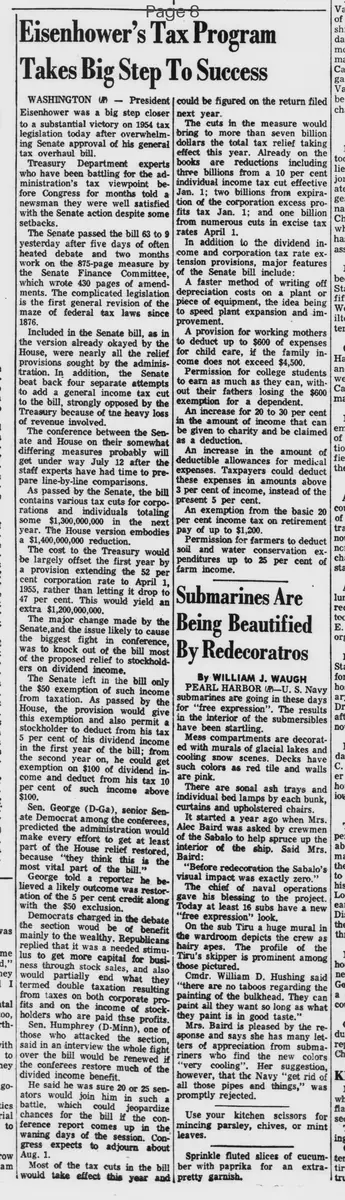
WASHINGTON - President Eisenhower was a big step closer to a substantial victory on 1954 tax legislation today after overwhelming Senate approval of his general tax overhaul bill.
Treasury Department experts who have been battling for the administration's tax viewpoint before Congress for months told a newsman they were well satisfied with the Senate action despite some setbacks.
The Senate passed the bill 63 to 9 yesterday after five days of often heated debate and two months work on the 875-page measure by the Senate Finance Committee, which wrote 430 pages of amendments. The complicated legislation is the first general revision of the maze of federal tax laws since 1876.
Included in the Senate bill, as in the version already okayed by the House, were nearly all the relief provisions sought by the administration. In addition, the Senate beat back four separate attempts to add a general income tax cut to the bill, strongly opposed by the Treasury because of the heavy loss of revenue involved.
The conference between the Senate and House on their somewhat differing measures probably will get under way July 12 after the staff experts have had time to prepare line-by-line comparisons.
As passed by the Senate, the bill contains various tax cuts for corporations and individuals totaling some $1,300,000,000 in the next year. The House version embodies a $1,400,000,000 reduction.
The cost to the Treasury would be largely offset the first year by a provision extending the 52 per cent corporation rate to April 1, 1955, rather than letting it drop to 47 per cent. This would yield an extra $1,200,000,000.
The major change made by the Senate, and the issue likely to cause the biggest fight in conference, was to knock out of the bill most of the proposed relief to stockholders on dividend income.
The Senate left in the bill only the $50 exemption of such income from taxation. As passed by the House, the provision would give this exemption and also permit a stockholder to deduct from his tax 5 per cent of his dividend income in the first year of the bill; from the second year on, he could get exemption on $100 of dividend income and deduct from his tax 10 per cent of such income above $100.
Sen. George (D-Ga), senior Senate Democrat among the conferees, predicted the administration would make every effort to get at least part of the House relief restored, because "they think this is the most vital part of the bill."
George told a reporter he believed a likely outcome was restoration of the 5 per cent credit along with the $50 exclusion.
Democrats charged in the debate the section would be of benefit mainly to the wealthy. Republicans replied that it was a needed stimulus to get more capital for business through stock sales, and also would partially end what they termed double taxation resulting from taxes on both corporate profits and on the income of stockholders who are paid those profits.
Sen. Humphrey (D-Minn), one of those who attacked the section, said in an interview the whole fight over the bill would be renewed if the conferees restore much of the dividend income benefit.
He said he was sure 20 or 25 senators would join him in such a battle, which could jeopardize chances for the bill if the conference report comes up in the waning days of the session. Congress expects to adjourn about Aug. 1.
Most of the tax cuts in the bill would take effect this year and could be figured on the return filed next year.
The cuts in the measure would bring to more than seven billion dollars the total tax relief taking effect this year. Already on the books are reductions including three billions from a 10 per cent individual income tax cut effective Jan. 1; two billions from expiration of the corporation excess profits tax Jan. 1; and one billion from numerous cuts in excise tax rates April 1.
In addition to the dividend income and corporation tax rate extension provisions, major features of the Senate bill include:
A faster method of writing off depreciation costs on a plant or piece of equipment, the idea being to speed plant expansion and improvement.
A provision for working mothers to deduct up to $600 of expenses for child care, if the family income does not exceed $4,500.
Permission for college students to earn as much as they can, without their fathers losing the $600 exemption for a dependent.
An increase for 20 to 30 per cent in the amount of income that can be given to charity and be claimed as a deduction.
An increase in the amount of deductible allowances for medical expenses. Taxpayers could deduct these expenses in amounts above 3 per cent of income, instead of the present 5 per cent.
An exemption from the basic 20 per cent income tax on retirement pay of up to $1,200.
Permission for farmers to deduct soil and water conservation expenditures up to 25 per cent of farm income.
What sub-type of article is it?
What themes does it cover?
What keywords are associated?
What entities or persons were involved?
Where did it happen?
Story Details
Key Persons
Location
Washington
Event Date
1954
Story Details
The Senate passed President Eisenhower's general tax overhaul bill 63 to 9 after five days of debate, including nearly all administration relief provisions and various tax cuts totaling $1,300,000,000, but rejected most proposed relief for stockholders on dividend income. Conference with the House to begin July 12.