Thank you for visiting SNEWPapers!
Sign up free
The Cio News
Cumberland, Allegany County, Maryland
What is this article about?
CIO's Lee Pressman analyzes Smith-Connally Act, allowing unions broad political activities except direct federal candidate contributions; requires 30-day strike notices; affirms WLB powers and presidential seizure authority. Circulated to CIO affiliates in Washington on July 17.
Clipping
OCR Quality
Full Text
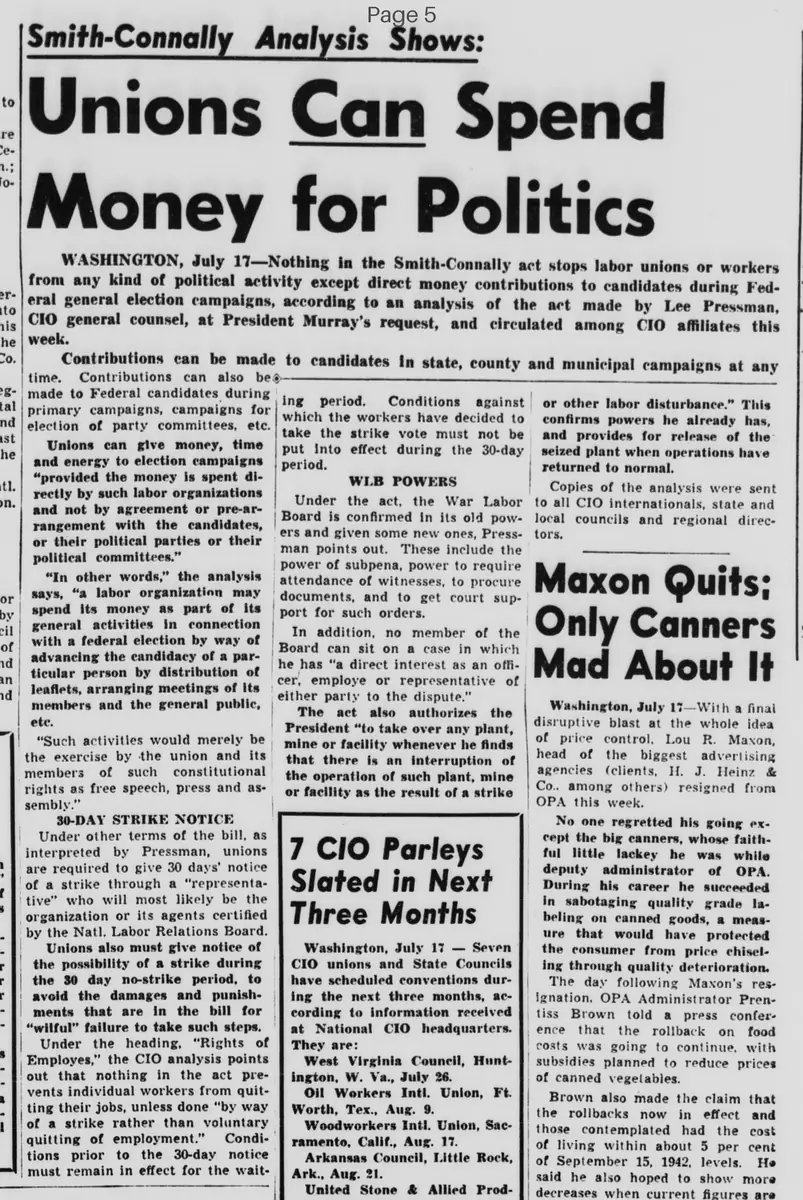
Unions Can Spend Money for Politics
WASHINGTON, July 17—Nothing in the Smith-Connally act stops labor unions or workers from any kind of political activity except direct money contributions to candidates during Federal general election campaigns, according to an analysis of the act made by Lee Pressman, CIO general counsel, at President Murray's request, and circulated among CIO affiliates this week.
Contributions can be made to candidates in state, county and municipal campaigns at any time. Contributions can also be made to political action committees and other organizations.
Unions can give money, time and energy to election campaigns "provided the money is spent directly by such labor organizations and not by agreement or pre-arrangement with the candidates, or their political parties or their political committees."
"In other words," the analysis says, "a labor organization may spend its money as part of its general activities in connection with a federal election by way of advancing the candidacy of a particular person by distribution of leaflets, arranging meetings of its members and the general public, etc.
"Such activities would merely be the exercise by the union and its members of such constitutional rights as free speech, press and assembly."
30-DAY STRIKE NOTICE
Under other terms of the bill, as interpreted by Pressman, unions are required to give 30 days' notice of a strike through a "representative" who will most likely be the organization or its agents certified by the Natl. Labor Relations Board.
Unions also must give notice of the possibility of a strike during the 30 day no-strike period, to avoid the damages and punishments that are in the bill for "wilful" failure to take such steps.
Under the heading, "Rights of Employes," the CIO analysis points out that nothing in the act prevents individual workers from quitting their jobs, unless done "by way of a strike rather than voluntary quitting of employment."
Conditions prior to the 30-day notice must remain in effect for the waiting period. Conditions against which the workers have decided to take the strike vote must not be put into effect during the 30-day period.
WLB POWERS
Under the act, the War Labor Board is confirmed in its old powers and given some new ones, Pressman points out. These include the power of subpena, power to require attendance of witnesses, to procure documents, and to get court support for such orders.
In addition, no member of the Board can sit on a case in which he has "a direct interest as an officer, employe or representative of either party to the dispute."
The act also authorizes the President "to take over any plant, mine or facility whenever he finds that there is an interruption of the operation of such plant, mine or facility as the result of a strike or other labor disturbance." This confirms powers he already has, and provides for release of the seized plant when operations have returned to normal.
Copies of the analysis were sent to all CIO internationals, state and local councils and regional directors.
What sub-type of article is it?
What keywords are associated?
What entities or persons were involved?
Where did it happen?
Domestic News Details
Primary Location
Washington
Event Date
July 17
Key Persons
Event Details
Analysis of the Smith-Connally act by Lee Pressman, CIO general counsel, at President Murray's request, circulated among CIO affiliates, clarifying that unions can engage in political activities except direct money contributions to candidates in federal general elections; contributions allowed in state, county, municipal campaigns and to political action committees; unions can spend money, time, energy on campaigns if spent directly without pre-arrangement; 30-day strike notice required; individual workers can quit jobs unless as strike; War Labor Board powers confirmed and expanded; President authorized to seize plants during strikes.