Thank you for visiting SNEWPapers!
Sign up free
Workmen's Advocate
New Haven, New Haven County, Connecticut
What is this article about?
In Holyoke, 90 of 104 weavers at W. Skinner & Son's silk mill quit work on the 4th inst. due to grievances over weekly wages, short-measured cloth payments, unsteady work, and unfair treatment by overseer Mr. Gets. They demanded fair pay per yard, equal work distribution, no victimization, and Gets' discharge.
Clipping
OCR Quality
Full Text
A Skinner by Name and Nature - His Tool, Gets.
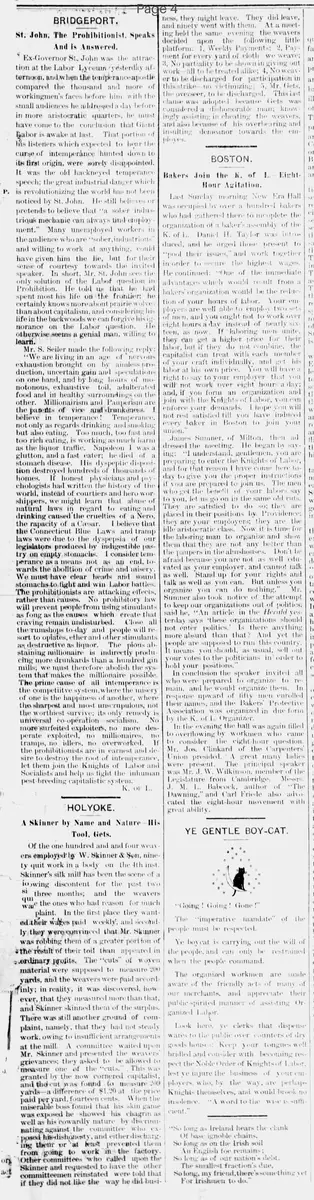
Of the one hundred and four weavers employed by W. Skinner & Son, ninety quit work in a body on the 4th inst. Skinner's silk mill has been the scene of a growing discontent for the past two or three months; and the weavers was the ones who had reason for much complaint. In the first place they wanted their wages paid weekly, and secondly they were convinced that Mr. Skinner was robbing them of a greater portion of the result of their toil than appeared in ordinary profits. The "cuts" of woven material were supposed to measure 200 yards, and the weavers were paid accordingly; in reality, it was discovered, however, that they measured more than that, and Skinner skinned them of the surplus. There was still another ground of complaint, namely, that they had not steady work, owing to insufficient arrangements at the mill. A committee waited upon Mr. Skinner and presented the weavers grievances; they asked to be allowed to measure one of the "cuts." This was granted by the now cornered capitalist, and that cut was found to measure 209 yards—a difference of $1.20 at the price paid per yard, fourteen cents. When the miserable boss found that his skin game was exposed he showed his chagrin as well as his cowardly nature by discriminating against the committee who exposed his dishonesty, and either discharging them or at least prevented them from going to work in the factory. Other committees who called upon the Skinner and requested to have the other committeemen reinstated were told that if they did not like the way he did business, they might leave. They did leave, and ninety went with them. "At a meeting held the same evening the weavers decided upon the following little platform: 1, Weekly Payments; 2, Payment for every yard of cloth we weave; 3, No partiality to be shown in giving out work—all to be treated alike; 4, No weaver to be discharged for participation in this strike—no victimizing; 5. Mr. Gets, the overseer, to be discharged. This last clause was adopted because Gets was considered a dishonorable man; knowingly assisting in cheating the weavers, and also because of his overbearing and insulting demeanor towards the employees.
What sub-type of article is it?
What keywords are associated?
What entities or persons were involved?
Where did it happen?
Domestic News Details
Primary Location
Holyoke
Event Date
On The 4th Inst.
Key Persons
Outcome
ninety weavers quit work; demands include weekly payments, full payment per yard woven, equal work distribution, no discharges for striking, and discharge of overseer mr. gets.
Event Details
Weavers at Skinner's silk mill complained of irregular weekly wages, short-measured cloth cuts (209 yards instead of 200, shorting $1.20 per cut at 14 cents per yard), unsteady work due to poor mill arrangements, and discrimination against committee members who exposed the issue; after refusals to reinstate, 90 weavers struck, adopting a platform of grievances at a meeting.