Thank you for visiting SNEWPapers!
Sign up free
Anti Slavery Bugle
New Lisbon, Salem, Columbiana County, Ohio
What is this article about?
In 1846, the Hutchinson Family visits Sing Sing prison on Thanksgiving at the invitation of the chaplain and keepers, performing music to inspire moral reformation among inmates. Matron E.W. Farnham's letter describes the uplifting songs and their profound impact on prisoners.
Clipping
OCR Quality
Full Text
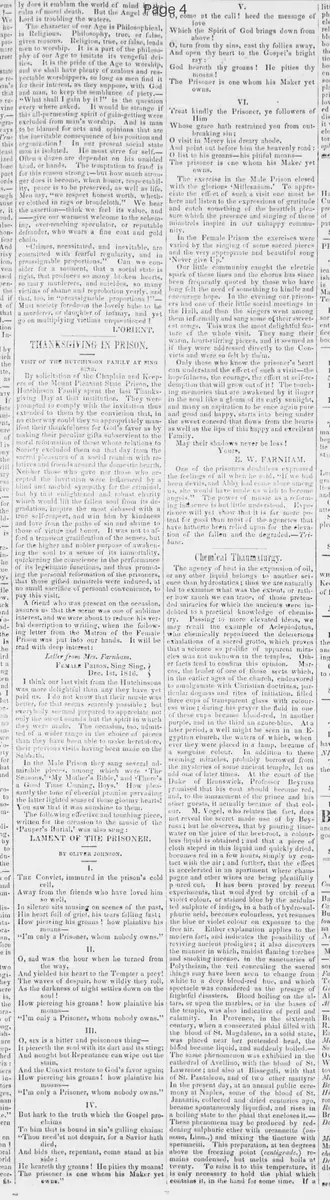
THANKSGIVING IN PRISON.
VISIT OF THE HUTCHINSON FAMILY AT SING SING.
By solicitation of the Chaplain and Keepers of the Mount Pleasant State Prison, the Hutchinson Family spent the last Thanksgiving Day at that institution. They were prompted to comply with the invitation thus extended to them by the conviction that, in no other way could they so appropriately manifest their thankfulness for God's favor as by making their peculiar gifts subservient to the moral reformation of those whose relations to Society excluded them on that day from the sacred pleasures of a social reunion with relatives and friends around the domestic hearth.
Neither those who gave nor those who accepted the invitation were influenced by a blind and morbid sympathy for the criminal, but by that enlightened and robust charity which would lift the fallen soul from its degradation, inspire the most debased with a true self-respect, and win him by kindness and love from the paths of sin and shame to those of virtue and honor. It was not to afford a transient gratification of the senses, but for the higher and nobler purpose of awakening the soul to a sense of its immortality, quickening the conscience in the performance of its legitimate functions, and thus promoting the personal reformation of the prisoners, that those gifted minstrels were induced, at no small sacrifice of personal convenience, to pay this visit.
A friend who was present on the occasion, assures us that the scene was one of sublime interest, and we were about to reduce his verbal description to writing, when the following letter from the Matron of the Female Prison was put into our hands. It will be read with deep interest:
Letter from Mrs. Farnham.
Female Prison, Sing Sing, Dec. 1st, 1846.
I think our last visit from the Hutchinsons was more delightful than any they have yet paid us. I do not know that their music was better, for that seems scarcely possible; but everybody seemed prepared to appreciate not only the sweet sounds but the spirit in which they were made. The occasion, too, admitted of a wider range in the choice of pieces than they have been able to make heretofore, their previous visits having been made on the Sabbath.
In the Male Prison they sang several admirable pieces, among which were "The Seasons," "My Mother's Bible," and "There's a Good Time Coming, Boys." How pleasantly the tone of cheerful promise pervading the latter lighted some of those gloomy hearts! You saw that it was sunshine to them.
The following effective and touching piece, written for the occasion to the music of the "Pauper's Burial," was also sung:
LAMENT OF THE PRISONER.
BY OLIVER JOHNSON.
I.
The Convict, immured in the prison's cold cell,
Away from the friends who have loved him so well,
In silence sits musing on scenes of the past,
His heart full of grief, his tears falling fast;
How piercing his groans! how plaintive his moans -
"I'm only a Prisoner, whom nobody owns."
II.
O, sad was the hour when he turned from the way,
And yielded his heart to the Tempter a prey!
The waves of despair, how wildly they roll,
As the darkness of night settles down on the soul!
How piercing his groans! how plaintive his moans -
"I'm only a Prisoner, whom nobody owns."
III.
O, sin is a bitter and poisonous thing -
It pierceth the soul with its dart and its sting;
And nought but Repentance can wipe out the stain,
And the Convict restore to God's favor again;
How piercing his groans! how plaintive his moans -
"I'm only a Prisoner, whom nobody owns."
IV.
But hark to the truth which the Gospel proclaims
To him that is bound in sin's galling chains:
"Thou need'st not despair, for a Savior hath died,
And bids thee, repentant, come stand at his side:
He heareth thy groans! He pities thy moans!
The prisoner is one whom his Maker yet owns."
V.
O, come at the call! heed the message of love
Which the Spirit of God brings down from above!
O, turn from thy sins, cast thy follies away,
And open thy heart to the Gospel's bright ray:
God heareth thy groans! He pities thy moans!
The Prisoner is one whom his Maker yet owns.
VI.
Treat kindly the Prisoner, ye followers of Him
Whose grace hath restrained you from outbreaking sin;
O visit in Mercy his dreary abode,
And point out before him the heavenly road:
O list to his groans - his pitiful moans -
The prisoner is one whom his Maker yet owns.
The exercise in the Male Prison closed with the glorious "Millennium." To appreciate the effect of such a visit one must be here and listen to the expressions of gratitude and catch something of the heartfelt pleasure which the presence and singing of these minstrels inspire in our unhappy community.
In the Female Prison the exercises were varied by the singing of some sacred pieces and the very appropriate and beautiful song "Never give Up."
Our little community caught the electric spark of these lines and the chorus has since been frequently quoted by those who have long felt the need of something to kindle and encourage hope. In the evening our prisoners had one of their little social meetings in the Hall, and then the singers went among them informally and sang some of their sweetest songs. This was the most delightful feature of the whole visit. They sang their warm, heart-stirring pieces, and it seemed as if they were addressed directly to the Convicts and were so felt by them.
Only those who know the prisoner's heart can understand the effect of such a visit - the hopefulness, the courage, the effort at self-redemption that will grow out of it! The touching memories that are awakened by it linger in the soul like a gleam of its early sunlight, and many an aspiration to be once again pure and good and happy, starts into being under the sweet concord that flows from the hearts as well as the lips of this happy and excellent Family.
May their shadows never be less!
Yours,
E. W. FARNHAM.
One of the prisoners doubtless expressed the feelings of all when he said, "if we had been devils, and Abby had come alone among us, she would have made us wish to become angels." The power of music as a reforming influence is but little understood. Experience will yet show that it is far more potent for good than most of the agencies that have hitherto been relied upon for the elevation of the fallen and the degraded. - Tribune.
What sub-type of article is it?
What themes does it cover?
What keywords are associated?
What entities or persons were involved?
Where did it happen?
Story Details
Key Persons
Location
Sing Sing, Mount Pleasant State Prison
Event Date
Thanksgiving Day 1846
Story Details
The Hutchinson Family visits Sing Sing prison on Thanksgiving 1846 to perform music for inmates, aiming to inspire moral reformation through songs like 'Lament of the Prisoner' by Oliver Johnson, as detailed in matron E.W. Farnham's letter, fostering hope and self-redemption among prisoners.