Thank you for visiting SNEWPapers!
Sign up free
The Indianapolis Journal
Indianapolis, Marion County, Indiana
What is this article about?
Historical overview of US postal system evolution from 1792, rate reductions culminating in two-cent postage next Monday; early origins, Franklin's role, national growth to 1883 surplus; Indianapolis office details under Postmaster Wildman, expecting increased business to offset revenue drop.
Clipping
OCR Quality
Full Text
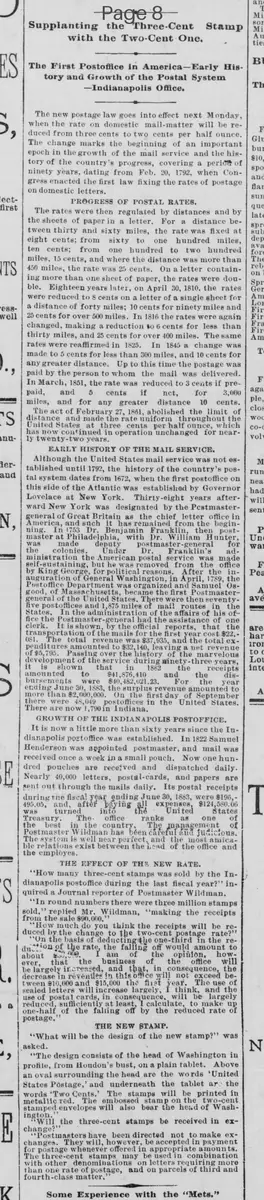
The First Postoffice in America—Early History and Growth of the Postal System—Indianapolis Office.
The new postage law goes into effect next Monday, when the rate on domestic mail-matter will be reduced from three cents to two cents per half ounce.
The change marks the beginning of an important epoch in the growth of the mail service and the history of the country's progress, covering a period of ninety years, dating from Feb. 20, 1792, when Congress enacted the first law fixing the rates of postage on domestic letters.
PROGRESS OF POSTAL RATES.
The rates were then regulated by distances and by the sheets of paper in a letter. For a distance between thirty and sixty miles, the rate was fixed at eight cents; from sixty to one hundred miles, ten cents; from one hundred to two hundred miles, 15 cents, and where the distance was more than 450 miles, the rate was 25 cents. On a letter containing more than one sheet of paper, the rates were double.
Eighteen years later, on April 30, 1810, the rates were reduced to 8 cents on a letter of a single sheet for a distance of forty miles; 10 cents for ninety miles and 25 cents for over 500 miles.
In 1816 the rates were again changed, making a reduction to 6 cents for less than thirty miles, and 25 cents for over 400 miles. The same rates were reaffirmed in 1825.
In 1845 a change was made to 5 cents for less than 300 miles, and 10 cents for any greater distance.
Up to this time the postage was paid by the person to whom the mail was delivered.
In March, 1851, the rate was reduced to 3 cents if prepaid, and 5 cents if not, for 3,000 miles, and for any greater distance 10 cents.
The act of February 27, 1863, abolished the limit of distance and made the rate uniform throughout the United States at three cents per half ounce, which has now continued in operation unchanged for nearly twenty-two years.
EARLY HISTORY OF THE MAIL SERVICE.
Although the United States mail service was not established until 1792, the history of the country's postal system dates from 1672, when the first postoffice on this side of the Atlantic was established by Governor Lovelace at New York.
Thirty-eight years afterward New York was designated by the Postmaster-general of Great Britain as the chief letter office in America, and such it has remained from the beginning.
In 1753 Dr. Benjamin Franklin, then postmaster at Philadelphia, with Dr. William Hunter, was made deputy postmaster-general for the colonies.
Under Dr. Franklin's administration the American postal service was made self-sustaining, but he was removed from the office by King George, for political reasons.
After the inauguration of General Washington, in April, 1789, the Postoffice Department was organized and Samuel Osgood, of Massachusetts, became the first Postmaster-general of the United States.
There were then seventy-five postoffices and 1,875 miles of mail routes in the States.
In the administration of the affairs of his office the Postmaster-general had the assistance of one clerk.
It is shown, by the official reports, that the transportation of the mails for the first year cost $22,051. The total revenue was $37,935, and the total expenditures amounted to $32,140, leaving a net revenue of $5,795.
Passing over the history of the marvelous development of the service during ninety-three years, it is shown that in 1882 the receipts amounted to $41,876,410 and the disbursements were $40,482,021.23.
For the year ending June 30, 1883, the surplus revenue amounted to more than $2,000,000.
On the first day of September there were 48,049 postoffices in the United States. There are now 1,790 in Indiana.
GROWTH OF THE INDIANAPOLIS POSTOFFICE.
It is now a little more than sixty years since the Indianapolis postoffice was established. In 1822 Samuel Henderson was appointed postmaster, and mail was received once a week in a small pouch.
Now one hundred pouches are received and dispatched daily.
Nearly 40,000 letters, postal-cards, and papers are sent out through the mails daily.
Its postal receipts during the fiscal year ending June 30, 1883, were $196,495.05, and, after paying all expenses, $124,580.06 was turned into the United States Treasury.
The office ranks one of the best in the country.
The management of Postmaster Wildman has been careful and judicious.
The system is well near perfect, and the most amicable relations exist between the head of the office and the employes.
THE EFFECT OF THE NEW RATE.
"How many three-cent stamps were sold by the Indianapolis postoffice during the last fiscal year?" inquired a Journal reporter of Postmaster Wildman.
"In round numbers there were three million stamps sold," replied Mr. Wildman, "making the receipts from the sale $90,000."
"How much do you think the receipts will be reduced by the change to the two-cent postage rate?"
"On the basis of deducting the one-third in the reduction of the rate, the falling off would amount to about $30,000.
I am of the opinion, however, that the business of the office will be largely increased, and that, in consequence, the decrease in revenues in this office will not exceed between $10,000 and $15,000 the first year.
The use of sealed letters will increase largely, I think, and the use of postal cards, in consequence, will be largely reduced, sufficiently at least, I calculate, to make up one-half of the falling off by the reduced rate of postage.
THE NEW STAMP.
"What will be the design of the new stamp?" was asked.
"The design consists of the head of Washington in profile, from Houdon's bust, on a plain tablet. Above an oval surrounding the head are the words 'United States Postage,' and underneath the tablet are the words 'Two Cents.'
The stamps will be printed in metallic red.
The embossed stamp on the two-cent stamped envelopes will also bear the head of Washington.
Will the three-cent stamps be received in exchange?
"Postmasters have been directed not to make exchanges. They will, however, be accepted in payment for postage whenever offered in appropriate amounts.
The three-cent stamps may be used in combination with other denominations on letters requiring more than one rate of postage, and on parcels of third and fourth-class matter."
What sub-type of article is it?
What themes does it cover?
What keywords are associated?
What entities or persons were involved?
Where did it happen?
Story Details
Key Persons
Location
United States, Indianapolis, New York
Event Date
Next Monday (Rate Change); Feb. 20, 1792 (First Law); Various Historical Dates
Story Details
Article details the history of US postal rates from 1792 reductions to the upcoming two-cent rate effective next Monday, early postal establishment from 1672, growth under Franklin and Osgood, national statistics, and specifics of Indianapolis post office under Wildman, predicting minimal revenue loss due to increased volume.