Thank you for visiting SNEWPapers!
Sign up free
Literary
August 28, 1799
The Providence Journal, And Town And Country Advertiser
Providence, Providence County, Rhode Island
What is this article about?
Philosophical essay in 'The Adelphiad, No. XIV' defends the 'luxury of grief' as a poetic and just expression, drawing on Ossian to describe melancholy satisfaction in cherishing departed friends' memories. It speculates on spirits watching over the living and eternal friendships in heaven, affirmed by reason and divine revelation.
Clipping
OCR Quality
95%
Excellent
Full Text
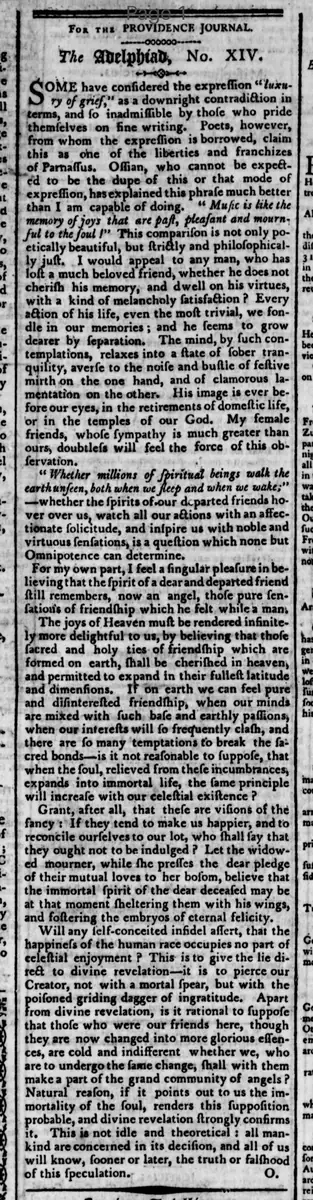
FOR THE PROVIDENCE JOURNAL.
The Adelphiad, No. XIV.
Some have considered the expression "luxury of grief," as a downright contradiction in terms, and so inadmissible by those who pride themselves on fine writing. Poets, however, from whom the expression is borrowed, claim this as one of the liberties and franchises of Parnassus. Ossian, who cannot be expected to be the dupe of this or that mode of expression, has explained this phrase much better than I am capable of doing. "Music is like the memory of joys that are past, pleasant and mournful to the soul!" This comparison is not only poetically beautiful, but strictly and philosophically just. I would appeal to any man, who has lost a much beloved friend, whether he does not cherish his memory, and dwell on his virtues, with a kind of melancholy satisfaction? Every action of his life, even the most trivial, we fondle in our memories; and he seems to grow dearer by separation. The mind, by such contemplations, relaxes into a state of sober tranquility, averse to the noise and bustle of festive mirth on the one hand, and of clamorous lamentation on the other. His image is ever before our eyes, in the retirements of domestic life, or in the temples of our God. My female friends, whose sympathy is much greater than ours, doubtless will feel the force of this observation.
"Whether millions of spiritual beings walk the earth unseen, both when we sleep and when we wake;"—whether the spirits of our departed friends hover over us, watch all our actions with an affectionate solicitude, and inspire us with noble and virtuous sensations, is a question which none but Omnipotence can determine.
For my own part, I feel a singular pleasure in believing that the spirit of a dear and departed friend still remembers, now an angel, those pure emanations of friendship which he felt while a man: The joys of Heaven must be rendered infinitely more delightful to us, by believing that those sacred and holy ties of friendship which are formed on earth, shall be cherished in heaven, and permitted to expand in their fullest latitude and dimensions. If on earth we can feel pure and disinterested friendship, when our minds are mixed with such base and earthly passions: when our interests will so frequently clash, and there are so many temptations to break the sacred bonds—is it not reasonable to suppose, that when the soul, relieved from these incumbrances, expands into immortal life, the same principle will increase with our celestial existence?
Grant, after all, that these are visions of the fancy: If they tend to make us happier, and to reconcile ourselves to our lot, who shall say that they ought not to be indulged? Let the widowed mourner, while she presses the dear pledge of their mutual loves to her bosom, believe that the immortal spirit of the dear deceased may be at that moment sheltering them with his wings, and fostering the embryos of eternal felicity.
Will any self-conceited infidel assert, that the happiness of the human race occupies no part of celestial enjoyment? This is to give the lie direct to divine revelation—it is to pierce our Creator, not with a mortal spear, but with the poisoned grinding dagger of ingratitude. Apart from divine revelation, is it rational to suppose that those who were our friends here, though they are now changed into more glorious beings, are cold and indifferent whether we, who are to undergo the same change, shall with them make a part of the grand community of angels? Natural reason, if it points out to us the immortality of the soul, renders this supposition probable, and divine revelation strongly confirms it. This is not idle and theoretical: all mankind are concerned in its decision, and all of us will know, sooner or later, the truth or falsehood of this speculation.
The Adelphiad, No. XIV.
Some have considered the expression "luxury of grief," as a downright contradiction in terms, and so inadmissible by those who pride themselves on fine writing. Poets, however, from whom the expression is borrowed, claim this as one of the liberties and franchises of Parnassus. Ossian, who cannot be expected to be the dupe of this or that mode of expression, has explained this phrase much better than I am capable of doing. "Music is like the memory of joys that are past, pleasant and mournful to the soul!" This comparison is not only poetically beautiful, but strictly and philosophically just. I would appeal to any man, who has lost a much beloved friend, whether he does not cherish his memory, and dwell on his virtues, with a kind of melancholy satisfaction? Every action of his life, even the most trivial, we fondle in our memories; and he seems to grow dearer by separation. The mind, by such contemplations, relaxes into a state of sober tranquility, averse to the noise and bustle of festive mirth on the one hand, and of clamorous lamentation on the other. His image is ever before our eyes, in the retirements of domestic life, or in the temples of our God. My female friends, whose sympathy is much greater than ours, doubtless will feel the force of this observation.
"Whether millions of spiritual beings walk the earth unseen, both when we sleep and when we wake;"—whether the spirits of our departed friends hover over us, watch all our actions with an affectionate solicitude, and inspire us with noble and virtuous sensations, is a question which none but Omnipotence can determine.
For my own part, I feel a singular pleasure in believing that the spirit of a dear and departed friend still remembers, now an angel, those pure emanations of friendship which he felt while a man: The joys of Heaven must be rendered infinitely more delightful to us, by believing that those sacred and holy ties of friendship which are formed on earth, shall be cherished in heaven, and permitted to expand in their fullest latitude and dimensions. If on earth we can feel pure and disinterested friendship, when our minds are mixed with such base and earthly passions: when our interests will so frequently clash, and there are so many temptations to break the sacred bonds—is it not reasonable to suppose, that when the soul, relieved from these incumbrances, expands into immortal life, the same principle will increase with our celestial existence?
Grant, after all, that these are visions of the fancy: If they tend to make us happier, and to reconcile ourselves to our lot, who shall say that they ought not to be indulged? Let the widowed mourner, while she presses the dear pledge of their mutual loves to her bosom, believe that the immortal spirit of the dear deceased may be at that moment sheltering them with his wings, and fostering the embryos of eternal felicity.
Will any self-conceited infidel assert, that the happiness of the human race occupies no part of celestial enjoyment? This is to give the lie direct to divine revelation—it is to pierce our Creator, not with a mortal spear, but with the poisoned grinding dagger of ingratitude. Apart from divine revelation, is it rational to suppose that those who were our friends here, though they are now changed into more glorious beings, are cold and indifferent whether we, who are to undergo the same change, shall with them make a part of the grand community of angels? Natural reason, if it points out to us the immortality of the soul, renders this supposition probable, and divine revelation strongly confirms it. This is not idle and theoretical: all mankind are concerned in its decision, and all of us will know, sooner or later, the truth or falsehood of this speculation.
What sub-type of article is it?
Essay
What themes does it cover?
Death Mortality
Friendship
Religious
What keywords are associated?
Luxury Of Grief
Ossian
Departed Friends
Afterlife
Eternal Friendship
Divine Revelation
Immortality
Literary Details
Title
The Adelphiad, No. Xiv.
Subject
On The Luxury Of Grief And Eternal Friendship
Form / Style
Philosophical Essay In Prose
Key Lines
"Music Is Like The Memory Of Joys That Are Past, Pleasant And Mournful To The Soul!"
"Whether Millions Of Spiritual Beings Walk The Earth Unseen, Both When We Sleep And When We Wake;"
The Joys Of Heaven Must Be Rendered Infinitely More Delightful To Us, By Believing That Those Sacred And Holy Ties Of Friendship Which Are Formed On Earth, Shall Be Cherished In Heaven, And Permitted To Expand In Their Fullest Latitude And Dimensions.
If They Tend To Make Us Happier, And To Reconcile Ourselves To Our Lot, Who Shall Say That They Ought Not To Be Indulged?
Natural Reason, If It Points Out To Us The Immortality Of The Soul, Renders This Supposition Probable, And Divine Revelation Strongly Confirms It.