Thank you for visiting SNEWPapers!
Sign up free
Literary
April 19, 1813
Virginia Argus
Richmond, Virginia
What is this article about?
Excerpt from Chateaubriand's travel narrative describing the desolate streets of Jerusalem, the steadfast Christian monks protecting villagers through faith, and the oppressed Jewish community enduring degradation while awaiting a deliverer, highlighting their miraculous persistence amid ruins.
Clipping
OCR Quality
98%
Excellent
Full Text
PRESENT CONDITION OF THE JEWS AT JERUSALEM.
From Chateaubriand's Travels in Greece, Palestine, Egypt and Barbary; an interesting work recently published.
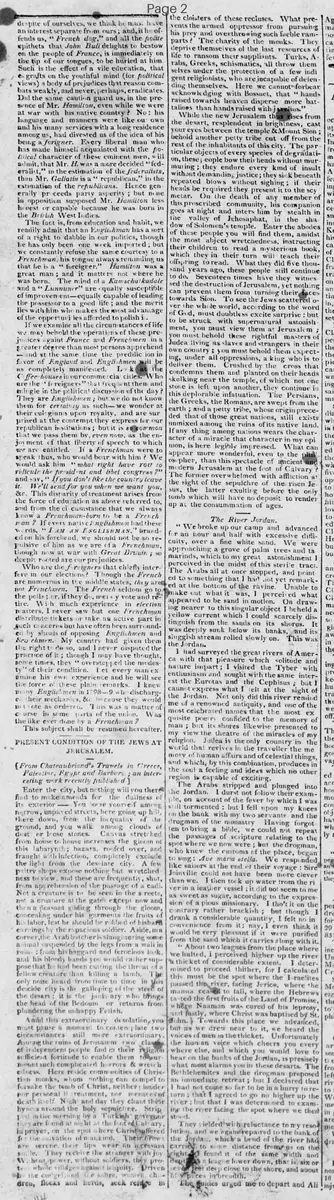
Enter the city, but nothing will you there find to make amends for the dullness of its exterior—You lose yourself among narrow, unpaved streets, here going up hill, there down, from the inequality of the ground, and you walk among clouds of dust or loose stones. Canvas stretched from house to house increases the gloom of this labyrinth; bazars, roofed over, and fraught with infection, completely exclude the light from the desolate city. A few paltry shops expose nothing but wretchedness to view, and these are frequently shut from apprehension of the passage of a cadi. Not a creature is to be seen in the streets, not a creature at the gate—except now and then a peasant gliding through the gloom, concealing under his garments the fruits of his labor, lest he should be robbed of his hard earnings by the rapacious soldier. Aside, a corner, the Arab butcher is slaughtering some animal suspended by the legs from a wall in ruin—from his haggard and ferocious look, and his bloody hands you would rather suppose that he had been cutting the throat of a fellow creature than killing a lamb. The only noise heard from time to time in this deicide city is the galloping of the steed of the desert: it is the janissary who brings the head of the Bedouin or returns from plundering the unhappy Fellah.
Amid this extraordinary desolation, you must pause a moment to contemplate two circumstances still more extraordinary. Among the ruins of Jerusalem two classes of independent people find in their religion sufficient fortitude to enable them to surmount such complicated horrors & wretchedness. Here reside communities of Christian monks, whom nothing can compel to forsake the tomb of Christ, neither plunder nor personal ill treatment, nor menaces of death itself. Night and day they chant their hymns around the holy sepulchre. Stripped in the morning by a Turkish governor they are found at night at the foot of Calvary, in prayer, on the spot where Christ suffered for the salvation of mankind. Their brows are serene. their lips wear an incessant smile. They receive the stranger with joy. Without power, without soldiers, they protect whole villages against iniquity. Driven by the cudgel and the sabre, women, children, flocks and herds, seek refuge in the cloisters of these recluses. What prevents the armed oppressor from pursuing his prey and overthrowing such feeble ramparts? The charity of the monks. They deprive themselves of the last resources of life to ransom their suppliants. Turks, Arabs, Greeks, schismatics, all throw themselves under the protection of a few indigent religionists, who are incapable of defending themselves. Here we cannot forbear acknowledging with Bossuet, that "hands raised towards heaven disperse more battalions than hands raised with javelins."
While the new Jerusalem thus rises from the desert, resplendent in brightness, cast your eyes between the temple & Mount Sion; behold another petty tribe cut off from the rest of the inhabitants of this city. The particular objects of every species of degradation, these people bow their heads without murmuring; they endure every kind of insult without demanding justice; they sink beneath repeated blows without sighing; if their heads be required they present it to the scymetar. On the death of any member of this proscribed community, his companion goes at night and inters him by stealth in the valley of Jehosaphat, in the shadow of Solomon's temple. Enter the abodes of these people you will find them, amidst the most abject wretchedness, instructing their children to read a mysterious book, which they in their turn will teach their offspring to read. What they did five thousand years ago, these people still continue to do. Seventeen times have they witnessed the destruction of Jerusalem, yet nothing can prevent them from turning their faces towards Sion. To see the Jews scattered over the whole world, according to the word of God, must doubtless excite surprise: but to be struck with supernatural astonishment, you must view them at Jerusalem; you must behold these rightful masters of Judea living as slaves and strangers in their own country; you must behold them expecting, under all oppressions, a king who is to deliver them. Crushed by the cross that condemns them and planted on their heads skulking near the temple, of which not one stone is left upon another, they continue in this deplorable infatuation. The Persians, the Greeks, the Romans, are swept from the earth; and a petty tribe, whose origin preceded that of those great nations, still exists unmixed among the ruins of its native land. If any thing among nations wears the character of a miracle that character in my opinion, is here legibly impressed. What can appear more wonderful, even to the philosopher, than this spectacle of ancient and modern Jerusalem at the foot of Calvary The former overwhelmed with affliction at the sight of the sepulchre of the risen Jesus, the latter exulting before the only tomb which will have no deposit to render up at the consummation of ages.
From Chateaubriand's Travels in Greece, Palestine, Egypt and Barbary; an interesting work recently published.
Enter the city, but nothing will you there find to make amends for the dullness of its exterior—You lose yourself among narrow, unpaved streets, here going up hill, there down, from the inequality of the ground, and you walk among clouds of dust or loose stones. Canvas stretched from house to house increases the gloom of this labyrinth; bazars, roofed over, and fraught with infection, completely exclude the light from the desolate city. A few paltry shops expose nothing but wretchedness to view, and these are frequently shut from apprehension of the passage of a cadi. Not a creature is to be seen in the streets, not a creature at the gate—except now and then a peasant gliding through the gloom, concealing under his garments the fruits of his labor, lest he should be robbed of his hard earnings by the rapacious soldier. Aside, a corner, the Arab butcher is slaughtering some animal suspended by the legs from a wall in ruin—from his haggard and ferocious look, and his bloody hands you would rather suppose that he had been cutting the throat of a fellow creature than killing a lamb. The only noise heard from time to time in this deicide city is the galloping of the steed of the desert: it is the janissary who brings the head of the Bedouin or returns from plundering the unhappy Fellah.
Amid this extraordinary desolation, you must pause a moment to contemplate two circumstances still more extraordinary. Among the ruins of Jerusalem two classes of independent people find in their religion sufficient fortitude to enable them to surmount such complicated horrors & wretchedness. Here reside communities of Christian monks, whom nothing can compel to forsake the tomb of Christ, neither plunder nor personal ill treatment, nor menaces of death itself. Night and day they chant their hymns around the holy sepulchre. Stripped in the morning by a Turkish governor they are found at night at the foot of Calvary, in prayer, on the spot where Christ suffered for the salvation of mankind. Their brows are serene. their lips wear an incessant smile. They receive the stranger with joy. Without power, without soldiers, they protect whole villages against iniquity. Driven by the cudgel and the sabre, women, children, flocks and herds, seek refuge in the cloisters of these recluses. What prevents the armed oppressor from pursuing his prey and overthrowing such feeble ramparts? The charity of the monks. They deprive themselves of the last resources of life to ransom their suppliants. Turks, Arabs, Greeks, schismatics, all throw themselves under the protection of a few indigent religionists, who are incapable of defending themselves. Here we cannot forbear acknowledging with Bossuet, that "hands raised towards heaven disperse more battalions than hands raised with javelins."
While the new Jerusalem thus rises from the desert, resplendent in brightness, cast your eyes between the temple & Mount Sion; behold another petty tribe cut off from the rest of the inhabitants of this city. The particular objects of every species of degradation, these people bow their heads without murmuring; they endure every kind of insult without demanding justice; they sink beneath repeated blows without sighing; if their heads be required they present it to the scymetar. On the death of any member of this proscribed community, his companion goes at night and inters him by stealth in the valley of Jehosaphat, in the shadow of Solomon's temple. Enter the abodes of these people you will find them, amidst the most abject wretchedness, instructing their children to read a mysterious book, which they in their turn will teach their offspring to read. What they did five thousand years ago, these people still continue to do. Seventeen times have they witnessed the destruction of Jerusalem, yet nothing can prevent them from turning their faces towards Sion. To see the Jews scattered over the whole world, according to the word of God, must doubtless excite surprise: but to be struck with supernatural astonishment, you must view them at Jerusalem; you must behold these rightful masters of Judea living as slaves and strangers in their own country; you must behold them expecting, under all oppressions, a king who is to deliver them. Crushed by the cross that condemns them and planted on their heads skulking near the temple, of which not one stone is left upon another, they continue in this deplorable infatuation. The Persians, the Greeks, the Romans, are swept from the earth; and a petty tribe, whose origin preceded that of those great nations, still exists unmixed among the ruins of its native land. If any thing among nations wears the character of a miracle that character in my opinion, is here legibly impressed. What can appear more wonderful, even to the philosopher, than this spectacle of ancient and modern Jerusalem at the foot of Calvary The former overwhelmed with affliction at the sight of the sepulchre of the risen Jesus, the latter exulting before the only tomb which will have no deposit to render up at the consummation of ages.
What sub-type of article is it?
Essay
Journey Narrative
What themes does it cover?
Religious
Taxation Oppression
Political
What keywords are associated?
Jerusalem
Jews
Christian Monks
Oppression
Religion
Desolation
Miracle
Temple
Calvary
Holy Sepulchre
What entities or persons were involved?
From Chateaubriand's Travels In Greece, Palestine, Egypt And Barbary
Literary Details
Title
Present Condition Of The Jews At Jerusalem.
Author
From Chateaubriand's Travels In Greece, Palestine, Egypt And Barbary
Subject
Description Of Jerusalem's Desolation And The Endurance Of Jews And Christian Monks Under Oppression
Key Lines
Here We Cannot Forbear Acknowledging With Bossuet, That "Hands Raised Towards Heaven Disperse More Battalions Than Hands Raised With Javelins."
What They Did Five Thousand Years Ago, These People Still Continue To Do.
To See The Jews Scattered Over The Whole World, According To The Word Of God, Must Doubtless Excite Surprise: But To Be Struck With Supernatural Astonishment, You Must View Them At Jerusalem;
If Any Thing Among Nations Wears The Character Of A Miracle That Character In My Opinion, Is Here Legibly Impressed.
What Can Appear More Wonderful, Even To The Philosopher, Than This Spectacle Of Ancient And Modern Jerusalem At The Foot Of Calvary