Thank you for visiting SNEWPapers!
Sign up free
Story
February 15, 1840
The Madisonian
Washington, District Of Columbia
What is this article about?
The Richmond Enquirer publishes Gen. William Henry Harrison's letter from Cincinnati outlining his Jeffersonian republican political beliefs, including opposition to the national bank, public debt, support for gradual emancipation initiated by slave states, and the importance of preserving the Union.
Clipping
OCR Quality
98%
Excellent
Full Text
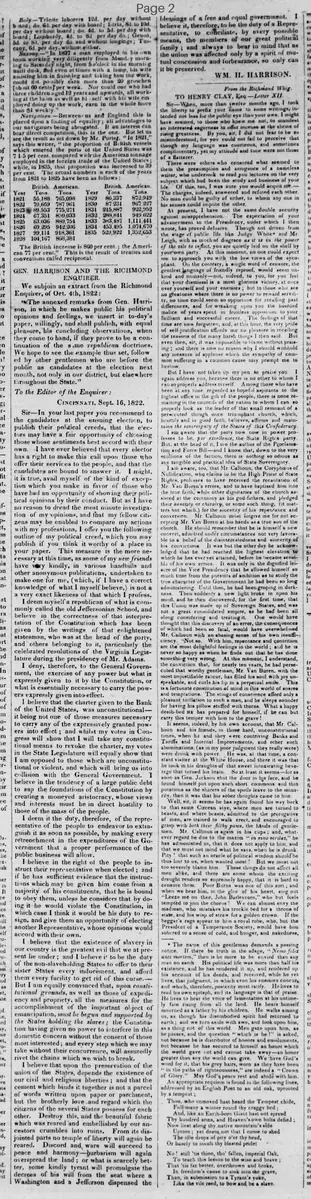
GEN. HARRISON AND THE RICHMOND ENQUIRER.
We subjoin an extract from the Richmond Enquirer, of Oct. 4th, 1822:
The annexed remarks from Gen. Harrison, in which he makes public his political opinions and feelings, we insert in to-day's paper, willingly, and shall publish, with equal pleasure, his concluding observations, when they come to hand, if they prove to be a continuation of the same republican doctrines. We hope to see the example thus set, followed by other gentlemen who are before the public as candidates at the election next month, not only in our district, but elsewhere throughout the State.
To the Editor of the Enquirer:
Cincinnati, Sept. 16, 1822.
Sir—In your last paper you recommend to the candidates at the ensuing election, to publish their political creeds, that the electors may have a fair opportunity of choosing those whose sentiments best accord with their own. I have ever believed that every elector has a right to make this call upon those who offer their services to the people, and that the candidates are bound to answer it. I might, it is true, avail myself of the kind of exception which you make in favor of those who have had an opportunity of showing their political opinions by their conduct. But as I have no reason to dread the most minute investigation of my opinions, and that my fellow citizens may be enabled to compare my actions with my professions, I offer you the following outline of my political creed, which you may publish if you think it worthy of a place in your paper. This measure is the more necessary at this time, as some of my new friends have very kindly, in various handbills and other anonymous publications, undertaken to make one for me, (which, if I have a correct knowledge of what I myself believe,) is not a very exact likeness of that which I profess. I deem myself a republican of what is commonly called the old Jeffersonian School, and believe in the correctness of that interpretation of the Constitution which has been given by the writings of that enlightened statesman, who was at the head of the party, and others belonging to it, particularly the celebrated resolutions of the Virginia Legislature during the presidency of Mr. Adams. I deny, therefore, to the General Government, the exercise of any power but what is expressly given to it by the Constitution, or what is essentially necessary to carry the powers expressly given into effect. I believe that the charter given to the Bank of the United States, was unconstitutional—it being not one of those measures necessary to carry any of the expressly granted powers into effect; and whilst my votes in Congress will show that I will take any constitutional means to revoke the charter, my votes in the State Legislature will equally show that I am opposed to those which are unconstitutional or violent, and which will bring us into collision with the General Government. I believe in the tendency of a large public debt to sap the foundations of the Constitution by creating a monied aristocracy, whose views and interests must be in direct hostility to those of the mass of the people. I deem it the duty, therefore, of the representative of the people to endeavor to extinguish it as soon as possible, by making every retrenchment in the expenditures of the Government that a proper performance of the public business will allow. I believe in the right of the people to instruct their representative when elected; and if he has sufficient evidence that the instructions which may be given him come from a majority of his constituents, that he is bound to obey them, unless he considers that by doing it he would violate the Constitution, in which case I think it would be his duty to resign, and give them an opportunity of electing another Representative, whose opinions would accord with their own. I believe that the existence of slavery in our country is the greatest evil that we at present lie under; and I believe it to be the duty of the non-slaveholding States to offer to their sister States every inducement, and afford them every facility to get rid of this curse. But I am equally convinced that, upon constitutional grounds, as well as those of expediency and propriety, all the measures for the accomplishment of the important object of emancipation, must be begun and supported by the States holding the slaves; the Constitution having given no power to interfere in this domestic concern without the consent of those most interested; and every step which we may take without their concurrence, will assuredly rivet the chains which we wish to break. I believe that upon the preservation of the union of the States, depends the existence of our civil and religious liberties; and that the cement which binds it together is not a parcel of words written upon paper or parchment, but the brotherly love and regard which the citizens of the several States possess for each other. Destroy this, and the beautiful fabric which was reared and embellished by our ancestors crumbles into ruins. From its disjointed parts no temple of liberty will again be reared. Discord and wars will succeed to peace and harmony—barbarism will again overspread the land; or what is scarcely better, some kingly tyrant will promulgate the decrees of his will from the seat where a Washington and a Jefferson dispensed the blessings of a free and equal government. I believe it, therefore, to be the duty of a Representative, to conciliate, by every possible means, the members of our great political family; and always to bear in mind that as the union was effected only by a spirit of mutual concession and forbearance, so only can it be preserved.
WM. H. HARRISON.
We subjoin an extract from the Richmond Enquirer, of Oct. 4th, 1822:
The annexed remarks from Gen. Harrison, in which he makes public his political opinions and feelings, we insert in to-day's paper, willingly, and shall publish, with equal pleasure, his concluding observations, when they come to hand, if they prove to be a continuation of the same republican doctrines. We hope to see the example thus set, followed by other gentlemen who are before the public as candidates at the election next month, not only in our district, but elsewhere throughout the State.
To the Editor of the Enquirer:
Cincinnati, Sept. 16, 1822.
Sir—In your last paper you recommend to the candidates at the ensuing election, to publish their political creeds, that the electors may have a fair opportunity of choosing those whose sentiments best accord with their own. I have ever believed that every elector has a right to make this call upon those who offer their services to the people, and that the candidates are bound to answer it. I might, it is true, avail myself of the kind of exception which you make in favor of those who have had an opportunity of showing their political opinions by their conduct. But as I have no reason to dread the most minute investigation of my opinions, and that my fellow citizens may be enabled to compare my actions with my professions, I offer you the following outline of my political creed, which you may publish if you think it worthy of a place in your paper. This measure is the more necessary at this time, as some of my new friends have very kindly, in various handbills and other anonymous publications, undertaken to make one for me, (which, if I have a correct knowledge of what I myself believe,) is not a very exact likeness of that which I profess. I deem myself a republican of what is commonly called the old Jeffersonian School, and believe in the correctness of that interpretation of the Constitution which has been given by the writings of that enlightened statesman, who was at the head of the party, and others belonging to it, particularly the celebrated resolutions of the Virginia Legislature during the presidency of Mr. Adams. I deny, therefore, to the General Government, the exercise of any power but what is expressly given to it by the Constitution, or what is essentially necessary to carry the powers expressly given into effect. I believe that the charter given to the Bank of the United States, was unconstitutional—it being not one of those measures necessary to carry any of the expressly granted powers into effect; and whilst my votes in Congress will show that I will take any constitutional means to revoke the charter, my votes in the State Legislature will equally show that I am opposed to those which are unconstitutional or violent, and which will bring us into collision with the General Government. I believe in the tendency of a large public debt to sap the foundations of the Constitution by creating a monied aristocracy, whose views and interests must be in direct hostility to those of the mass of the people. I deem it the duty, therefore, of the representative of the people to endeavor to extinguish it as soon as possible, by making every retrenchment in the expenditures of the Government that a proper performance of the public business will allow. I believe in the right of the people to instruct their representative when elected; and if he has sufficient evidence that the instructions which may be given him come from a majority of his constituents, that he is bound to obey them, unless he considers that by doing it he would violate the Constitution, in which case I think it would be his duty to resign, and give them an opportunity of electing another Representative, whose opinions would accord with their own. I believe that the existence of slavery in our country is the greatest evil that we at present lie under; and I believe it to be the duty of the non-slaveholding States to offer to their sister States every inducement, and afford them every facility to get rid of this curse. But I am equally convinced that, upon constitutional grounds, as well as those of expediency and propriety, all the measures for the accomplishment of the important object of emancipation, must be begun and supported by the States holding the slaves; the Constitution having given no power to interfere in this domestic concern without the consent of those most interested; and every step which we may take without their concurrence, will assuredly rivet the chains which we wish to break. I believe that upon the preservation of the union of the States, depends the existence of our civil and religious liberties; and that the cement which binds it together is not a parcel of words written upon paper or parchment, but the brotherly love and regard which the citizens of the several States possess for each other. Destroy this, and the beautiful fabric which was reared and embellished by our ancestors crumbles into ruins. From its disjointed parts no temple of liberty will again be reared. Discord and wars will succeed to peace and harmony—barbarism will again overspread the land; or what is scarcely better, some kingly tyrant will promulgate the decrees of his will from the seat where a Washington and a Jefferson dispensed the blessings of a free and equal government. I believe it, therefore, to be the duty of a Representative, to conciliate, by every possible means, the members of our great political family; and always to bear in mind that as the union was effected only by a spirit of mutual concession and forbearance, so only can it be preserved.
WM. H. HARRISON.
What sub-type of article is it?
Biography
Historical Event
What themes does it cover?
Moral Virtue
Justice
What keywords are associated?
Political Creed
Jeffersonian Republican
Bank Unconstitutional
Public Debt
Slavery Emancipation
Union Preservation
What entities or persons were involved?
Gen. Harrison
Wm. H. Harrison
Where did it happen?
Cincinnati, Richmond
Story Details
Key Persons
Gen. Harrison
Wm. H. Harrison
Location
Cincinnati, Richmond
Event Date
Sept. 16, 1822; Oct. 4, 1822
Story Details
Gen. Harrison publishes his political creed as a Jeffersonian republican, opposing the Bank of the United States, public debt, supporting states' rights on slavery, and emphasizing preservation of the Union through mutual concession.