Thank you for visiting SNEWPapers!
Sign up free
Story
April 28, 1955
The Key West Citizen
Key West, Monroe County, Florida
What is this article about?
Former President Harry S. Truman, in a 1954 speech in Chicago, urged vigilance in protecting individual rights under the Bill of Rights, warning against government overreach like Fascism and Nazism, and praised Adlai E. Stevenson as a potential 1956 Democratic nominee.
Clipping
OCR Quality
97%
Excellent
Full Text
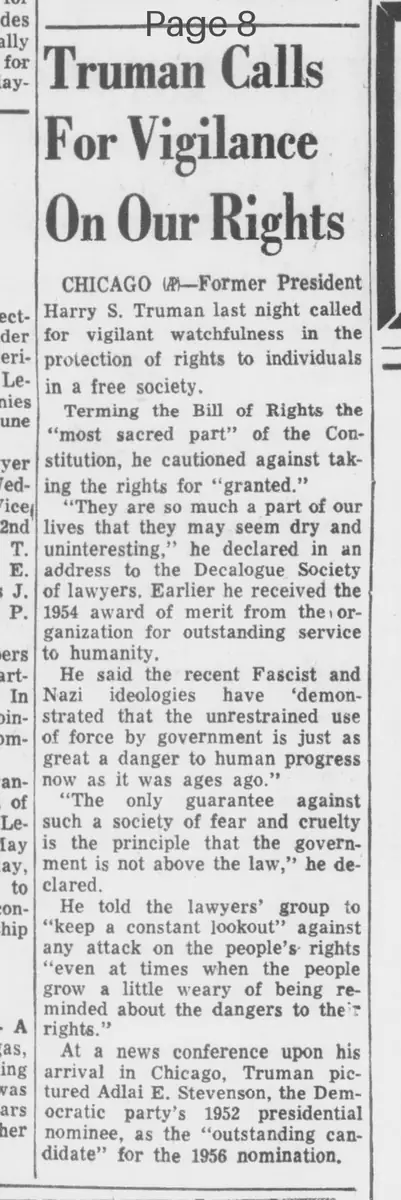
Truman Calls For Vigilance On Our Rights
CHICAGO (A') — Former President Harry S. Truman last night called for vigilant watchfulness in the protection of rights to individuals in a free society.
Terming the Bill of Rights the "most sacred part" of the Constitution, he cautioned against taking the rights for "granted."
"They are so much a part of our lives that they may seem dry and uninteresting," he declared in an address to the Decalogue Society of lawyers. Earlier he received the 1954 award of merit from the organization for outstanding service to humanity.
He said the recent Fascist and Nazi ideologies have 'demonstrated that the unrestrained use of force by government is just as great a danger to human progress now as it was ages ago."
"The only guarantee against such a society of fear and cruelty is the principle that the government is not above the law," he declared.
He told the lawyers' group to "keep a constant lookout" against any attack on the people's rights "even at times when the people grow a little weary of being reminded about the dangers to their rights."
At a news conference upon his arrival in Chicago, Truman pictured Adlai E. Stevenson, the Democratic party's 1952 presidential nominee, as the "outstanding candidate" for the 1956 nomination.
CHICAGO (A') — Former President Harry S. Truman last night called for vigilant watchfulness in the protection of rights to individuals in a free society.
Terming the Bill of Rights the "most sacred part" of the Constitution, he cautioned against taking the rights for "granted."
"They are so much a part of our lives that they may seem dry and uninteresting," he declared in an address to the Decalogue Society of lawyers. Earlier he received the 1954 award of merit from the organization for outstanding service to humanity.
He said the recent Fascist and Nazi ideologies have 'demonstrated that the unrestrained use of force by government is just as great a danger to human progress now as it was ages ago."
"The only guarantee against such a society of fear and cruelty is the principle that the government is not above the law," he declared.
He told the lawyers' group to "keep a constant lookout" against any attack on the people's rights "even at times when the people grow a little weary of being reminded about the dangers to their rights."
At a news conference upon his arrival in Chicago, Truman pictured Adlai E. Stevenson, the Democratic party's 1952 presidential nominee, as the "outstanding candidate" for the 1956 nomination.
What sub-type of article is it?
Historical Event
What themes does it cover?
Justice
Moral Virtue
What keywords are associated?
Civil Rights
Bill Of Rights
Truman Speech
Fascism Warning
Stevenson Nomination
What entities or persons were involved?
Harry S. Truman
Adlai E. Stevenson
Where did it happen?
Chicago
Story Details
Key Persons
Harry S. Truman
Adlai E. Stevenson
Location
Chicago
Event Date
1954
Story Details
Truman warns of dangers to individual rights from government force, as seen in Fascism and Nazism, emphasizes Bill of Rights and rule of law in speech to lawyers, receives award, and endorses Stevenson for 1956 nomination.