Thank you for visiting SNEWPapers!
Sign up free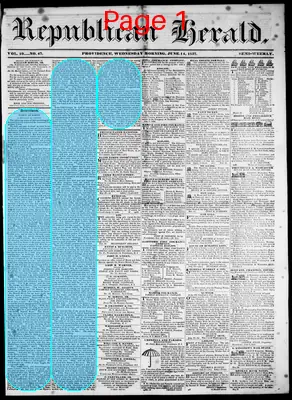
Literary
June 14, 1837
Republican Herald
Providence, Providence County, Rhode Island
What is this article about?
A review from the Journal of the American Temperance Union praises Nathan Sargent's tale 'Nancy Le Baron,' recounting the tragic fall of a once-prosperous woman who marries a drunken doctor, enduring abuse, poverty, and early death, highlighting intemperance's ravages.
Clipping
OCR Quality
88%
Good
Full Text
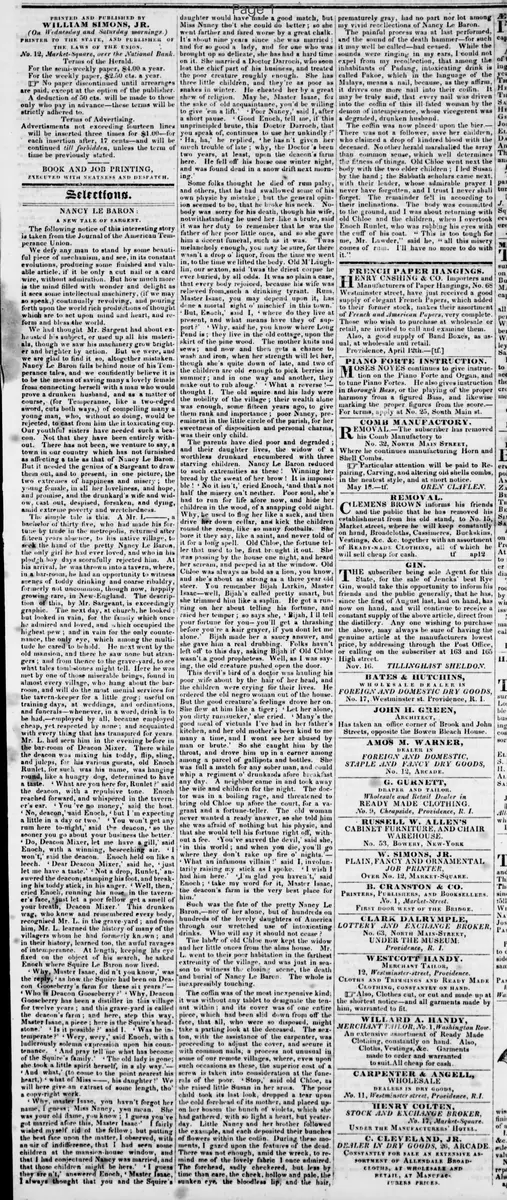
Selections.
NANCY LE BARON:
A NEW TALE OF SARGENT.
The following notice of this interesting story is taken from the Journal of the American Temperance Union.
We defy any man to stand by some beautiful piece of mechanism, and see, in its constant evolutions, producing some finished and valuable article, if it be only a cut nail or a card wire, without admiration. But how much more is the mind filled with wonder and delight as it sees some intellectual machinery, (if we may so speak,) continually revolving, and pouring forth upon the world rich productions of thought which are to act upon mind and heart, and reform and bless the world.
We had thought Mr. Sargent had about exhausted his subject, or used up all his materials, though we saw his machinery grow brighter and brighter by action. But we were, and we are glad to find it so, altogether mistaken. Nancy Le Baron falls behind none of his Temperance tales, and we confidently believe it is to be the means of saving many a lovely female from connecting herself with a man who would prove a drunken husband, and as a matter of course, (for Temperance, like a two-edged sword, cuts both ways,) of compelling many a young man, who, without so doing, would be rejected, to cast from him the intoxicating cup.
Our youthful sisters have needed such a beacon.
Not that they have been entirely without. There has not been, we venture to say, a town in our country which has not furnished as affecting a tale as that of Nancy Le Baron. But it needed the genius of a Sargent to draw them out, and to present, in one picture, the two extremes of happiness and misery; the young female, in all her loveliness, and hope, and promise, and the drunkard's wife and widow, cast out, despised, forsaken, and dying, amid extreme poverty and wretchedness.
The simple tale is this. A Mr. L., a bachelor of thirty five, who had made his fortune by trade in the metropolis, returned after fifteen years absence, to his native village, to seek the hand of the pretty Nancy Le Baron, the only girl he had ever loved, and who in his plough boy days scornfully rejected him. At his arrival, he was thrown into a tavern, where, in a bar-room, he had an opportunity to witness scenes of toddy drinking and coarse ribaldry, formerly not uncommon, though now, happily growing rare, in New-England. The description of this, by Mr. Sargent, is exceedingly graphic. The next day, at church, he looked; but looked in vain, for the family which once he admired and loved, and which occupied the highest pew; and in vain for the only countenance, the only eye, which among the multitude he cared to behold. He next went by the old mansion, and there he saw none but strangers; and from thence to the grave-yard, to see what tales tombstones might tell. Here he was met by one of those miserable beings, found in almost every village, who hang about the bar-room, and will do the most menial services for the tavern-keeper for a little grog; useful on training days, at weddings, and ordinations, and funerals—whenever, in a word, drink is to be had,—employed by all, because employed cheap, yet respected by none; and acquainted with every thing that has transpired for years. Mr. L. had seen him in the evening before in the bar-room of Deacon Mixer. There while the deacon was mixing his toddy, flip, sling, and juleps, for his various guests, old Enoch Runlet, for such was his name, was hanging round, like a hungry dog, determined to have a taste. 'What are you here for, Runlet?' said the deacon, with a repulsive tone. Enoch reached forward, and whispered in the tavern-ner's ear. 'You've no money,' said the host. 'No, deacon,' said Enoch, 'but I'm expecting a little in a day or two.' 'You won't get any rum here to-night,' said the deacon, 'so the sooner you go about your business the better.' 'Do, Deacon Mixer, let me have a gill,' said Enoch, with a winning, beseeching air. 'I won't,' said the deacon. Enoch held on like a leech. 'Dear Deacon Mixer,' said he, 'just let me have a taste.' 'Not a drop, Runlet,' answered the deacon, stamping his foot, and breaking his toddy stick, in his anger. 'Well, then,' cried Enoch, running his nose in the tavern-ner's face, 'just let a poor fellow get a smell of your breath, Deacon Mixer.' This drunken wag, who knew and remembered every body, recognised Mr. L. in the grave-yard; and from him, Mr. L. learned the history of many of the villagers whom he had formerly known; and in their history, learned too, the awful ravages of intemperance. At length, keeping his eye fixed on the object of his search, he asked Enoch where Squire Le Baron now lived. 'Why, Master Isaac, didn't you know,' was the reply, 'as how the Squire had been on Deacon Gooseberry's farm for these six years?' 'Who is Deacon Gooseberry?' 'Why, Deacon Gooseberry has been a distiller in this village for twelve years; and this grave-yard is called the deacon's farm; and here, step this way, Master Isaac, a piece; here is the Squire's head-stone.' 'Is it possible?' said I. 'Was he intemperate?' 'Wery, wery,' said Enoch, with a ludicrously solemn expression upon his countenance. 'And pray tell me what has become of the Squire's family.' 'The old lady is gone; she took a little spirit herself, in a sly way.' 'And what,' (to come to the point nearest his heart,) 'what of Miss—, his daughter!' We will here give an extract of some length, tho a copy-right work.
'Why, master Isaac, you havn't forgot her name, I guess; Miss Nancy, you mean. She was your old flame, you know; I guess you've got married afore this, Master Isaac.' I fairly wished myself rid of the fellow; but putting the best face upon the matter, I observed, with an air of indifference, that I had seen some children at the mansion-house window, and that I had conjectured Nancy was married, and that those children might be hers.' 'I guess they aren't,' answered Enoch, 'Master Isaac, I always thought that you and the Squire's daughter would have made a good match, but Miss Nancy tho't she could do better: so she went farther and fared worse by a great chalk. It's about nine years since she was married; and for so good a lady, and for one who was brought up so delicate, she has had a hard time on it. She married a Doctor Darroch, who soon lost the chief part of his business, and treated the poor creature roughly enough. She has three little children, and they're as poor as snakes in winter. He cheated her by a great shew of religion. May be, Master Isaac, for the sake of old acquaintance, you'd be willing to give 'em a lift.' 'Poor Nancy,' said I, after a short pause. 'Good Enoch, tell me, if this unprincipled brute, this Doctor Darroch, that you speak of, continues to use her unkindly?' 'Ha, ha,' he replied, 'he hasn't given her much trouble of late: why, the Doctor's been on the deacon's farm here two years, at least. He fell off his horse one winter night, and was found dead in a snow drift next morning: Some folks thought he died of rum palsy. and others, that he had swallowed some of his own physic by mistake; but the general opinion seemed to be, that he broke his neck. Nobody was sorry for his death, though his wife notwithstanding he used her like a brute, said it was her duty to remember that he was the father of her poor little ones, and so she gave him a decent funeral, such as it was. 'Twas melancholy enough, you may be sure, for there wasn't a drop o' liquor, from the time we went in, to the time we lifted the body. Old M'Laughlin, our sexton, said 'twas the driest corpse he ever buried, by all odds. It was so plain a case, that every body rejoiced, because his wife was relieved from such a drinking tyrant. Rum, Master Isaac, you may depend upon it, has done a mortal sight o' mischief in this town. But, Enoch,' said I, 'where do they live at present, and what means have they of support?' 'Why, said he, you know where Long Pond is; they live in the old cottage, upon the skirt of the pine wood. The mother knits and sews; and now and then gets a chance to wash and iron, when her strength will let her, though she's quite down of late, and two of the children are old enough to pick berries in summer; and in one way and another, they make out to rub along.' 'What a reverse! thought I. The old squire and his lady were the nobility of the village; their wealth alone was enough, some fifteen years ago, to give them rank and importance; poor Nancy, pre-eminent in the little circle of the parish, for her sweetness of disposition and personal charms, was their only child. The parents have died poor and degraded; and their daughter lives, the widow of a worthless drunkard encumbered with three starving children. Nancy Le Baron reduced to such extremities as these! Winning her bread by the sweat of her brow! It is impossible! No it isn't,' cried Enoch. 'and that's not half the misery on't neither. Poor soul, she's had to run for life afore now, and hide her children in the wood, of a snapping cold night. Why, he used to flog her like a sack, and then drive her down cellar, and kick the children round the room, like so many footballs. She bore it they say, like a saint, and never told of it for a long spell. Old Chloe, the fortune teller that used to be, first brought it out. She was passing by the house one night, and heard her scream, and peeped in at the window. Old Chloe was always as bold as a lion, you know, and she's about as strong as a three year old steer. You remember Bijah Larkin, Master Isaac—well, Bijah's called pretty smart, but she trimmed him like a saplin. He got a running on her about telling his fortune, and raised her temper; so says she, 'Bijah, I'll tell your fortune for you—you'll get a thrashing before you're a hair grayer, if you dont let me alone.' Bijah made her a saucy answer, and she gave him a real drubbing. Folks havn't left off to this day, asking Bijah if Old Chloe wasn't a good prophetess.' 'Well, as I was saying, the old creature pushed open the door. This devil's bird of a doctor was hauling his poor wife about by the hair of her head, and the children were crying for their lives. He ordered the old negro woman out of the house. But the good creature's feelings drove her on. She flew at him like a tiger; 'Let her alone, you dirty rumsucker,' she cried. 'Many's the good meal of victuals I've had in her father's kitchen, and her old mother's been kind to me many a time, and I wont see her abused by man or brute.' So she caught him by the throat, and drove him up in a corner among a parcel of gallipots and bottles. She was full a match for any sober man, and could whip a regiment o' drunkards afore breakfast any day. A neighbor came in and took away the wife and children for the night. The doctor was in a boiling rage, and threatened to bring old Chloe up afore the court, for a vagrant and a fortune-teller. The old woman never wanted a ready answer, so she told him she was afraid of nothing but his physic, and that she would tell his fortune right off, without a fee. 'You've sarved the devil,' said she, 'in this world; and when you die, you'll go where they don't rake up fire o' nights.' 'What an infamous villain!' said I, involuntarily raising my stick as I spoke. 'I wish I had him here.' 'I'm glad you haven't,' said Enoch; 'take my word for it, Master Isaac, the deacon's farm is the very best place for him.
Such was the fate of the pretty Nancy Le Baron,—nor of her alone, but of hundreds on hundreds of the lovely daughters of America through our wretched use of intoxicating drinks. Who will say it should not cease?
The labor of old Chloe now kept the widow and her little ones from the alms house. Mr. L. went to their poor habitation in the farthest extremity of the village, and was just in season to witness the closing scene, the death and burial of Nancy Le Baron. The whole is inexpressibly touching.
The coffin was of the most inexpensive kind: it was without any tablet to designate the tenant within; and its cover was of one entire piece, which had been slid down from off the face, that all, who were so disposed, might take a parting look at the deceased. The sexton, with the assistance of the carpenter, was proceeding to adjust the cover, and secure it with common nails, a process not unusual in some of our remote villages, where, even upon such occasions as these, the superior cost of a screw is taken into consideration at the funerals of the poor. 'Stop,' said old Chloe, as she raised little Susan in her arms. The poor child took its last look, dropped a tear upon the cold forehead of its mother, and placed upon her bosom the bunch of violets, which she had gathered, with so light a heart, but yesterday. Little Nancy and her brother followed the example, and each deposited their bunches of flowers within the coffin. During these moments, I gazed upon the features of the dead. There was not enough, amid the wreck, to remind me of the lovely fabric I once admired. The forehead, sadly checkered, but less by time than care, the cheek, hollow and pale, the sunken eye, the bloodless lip, and—the hair, prematurely gray, had no part nor lot among my vivid recollections of Nancy Le Baron.
The painful process was at last performed, and the sound of the death hammer—for such it may well be called—had ceased. While the sounds were ringing in my ears, I could not expel from my recollection, that among the inhabitants of Padang, intoxicating drink is called Pakoe, which in the language of the Malays, means a nail, because, as they affirm, it drives one more nail into their coffin. It may be truly said, that every nail was driven into the coffin of this ill fated woman by the demon of intemperance, whose vicegerent was a degraded, drunken husband.
The coffin was now placed upon the bier.—There was not a follower, save her children who claimed a drop of kindred blood with the deceased. No other herald marshalled the array than common sense, which well determines the fitness of things. Old Chloe went next the body with the two elder children: I led Susan by the hand; the Sabbath scholars came next, with their leader, whose admirable prayer I never have forgotten, and I trust I never shall forget. The remainder fell in according to their inclinations. The body was committed to the ground, and I was about returning with old Chloe and the children, when I overtook Enoch Runlet, who was rubbing his eyes with the cuff of his coat. 'This is too tough for me, Mr. Lawder,' said he, 'all this misery comes of rum. I'll have no more to do with it.'
NANCY LE BARON:
A NEW TALE OF SARGENT.
The following notice of this interesting story is taken from the Journal of the American Temperance Union.
We defy any man to stand by some beautiful piece of mechanism, and see, in its constant evolutions, producing some finished and valuable article, if it be only a cut nail or a card wire, without admiration. But how much more is the mind filled with wonder and delight as it sees some intellectual machinery, (if we may so speak,) continually revolving, and pouring forth upon the world rich productions of thought which are to act upon mind and heart, and reform and bless the world.
We had thought Mr. Sargent had about exhausted his subject, or used up all his materials, though we saw his machinery grow brighter and brighter by action. But we were, and we are glad to find it so, altogether mistaken. Nancy Le Baron falls behind none of his Temperance tales, and we confidently believe it is to be the means of saving many a lovely female from connecting herself with a man who would prove a drunken husband, and as a matter of course, (for Temperance, like a two-edged sword, cuts both ways,) of compelling many a young man, who, without so doing, would be rejected, to cast from him the intoxicating cup.
Our youthful sisters have needed such a beacon.
Not that they have been entirely without. There has not been, we venture to say, a town in our country which has not furnished as affecting a tale as that of Nancy Le Baron. But it needed the genius of a Sargent to draw them out, and to present, in one picture, the two extremes of happiness and misery; the young female, in all her loveliness, and hope, and promise, and the drunkard's wife and widow, cast out, despised, forsaken, and dying, amid extreme poverty and wretchedness.
The simple tale is this. A Mr. L., a bachelor of thirty five, who had made his fortune by trade in the metropolis, returned after fifteen years absence, to his native village, to seek the hand of the pretty Nancy Le Baron, the only girl he had ever loved, and who in his plough boy days scornfully rejected him. At his arrival, he was thrown into a tavern, where, in a bar-room, he had an opportunity to witness scenes of toddy drinking and coarse ribaldry, formerly not uncommon, though now, happily growing rare, in New-England. The description of this, by Mr. Sargent, is exceedingly graphic. The next day, at church, he looked; but looked in vain, for the family which once he admired and loved, and which occupied the highest pew; and in vain for the only countenance, the only eye, which among the multitude he cared to behold. He next went by the old mansion, and there he saw none but strangers; and from thence to the grave-yard, to see what tales tombstones might tell. Here he was met by one of those miserable beings, found in almost every village, who hang about the bar-room, and will do the most menial services for the tavern-keeper for a little grog; useful on training days, at weddings, and ordinations, and funerals—whenever, in a word, drink is to be had,—employed by all, because employed cheap, yet respected by none; and acquainted with every thing that has transpired for years. Mr. L. had seen him in the evening before in the bar-room of Deacon Mixer. There while the deacon was mixing his toddy, flip, sling, and juleps, for his various guests, old Enoch Runlet, for such was his name, was hanging round, like a hungry dog, determined to have a taste. 'What are you here for, Runlet?' said the deacon, with a repulsive tone. Enoch reached forward, and whispered in the tavern-ner's ear. 'You've no money,' said the host. 'No, deacon,' said Enoch, 'but I'm expecting a little in a day or two.' 'You won't get any rum here to-night,' said the deacon, 'so the sooner you go about your business the better.' 'Do, Deacon Mixer, let me have a gill,' said Enoch, with a winning, beseeching air. 'I won't,' said the deacon. Enoch held on like a leech. 'Dear Deacon Mixer,' said he, 'just let me have a taste.' 'Not a drop, Runlet,' answered the deacon, stamping his foot, and breaking his toddy stick, in his anger. 'Well, then,' cried Enoch, running his nose in the tavern-ner's face, 'just let a poor fellow get a smell of your breath, Deacon Mixer.' This drunken wag, who knew and remembered every body, recognised Mr. L. in the grave-yard; and from him, Mr. L. learned the history of many of the villagers whom he had formerly known; and in their history, learned too, the awful ravages of intemperance. At length, keeping his eye fixed on the object of his search, he asked Enoch where Squire Le Baron now lived. 'Why, Master Isaac, didn't you know,' was the reply, 'as how the Squire had been on Deacon Gooseberry's farm for these six years?' 'Who is Deacon Gooseberry?' 'Why, Deacon Gooseberry has been a distiller in this village for twelve years; and this grave-yard is called the deacon's farm; and here, step this way, Master Isaac, a piece; here is the Squire's head-stone.' 'Is it possible?' said I. 'Was he intemperate?' 'Wery, wery,' said Enoch, with a ludicrously solemn expression upon his countenance. 'And pray tell me what has become of the Squire's family.' 'The old lady is gone; she took a little spirit herself, in a sly way.' 'And what,' (to come to the point nearest his heart,) 'what of Miss—, his daughter!' We will here give an extract of some length, tho a copy-right work.
'Why, master Isaac, you havn't forgot her name, I guess; Miss Nancy, you mean. She was your old flame, you know; I guess you've got married afore this, Master Isaac.' I fairly wished myself rid of the fellow; but putting the best face upon the matter, I observed, with an air of indifference, that I had seen some children at the mansion-house window, and that I had conjectured Nancy was married, and that those children might be hers.' 'I guess they aren't,' answered Enoch, 'Master Isaac, I always thought that you and the Squire's daughter would have made a good match, but Miss Nancy tho't she could do better: so she went farther and fared worse by a great chalk. It's about nine years since she was married; and for so good a lady, and for one who was brought up so delicate, she has had a hard time on it. She married a Doctor Darroch, who soon lost the chief part of his business, and treated the poor creature roughly enough. She has three little children, and they're as poor as snakes in winter. He cheated her by a great shew of religion. May be, Master Isaac, for the sake of old acquaintance, you'd be willing to give 'em a lift.' 'Poor Nancy,' said I, after a short pause. 'Good Enoch, tell me, if this unprincipled brute, this Doctor Darroch, that you speak of, continues to use her unkindly?' 'Ha, ha,' he replied, 'he hasn't given her much trouble of late: why, the Doctor's been on the deacon's farm here two years, at least. He fell off his horse one winter night, and was found dead in a snow drift next morning: Some folks thought he died of rum palsy. and others, that he had swallowed some of his own physic by mistake; but the general opinion seemed to be, that he broke his neck. Nobody was sorry for his death, though his wife notwithstanding he used her like a brute, said it was her duty to remember that he was the father of her poor little ones, and so she gave him a decent funeral, such as it was. 'Twas melancholy enough, you may be sure, for there wasn't a drop o' liquor, from the time we went in, to the time we lifted the body. Old M'Laughlin, our sexton, said 'twas the driest corpse he ever buried, by all odds. It was so plain a case, that every body rejoiced, because his wife was relieved from such a drinking tyrant. Rum, Master Isaac, you may depend upon it, has done a mortal sight o' mischief in this town. But, Enoch,' said I, 'where do they live at present, and what means have they of support?' 'Why, said he, you know where Long Pond is; they live in the old cottage, upon the skirt of the pine wood. The mother knits and sews; and now and then gets a chance to wash and iron, when her strength will let her, though she's quite down of late, and two of the children are old enough to pick berries in summer; and in one way and another, they make out to rub along.' 'What a reverse! thought I. The old squire and his lady were the nobility of the village; their wealth alone was enough, some fifteen years ago, to give them rank and importance; poor Nancy, pre-eminent in the little circle of the parish, for her sweetness of disposition and personal charms, was their only child. The parents have died poor and degraded; and their daughter lives, the widow of a worthless drunkard encumbered with three starving children. Nancy Le Baron reduced to such extremities as these! Winning her bread by the sweat of her brow! It is impossible! No it isn't,' cried Enoch. 'and that's not half the misery on't neither. Poor soul, she's had to run for life afore now, and hide her children in the wood, of a snapping cold night. Why, he used to flog her like a sack, and then drive her down cellar, and kick the children round the room, like so many footballs. She bore it they say, like a saint, and never told of it for a long spell. Old Chloe, the fortune teller that used to be, first brought it out. She was passing by the house one night, and heard her scream, and peeped in at the window. Old Chloe was always as bold as a lion, you know, and she's about as strong as a three year old steer. You remember Bijah Larkin, Master Isaac—well, Bijah's called pretty smart, but she trimmed him like a saplin. He got a running on her about telling his fortune, and raised her temper; so says she, 'Bijah, I'll tell your fortune for you—you'll get a thrashing before you're a hair grayer, if you dont let me alone.' Bijah made her a saucy answer, and she gave him a real drubbing. Folks havn't left off to this day, asking Bijah if Old Chloe wasn't a good prophetess.' 'Well, as I was saying, the old creature pushed open the door. This devil's bird of a doctor was hauling his poor wife about by the hair of her head, and the children were crying for their lives. He ordered the old negro woman out of the house. But the good creature's feelings drove her on. She flew at him like a tiger; 'Let her alone, you dirty rumsucker,' she cried. 'Many's the good meal of victuals I've had in her father's kitchen, and her old mother's been kind to me many a time, and I wont see her abused by man or brute.' So she caught him by the throat, and drove him up in a corner among a parcel of gallipots and bottles. She was full a match for any sober man, and could whip a regiment o' drunkards afore breakfast any day. A neighbor came in and took away the wife and children for the night. The doctor was in a boiling rage, and threatened to bring old Chloe up afore the court, for a vagrant and a fortune-teller. The old woman never wanted a ready answer, so she told him she was afraid of nothing but his physic, and that she would tell his fortune right off, without a fee. 'You've sarved the devil,' said she, 'in this world; and when you die, you'll go where they don't rake up fire o' nights.' 'What an infamous villain!' said I, involuntarily raising my stick as I spoke. 'I wish I had him here.' 'I'm glad you haven't,' said Enoch; 'take my word for it, Master Isaac, the deacon's farm is the very best place for him.
Such was the fate of the pretty Nancy Le Baron,—nor of her alone, but of hundreds on hundreds of the lovely daughters of America through our wretched use of intoxicating drinks. Who will say it should not cease?
The labor of old Chloe now kept the widow and her little ones from the alms house. Mr. L. went to their poor habitation in the farthest extremity of the village, and was just in season to witness the closing scene, the death and burial of Nancy Le Baron. The whole is inexpressibly touching.
The coffin was of the most inexpensive kind: it was without any tablet to designate the tenant within; and its cover was of one entire piece, which had been slid down from off the face, that all, who were so disposed, might take a parting look at the deceased. The sexton, with the assistance of the carpenter, was proceeding to adjust the cover, and secure it with common nails, a process not unusual in some of our remote villages, where, even upon such occasions as these, the superior cost of a screw is taken into consideration at the funerals of the poor. 'Stop,' said old Chloe, as she raised little Susan in her arms. The poor child took its last look, dropped a tear upon the cold forehead of its mother, and placed upon her bosom the bunch of violets, which she had gathered, with so light a heart, but yesterday. Little Nancy and her brother followed the example, and each deposited their bunches of flowers within the coffin. During these moments, I gazed upon the features of the dead. There was not enough, amid the wreck, to remind me of the lovely fabric I once admired. The forehead, sadly checkered, but less by time than care, the cheek, hollow and pale, the sunken eye, the bloodless lip, and—the hair, prematurely gray, had no part nor lot among my vivid recollections of Nancy Le Baron.
The painful process was at last performed, and the sound of the death hammer—for such it may well be called—had ceased. While the sounds were ringing in my ears, I could not expel from my recollection, that among the inhabitants of Padang, intoxicating drink is called Pakoe, which in the language of the Malays, means a nail, because, as they affirm, it drives one more nail into their coffin. It may be truly said, that every nail was driven into the coffin of this ill fated woman by the demon of intemperance, whose vicegerent was a degraded, drunken husband.
The coffin was now placed upon the bier.—There was not a follower, save her children who claimed a drop of kindred blood with the deceased. No other herald marshalled the array than common sense, which well determines the fitness of things. Old Chloe went next the body with the two elder children: I led Susan by the hand; the Sabbath scholars came next, with their leader, whose admirable prayer I never have forgotten, and I trust I never shall forget. The remainder fell in according to their inclinations. The body was committed to the ground, and I was about returning with old Chloe and the children, when I overtook Enoch Runlet, who was rubbing his eyes with the cuff of his coat. 'This is too tough for me, Mr. Lawder,' said he, 'all this misery comes of rum. I'll have no more to do with it.'
What sub-type of article is it?
Essay
Prose Fiction
What themes does it cover?
Temperance
Moral Virtue
Death Mortality
What keywords are associated?
Temperance Tale
Intemperance
Drunken Husband
Poverty
Abuse
Widowhood
Moral Reform
Village Life
What entities or persons were involved?
Mr. Sargent
Literary Details
Title
Nancy Le Baron: A New Tale Of Sargent.
Author
Mr. Sargent
Subject
Warning Against The Dangers Of Intemperance And Marrying Drunkards
Form / Style
Prose Review And Narrative Summary Of A Temperance Tale
Key Lines
We Defy Any Man To Stand By Some Beautiful Piece Of Mechanism... Reform And Bless The World.
Nancy Le Baron Falls Behind None Of His Temperance Tales... Cast From Him The Intoxicating Cup.
'What An Infamous Villain!' Said I... The Deacon's Farm Is The Very Best Place For Him.
It May Be Truly Said, That Every Nail Was Driven Into The Coffin Of This Ill Fated Woman By The Demon Of Intemperance...
'This Is Too Tough For Me, Mr. Lawder,' Said He, 'All This Misery Comes Of Rum. I'll Have No More To Do With It.'