Thank you for visiting SNEWPapers!
Sign up free
Literary
November 10, 1810
Alexandria Daily Gazette, Commercial & Political
Alexandria, Virginia
What is this article about?
A prose essay satirically depicts the harmonious marriage of Ephraim Merrily and wife Susan, where she maintains the illusion of obedience by seeking and following his advice, which he tailors to her true desires, ensuring mutual satisfaction.
Merged-components note: Continuation of the literary piece 'Delineator' from the Connecticut Courant; text flows directly.
Clipping
OCR Quality
95%
Excellent
Full Text
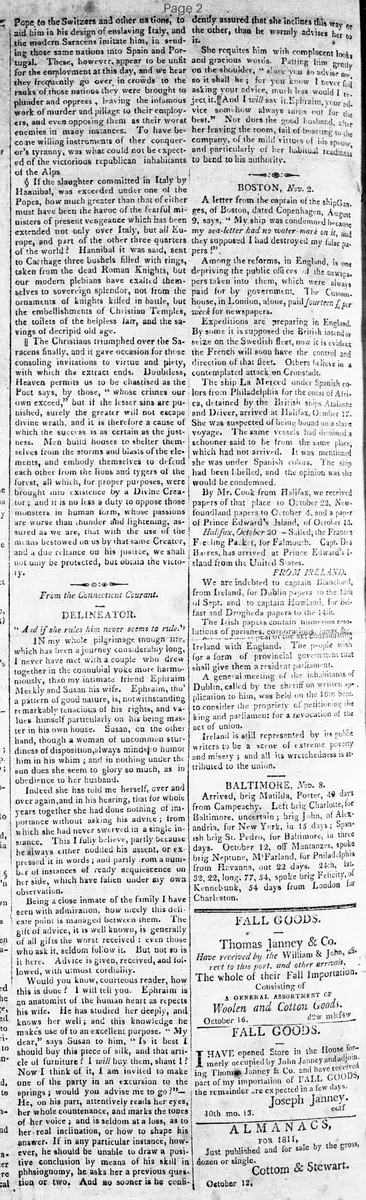
From the Connecticut Courant.
DELINEATOR.
"And if she rules him never seems to rule."
IN my whole pilgrimage through life,
which has been a journey considerably long.
I never have met with a couple who drew
together in the connubial yoke more harmoniously,
than my intimate friend Ephraim
Merrily and Susan his wife. Ephraim, tho'
a pattern of good nature, is, notwithstanding
remarkably tenacious of his rights, and values
himself particularly on his being master
in his own house. Susan, on the other
hand, though a woman of uncommon sturdiness
of disposition, always minds to humor
him in his whim; and in nothing under the
sun does she seem to glory so much, as in
obedience to her husband.
Indeed she has told me herself, over and
over again, and in his hearing, that for whole
years together she had done nothing of importance
without asking his advice; from
which she had never swerved in a single instance.
This I fully believe, partly because
he always either nodded his assent, or expressed
it in words; and partly from a number
of instances of ready acquiescence on
her side, which have fallen under my own
observation.
Being a close inmate of the family I have
seen with admiration, how nicely this delicate
point is managed between them. The
gift of advice, it is well known, is generally
of all gifts the worst received: even those
who ask it, seldom follow it. But not so is
it here. Advice is given, received, and followed,
with utmost cordiality.
Would you know, courteous reader, how
this is done? I will tell you. Ephraim is
an anatomist of the human heart as respects
his wife. He has studied her deeply, and
knows her well; and this knowledge he
makes use of to an excellent purpose. "My
dear," says Susan to him, "Is it best I
should buy this piece of silk, and that article
of furniture? I will buy them, shan't I?
Now I think of it, I am invited to make
one of the party in an excursion to the
springs; would you advise me to go?".
He, on his part, attentively reads her eyes,
her whole countenance, and marks the tones
of her voice; and is seldom at a loss, as to
her real inclination, or how to shape his
answer. If in any particular instance, however,
he should be unable to draw a positive
conclusion by means of his skill in
physiognomy, he asks her a previous question
or two. And no sooner is he confidently
assured that she inclines this way or
the other, than he warmly advises her to
it.
She requites him with complacent looks
and gracious words. Patting him gently
on the shoulder, "since you so advise me.
so it shall be; for you know I never fail
to asking your advice, much less would I reject
it. And I will say it, Ephraim, your advice
somehow always turns out for the
best." Nor does the good husband, after
her leaving the room, fail of boasting to the
company, of the mild virtues of his spouse,
and particularly of her habitual readiness
to bend to his authority.
DELINEATOR.
"And if she rules him never seems to rule."
IN my whole pilgrimage through life,
which has been a journey considerably long.
I never have met with a couple who drew
together in the connubial yoke more harmoniously,
than my intimate friend Ephraim
Merrily and Susan his wife. Ephraim, tho'
a pattern of good nature, is, notwithstanding
remarkably tenacious of his rights, and values
himself particularly on his being master
in his own house. Susan, on the other
hand, though a woman of uncommon sturdiness
of disposition, always minds to humor
him in his whim; and in nothing under the
sun does she seem to glory so much, as in
obedience to her husband.
Indeed she has told me herself, over and
over again, and in his hearing, that for whole
years together she had done nothing of importance
without asking his advice; from
which she had never swerved in a single instance.
This I fully believe, partly because
he always either nodded his assent, or expressed
it in words; and partly from a number
of instances of ready acquiescence on
her side, which have fallen under my own
observation.
Being a close inmate of the family I have
seen with admiration, how nicely this delicate
point is managed between them. The
gift of advice, it is well known, is generally
of all gifts the worst received: even those
who ask it, seldom follow it. But not so is
it here. Advice is given, received, and followed,
with utmost cordiality.
Would you know, courteous reader, how
this is done? I will tell you. Ephraim is
an anatomist of the human heart as respects
his wife. He has studied her deeply, and
knows her well; and this knowledge he
makes use of to an excellent purpose. "My
dear," says Susan to him, "Is it best I
should buy this piece of silk, and that article
of furniture? I will buy them, shan't I?
Now I think of it, I am invited to make
one of the party in an excursion to the
springs; would you advise me to go?".
He, on his part, attentively reads her eyes,
her whole countenance, and marks the tones
of her voice; and is seldom at a loss, as to
her real inclination, or how to shape his
answer. If in any particular instance, however,
he should be unable to draw a positive
conclusion by means of his skill in
physiognomy, he asks her a previous question
or two. And no sooner is he confidently
assured that she inclines this way or
the other, than he warmly advises her to
it.
She requites him with complacent looks
and gracious words. Patting him gently
on the shoulder, "since you so advise me.
so it shall be; for you know I never fail
to asking your advice, much less would I reject
it. And I will say it, Ephraim, your advice
somehow always turns out for the
best." Nor does the good husband, after
her leaving the room, fail of boasting to the
company, of the mild virtues of his spouse,
and particularly of her habitual readiness
to bend to his authority.
What sub-type of article is it?
Essay
Satire
Prose Fiction
What themes does it cover?
Social Manners
Moral Virtue
What keywords are associated?
Marriage
Obedience
Harmony
Husband Wife
Advice
Connubial Yoke
What entities or persons were involved?
From The Connecticut Courant
Literary Details
Title
Delineator.
Author
From The Connecticut Courant
Key Lines
"And If She Rules Him Never Seems To Rule."
"My Dear," Says Susan To Him, "Is It Best I Should Buy This Piece Of Silk, And That Article Of Furniture? I Will Buy Them, Shan't I? Now I Think Of It, I Am Invited To Make One Of The Party In An Excursion To The Springs; Would You Advise Me To Go?".
"Since You So Advise Me. So It Shall Be; For You Know I Never Fail To Asking Your Advice, Much Less Would I Reject It. And I Will Say It, Ephraim, Your Advice Somehow Always Turns Out For The Best."