Thank you for visiting SNEWPapers!
Sign up free
Virginia Argus
Richmond, Virginia
What is this article about?
Commodore Isaac Chauncey's letter details a running naval engagement on Lake Ontario on September 28, 1813, where his squadron pursued and damaged the British fleet led by Sir James Yeo off Niagara, but relinquished chase due to damage, weather, and strategic risks. American losses: 27 killed/wounded; British: damage to HMS Wolfe.
Clipping
OCR Quality
Full Text
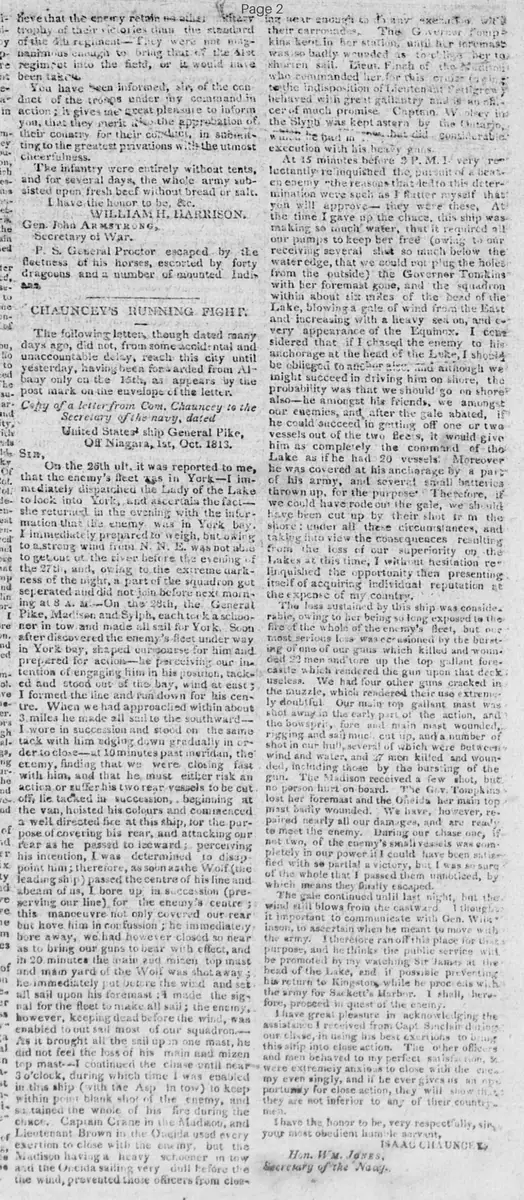
The following letters, though dated many days ago, did not, from some accidental and unaccountable delay, reach this city until yesterday, having been forwarded from Albany only on the 15th, as appears by the post mark on the envelope of the letter.
Copy of a letter from Com. Chauncey to the Secretary of the Navy, dated
United States ship General Pike,
Off Niagara, 1st Oct. 1813.
Sir,
On the 20th ult. it was reported to me, that the enemy's fleet was in York—I immediately dispatched the Lady of the Lake to look into York, and ascertain the fact—she returned in the evening with the information that the enemy was in York bay.
I immediately prepared to weigh, but owing to a strong wind from N. N. E. was not able to get out of the river before the evening of the 27th, and, owing to the extreme darkness of the night, a part of the squadron got separated and did not join before next morning at 8 A. M.—On the 28th, the General Pike, Madison and Sylph, each took a schooner in tow, and made all sail for York. Soon after discovered the enemy's fleet under way in York bay, shaped our course for him and prepared for action—he perceiving our intention of engaging him in his position, tacked and stood out of the bay, wind at east;
I formed the line and run down for his centre. When we had approached within about 3 miles he made all sail to the southward—I wore in succession and stood on the same tack with him riding down gradually in order to close—at 10 minutes past meridian, the enemy, finding that we were closing fast with him, and that he must either risk an action or suffer his two rear vessels to be cut off, he tacked in succession, beginning at the van, hoisted his colours and commenced a well directed fire at this ship, for the purpose of covering his rear, and attacking our rear as he passed to leeward; perceiving his intention, I was determined to disappoint him; therefore, as soon as the Wolf (the leading ship) passed the centre of his line and abeam of us, I bore up in Succession (preserving our line) for the enemy's centre; this manoeuvre not only covered our rear but threw him in confusion; he immediately bore away, we had however closed so near as to bring our guns to bear with effect, and in 20 minutes the main and mizen top mast and main yard of the Wolf was shot away; he immediately put before the wind and set all sail upon his foremast; I made the signal for the fleet to make all sail; the enemy however, keeping dead before the wind, was enabled to outsail most of our squadron.—
As it brought all the sail upon one mast, he did not feel the loss of his main and mizen top mast—I continued the chase until near 3 o'clock, during which time I was enabled in this ship (with the Asp in tow) to keep within point blank shot of the enemy, and sustained the whole of his fire during the chase. Captain Crane in the Madison, and Lieutenant Brown in the Oneida used every exertion to close with the enemy, but the Madison having a heavy schooner in tow and the Oneida sailing very dull before the wind, prevented those officers from closing near enough to do execution with their carronades. The Governor Tompkins kept in her station until her foremast was so badly wounded as to oblige her to shorten sail. Lieut. Finch of the Growler who commanded her for this cruise (owing to the indisposition of Lieutenant Pettigrew) behaved with great gallantry and is an officer of much promise. Captain Woolsey in the Sylph was kept astern by the Ontario, whom he had in tow—but did considerable execution with his heavy guns.
At 15 minutes before 3 P. M. I very reluctantly relinquished the pursuit of the enemy—the reasons that led to this determination were such as I flatter myself that you will approve—they were these, At the time I gave up the chase, this ship was making so much water, that it required all our pumps to keep her free (owing to our receiving several shot so much below the water edge, that we could not plug the holes from the outside) the Governor Tompkins with her foremast gone, and the squadron within about six miles of the end of the Lake, blowing a gale of wind from the East and increasing with a heavy sea on, and every appearance of the Equinox. I considered that if I chased the enemy to his anchorage at the head of the Lake, I should be obliged to anchor also, and although we might succeed in driving him on shore, the probability was that we should go on shore also—he amongst his Friends, we amongst our enemies, and after the gale abated, if he could succeed in getting off one or two vessels out of the two fleets, it would give him as completely the command of the Lake as if he had 20 vessels. Moreover he was covered at his anchorage by a part of his army, and several small batteries thrown up, for the purpose—Therefore, if we could have rode out the gale, we should have been cut up by their shot from the shore: under all these circumstances, and taking into view the consequences resulting from the loss of our superiority on the Lakes at this time, I without hesitation relinquished the opportunity then presenting itself of acquiring individual reputation at the expense of my country.
The loss sustained by this ship was considerable, owing to her being so long exposed to the fire of the whole of the enemy's fleet, but our most serious loss was occasioned by the bursting of one of our guns which killed and wounded 22 men and tore up the top gallant forecastle which rendered the gun upon that deck useless. We had four other guns cracked in the muzzle, which rendered their use extremely doubtful. Our main top gallant mast was shot away in the early part of the action, and the bowsprit, fore and main mast wounded, rigging and sails much cut up, and a number of shot in our hull, several of which were between wind and water, and 27 men killed and wounded, including those by the bursting of the gun. The Madison received a few shot, but no person hurt on board. The Gov. Tompkins lost her foremast and the Oneida her main top mast badly wounded. We have, however, repaired nearly all our damages, and are ready to meet the enemy. During our chase one, if not two, of the enemy's small vessels was completely in our power if I could have been satisfied with so partial a victory, but I was so sure of the whole that I passed them unnoticed, by which means they finally escaped.
The gale continued until last night, but the wind still blows from the eastward I thought it important to communicate with Gen. Wilkinson, to ascertain when he meant to move with the army. I therefore ran off this place for that purpose, and he thinks the public service will be promoted by my watching Sir James at the head of the Lake, and if possible preventing his return to Kingston while he proceeds with the army for Sacket's Harbor. I shall, therefore, proceed in quest of the enemy.
I have great pleasure in acknowledging the assistance I received from Capt. Sinclair during our chase, in using his best exertions to bring this ship into close action. The other officers and men behaved to my perfect satisfaction. They were extremely anxious to close with the enemy even singly, and if he ever gives us an opportunity for close action, they will show that they are not inferior to any of their countrymen.
I have the honor to be, very respectfully, sir, your most obedient humble servant,
ISAAC CHAUNCEY
Hon. WM. JONES,
Secretary of the Navy.
What sub-type of article is it?
What keywords are associated?
What entities or persons were involved?
Where did it happen?
Foreign News Details
Primary Location
Off Niagara
Event Date
28th Ult. 1813
Key Persons
Outcome
american: 27 killed and wounded, general pike heavily damaged including gun burst killing/wounding 22, masts and rigging wounded; governor tompkins lost foremast, oneida main top mast wounded. british: hms wolf lost main and mizen top masts and main yard; pursuit relinquished due to weather and risks.
Event Details
On September 28, 1813, Chauncey's squadron pursued the British fleet from York bay, engaging in a running fight. After maneuvering, they damaged the British lead ship Wolf, but the enemy outsailed most pursuers. Chase ended near 3 PM due to American ship damage, impending gale, and strategic concerns about losing lake superiority.