Thank you for visiting SNEWPapers!
Sign up free
Story
June 29, 1923
The Midland Journal
Rising Sun, Cecil County, Maryland
What is this article about?
The United States Department of Agriculture offers practical suggestions to clothing club members on buying and using commercial sewing patterns, covering sizing, alterations, cutting techniques, and material estimation.
Clipping
OCR Quality
98%
Excellent
Full Text
MIDLAND JOURNAL, RISING SUN. MD
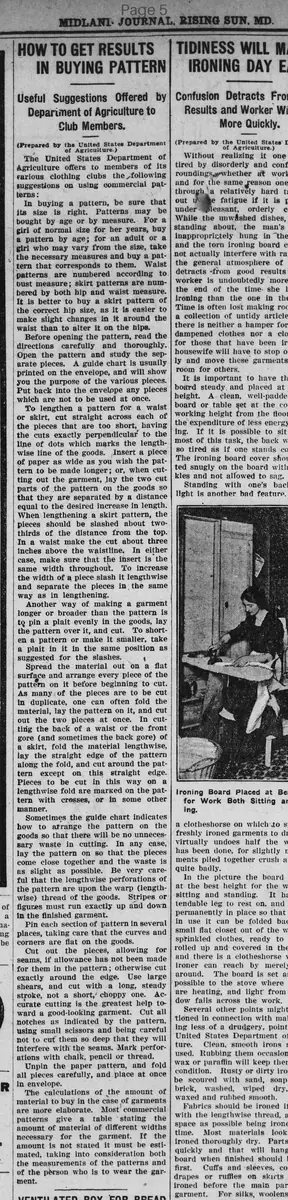
HOW TO GET RESULTS IN BUYING PATTERN
Useful Suggestions Offered by Department of Agriculture to Club Members.
(Prepared by the United States Department of Agriculture.)
The United States Department of Agriculture offers to members of its various clothing clubs the following suggestions on using commercial patterns:
In buying a pattern, be sure that its size is right. Patterns may be bought by age or by measure. For a girl of normal size for her years, buy a pattern by age; for an adult or a girl who may vary from the size, take the necessary measures and buy a pattern that corresponds to them. Waist patterns are numbered according to bust measure: skirt patterns are numbered by both hip and waist measure.
It is better to buy a skirt pattern of the correct hip size, as it is easier to make slight changes in it around the waist than to alter it on the hips.
Before opening the pattern, read the directions carefully and thoroughly. Open the pattern and study the separate pieces. A guide chart is usually printed on the envelope, and will show you the purpose of the various pieces. Put back into the envelope any pieces which are not to be used at once.
To lengthen a pattern for a waist or skirt, cut straight across each of the pieces that are too short, having the cuts exactly perpendicular to the line of dots which marks the lengthwise line of the goods. Insert a piece of paper as wide as you wish the pattern to be made longer; or, when cutting out the garment, lay the two cut parts of the pattern on the goods so that they are separated by a distance equal to the desired increase in length.
When lengthening a skirt pattern, the pieces should be slashed about two-thirds of the distance from the top. In a waist make the cut about three inches above the waistline. In either case, make sure that the insert is the same width throughout. To increase the width of a piece slash it lengthwise and separate the pieces in the same way as in lengthening.
Another way of making a garment longer or broader than the pattern is to pin a plait evenly in the goods, lay the pattern over it, and cut. To shorten a pattern or make it smaller, take a plait in it in the same position as suggested for the slashes.
Spread the material out on a flat surface and arrange every piece of the pattern on it before beginning to cut. As many of the pieces are to be cut in duplicate, one can often fold the material, lay the pattern on it, and cut out the two pieces at once. In cutting the back of a waist or the front gore (and sometimes the back gore) of a skirt, fold the material lengthwise, lay the straight edge of the pattern along the fold, and cut around the pattern except on this straight edge.
Pieces to be cut in this way on a lengthwise fold are marked on the pattern with crosses, or in some other manner.
Sometimes the guide chart indicates how to arrange the pattern on the goods so that there will be no unnecessary waste in cutting. In any case, lay the pattern on so that the pieces come close together and the waste is as slight as possible. Be very careful that the lengthwise perforations of the pattern are upon the warp (lengthwise) thread of the goods. Stripes or figures must run exactly up and down in the finished garment.
Pin each section of pattern in several places, taking care that the curves and corners are flat on the goods. Cut out the pieces, allowing for seams, if allowance has not been made for them in the pattern; otherwise cut exactly around the edge. Use large shears, and cut with a long, steady stroke, not a short, choppy one. Accurate cutting is the greatest help toward a good-looking garment. Cut all notches as indicated by the pattern, using small scissors and being careful not to cut them so deep that they will interfere with the seams. Mark perforations with chalk, pencil or thread.
Unpin the paper pattern, and fold all pieces carefully, and place at once in envelope.
The calculations of the amount of material to buy in the case of garments are more elaborate. Most commercial patterns give a table stating the amount of material of different widths necessary for the garment. If the amount is not stated it must be estimated, taking into consideration both the measurements of the patterns and of the person who is to wear the garment.
HOW TO GET RESULTS IN BUYING PATTERN
Useful Suggestions Offered by Department of Agriculture to Club Members.
(Prepared by the United States Department of Agriculture.)
The United States Department of Agriculture offers to members of its various clothing clubs the following suggestions on using commercial patterns:
In buying a pattern, be sure that its size is right. Patterns may be bought by age or by measure. For a girl of normal size for her years, buy a pattern by age; for an adult or a girl who may vary from the size, take the necessary measures and buy a pattern that corresponds to them. Waist patterns are numbered according to bust measure: skirt patterns are numbered by both hip and waist measure.
It is better to buy a skirt pattern of the correct hip size, as it is easier to make slight changes in it around the waist than to alter it on the hips.
Before opening the pattern, read the directions carefully and thoroughly. Open the pattern and study the separate pieces. A guide chart is usually printed on the envelope, and will show you the purpose of the various pieces. Put back into the envelope any pieces which are not to be used at once.
To lengthen a pattern for a waist or skirt, cut straight across each of the pieces that are too short, having the cuts exactly perpendicular to the line of dots which marks the lengthwise line of the goods. Insert a piece of paper as wide as you wish the pattern to be made longer; or, when cutting out the garment, lay the two cut parts of the pattern on the goods so that they are separated by a distance equal to the desired increase in length.
When lengthening a skirt pattern, the pieces should be slashed about two-thirds of the distance from the top. In a waist make the cut about three inches above the waistline. In either case, make sure that the insert is the same width throughout. To increase the width of a piece slash it lengthwise and separate the pieces in the same way as in lengthening.
Another way of making a garment longer or broader than the pattern is to pin a plait evenly in the goods, lay the pattern over it, and cut. To shorten a pattern or make it smaller, take a plait in it in the same position as suggested for the slashes.
Spread the material out on a flat surface and arrange every piece of the pattern on it before beginning to cut. As many of the pieces are to be cut in duplicate, one can often fold the material, lay the pattern on it, and cut out the two pieces at once. In cutting the back of a waist or the front gore (and sometimes the back gore) of a skirt, fold the material lengthwise, lay the straight edge of the pattern along the fold, and cut around the pattern except on this straight edge.
Pieces to be cut in this way on a lengthwise fold are marked on the pattern with crosses, or in some other manner.
Sometimes the guide chart indicates how to arrange the pattern on the goods so that there will be no unnecessary waste in cutting. In any case, lay the pattern on so that the pieces come close together and the waste is as slight as possible. Be very careful that the lengthwise perforations of the pattern are upon the warp (lengthwise) thread of the goods. Stripes or figures must run exactly up and down in the finished garment.
Pin each section of pattern in several places, taking care that the curves and corners are flat on the goods. Cut out the pieces, allowing for seams, if allowance has not been made for them in the pattern; otherwise cut exactly around the edge. Use large shears, and cut with a long, steady stroke, not a short, choppy one. Accurate cutting is the greatest help toward a good-looking garment. Cut all notches as indicated by the pattern, using small scissors and being careful not to cut them so deep that they will interfere with the seams. Mark perforations with chalk, pencil or thread.
Unpin the paper pattern, and fold all pieces carefully, and place at once in envelope.
The calculations of the amount of material to buy in the case of garments are more elaborate. Most commercial patterns give a table stating the amount of material of different widths necessary for the garment. If the amount is not stated it must be estimated, taking into consideration both the measurements of the patterns and of the person who is to wear the garment.
What sub-type of article is it?
Instructional Guide
Sewing Advice
What keywords are associated?
Sewing Patterns
Clothing Clubs
Pattern Sizing
Fabric Cutting
Garment Alteration
What entities or persons were involved?
United States Department Of Agriculture
Story Details
Key Persons
United States Department Of Agriculture
Story Details
Suggestions for clothing club members on selecting patterns by size or measure, altering for length and width, arranging and cutting fabric, and estimating material needs.