Thank you for visiting SNEWPapers!
Sign up free
Gazette Of The United States, & Philadelphia Daily Advertiser
Philadelphia, Philadelphia County, Pennsylvania
What is this article about?
A letter from Lower Saxony dated September 26, 1798, expresses skepticism about reports of Napoleon's retreat from Cairo, discusses threats to his army in Egypt including Ottoman hostility and climate, details Ottoman measures against the French, and reports the French fleet's heavy losses to Admiral Nelson: 5226 killed and 3705 prisoners.
Clipping
OCR Quality
Full Text
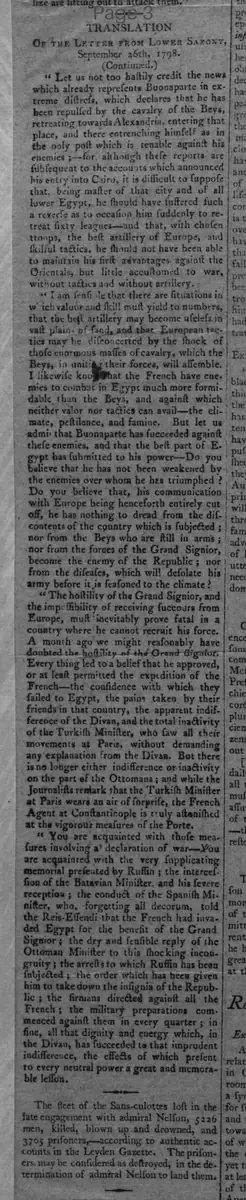
Of the Letter from Lower Saxony,
September 26th, 1798.
(Continued.)
"Let us not too hastily credit the news which already represents Buonaparte in extreme distress, which declares that he has been repulsed by the cavalry of the Beys, retreating towards Alexandria, entering that place, and there entrenching himself as in the only post which is tenable against his enemies;—for, although these reports are subsequent to the accounts which announced his entry into Cairo, it is difficult to suppose that, being master of that city and of all lower Egypt, he should have suffered such a reverse as to occasion him suddenly to retreat sixty leagues—and that, with chosen troops, the best artillery of Europe, and skillful tactics, he should not have been able to maintain his first advantages against the Orientals, but little accustomed to war, without tactics and without artillery.
"I am sensible that there are situations in which valour and skill must yield to numbers, that the best artillery may become useless in vast plains of sand, and that European tactics may be disconcerted by the shock of those enormous masses of cavalry, which the Beys, in uniting their forces, will assemble. I likewise know that the French have enemies to combat in Egypt much more formidable than the Beys, and against which neither valor nor tactics can avail—the climate, pestilence, and famine. But let us admit that Buonaparte has succeeded against these enemies, and that the best part of Egypt has submitted to his power—Do you believe that he has not been weakened by the enemies over whom he has triumphed? Do you believe that, his communication with Europe being henceforth entirely cut off, he has nothing to dread from the discontents of the country which is subjugated; nor from the Beys who are still in arms; nor from the forces of the Grand Signior, become the enemy of the Republic; nor from the diseases, which will desolate his army before it is seasoned to the climate?
"The hostility of the Grand Signior, and the impossibility of receiving succours from Europe, must inevitably prove fatal in a country where he cannot recruit his force. A month ago we might reasonably have doubted the hostility of the Grand Signior. Every thing led to a belief that he approved, or at least permitted the expedition of the French—the confidence with which they sailed to Egypt, the pains taken by their friends in that country, the apparent indifference of the Divan, and the total inactivity of the Turkish Minister, who saw all their movements at Paris, without demanding any explanation from the Divan. But there is no longer either indifference or inactivity on the part of the Ottomans; and while the Journalists remark that the Turkish Minister at Paris wears an air of surprise, the French Agent at Constantinople is truly astonished at the vigorous measures of the Porte.
"You are acquainted with those measures involving a declaration of war—You are acquainted with the very supplicating memorial presented by Rufin; the intercession of the Batavian Minister, and his severe reception; the conduct of the Spanish Minister, who, forgetting all decorum, told the Reis-Effendi that the French had invaded Egypt for the benefit of the Grand Signior; the dry and sensible reply of the Ottoman Minister to this shocking incongruity; the arrests to which Rufin has been subjected: the order which has been given him to take down the insignia of the Republic; the firmans directed against all the French; the military preparations commenced against them in every quarter; in fine, all that dignity and energy which, in the Divan, has succeeded to that imprudent indifference, the effects of which present to every neutral power a great and memorable lesson.
The fleet of the Sans-culottes lost in the late engagement with admiral Nelson, 5226 men, killed, blown up and drowned, and 3705 prisoners, according to authentic accounts in the Leyden Gazette. The prisoners, may be considered as destroyed, in the determination of admiral Nelson to land them."
What sub-type of article is it?
What keywords are associated?
What entities or persons were involved?
Where did it happen?
Foreign News Details
Primary Location
Egypt
Event Date
September 26th, 1798
Key Persons
Outcome
the fleet of the sans-culottes lost in the late engagement with admiral nelson, 5226 men, killed, blown up and drowned, and 3705 prisoners, according to authentic accounts in the leyden gazette. the prisoners, may be considered as destroyed, in the determination of admiral nelson to land them.
Event Details
Skepticism about reports of Buonaparte's retreat from Cairo after repulse by Beys' cavalry; discussion of threats to French army in Egypt including climate, pestilence, famine, discontents, remaining Beys, forces of the Grand Signior, and diseases; Ottoman declaration of war measures against French including supplicating memorial by Rufin, intercession by Batavian Minister, conduct of Spanish Minister, arrests of Rufin, orders to remove insignia, firmans against French, military preparations; loss of French fleet to Nelson.