Thank you for visiting SNEWPapers!
Sign up free
Literary
October 5, 1837
Watchman Of The South
Richmond, Virginia
What is this article about?
Excerpt from Dr. Green's lectures explaining the Shorter Catechism's definition of God's decrees as his eternal purpose foreordaining all events for his glory, drawing on Ephesians, Corinthians, and Romans; discusses theological implications of divine eternity; concludes with Dr. Watts' poem on God's timelessness.
Clipping
OCR Quality
98%
Excellent
Full Text
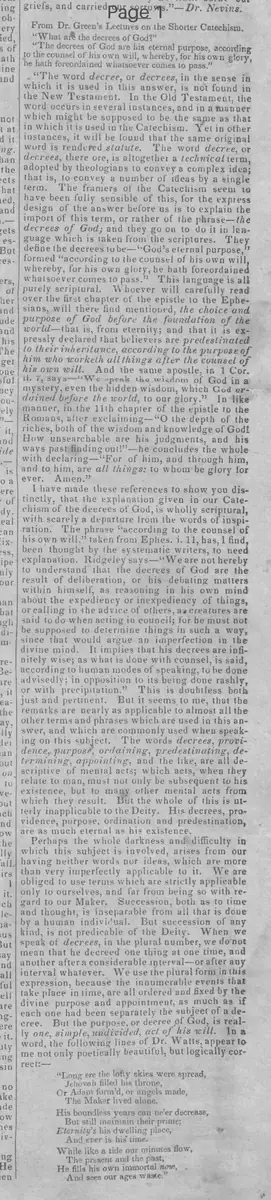
From Dr. Green's Lectures on the Shorter Catechism.
"What are the decrees of God?"
"The decrees of God are his eternal purpose, according to the counsel of his own will, whereby, for his own glory, he hath foreordained whatsoever comes to pass."
"The word decree, or decrees, in the sense in which it is used in this answer, is not found in the New Testament. In the Old Testament, the word occurs in several instances, and in a manner which might be supposed to be the same as that in which it is used in the Catechism. Yet in other instances, it will be found that the same original word is rendered statute. The word decree, or decrees, therefore, is altogether a technical term, adopted by theologians to convey a complex idea; that is, to convey a number of ideas by a single term. The framers of the Catechism seem to have been fully sensible of this, for the express design of the answer before us is to explain the import of this term, or rather of the phrase-the decrees of God; and they go on to do it in language which is taken from the scriptures. They define the decrees to be—"God's eternal purpose, formed "according to the counsel of his own will, whereby, for his own glory, he hath foreordained whatsoever comes to pass." This language is all purely scriptural. Whoever will carefully read over the first chapter of the epistle to the Ephesians, will there find mentioned, the choice and purpose of God before the foundation of the world-that is, from eternity; and that it is expressly declared that believers are predestinated to their inheritance, according to the purpose of him who worketh all things after the counsel of his own will. And the same apostle, in 1 Cor. II. 7, says—"We speak the wisdom of God in a mystery, even the hidden wisdom, which God ordained before the world, to our glory." In like manner, in the 11th chapter of the epistle to the Romans, after exclaiming—"O the depth of the riches, both of the wisdom and knowledge of God! How unsearchable are his judgments, and his ways past finding out!"—he concludes the whole with declaring—"For of him, and through him, and to him, are all things: to whom be glory forever. Amen."
I have made these references to show you distinctly, that the explanation given in our Catechism of the decrees of God, is wholly scriptural, with scarcely a departure from the words of inspiration. The phrase "according to the counsel of his own will," taken from Ephes. i. 11, has, I find, been thought by the systematic writers, to need explanation. Ridgeley says—"We are not hereby to understand that the decrees of God are the result of deliberation, or his debating matters within himself, as reasoning in his own mind about the expediency or inexpediency of things, or calling in the advice of others, as creatures are said to do when acting in council; for he must not be supposed to determine things in such a way, since that would argue an imperfection in the divine mind. It implies that his decrees are infinitely wise; as what is done with counsel, is said, according to human modes of speaking, to be done advisedly; in opposition to its being done rashly, or with precipitation." This is doubtless both just and pertinent. But it seems to me, that the remarks are nearly as applicable to almost all the other terms and phrases which are used in this answer, and which are commonly used when speaking on this subject. The words decrees, providence, purpose, ordaining, predestinating, determining, appointing, and the like, are all descriptive of mental acts; which acts, when they relate to man, must not only be subsequent to his existence, but to many other mental acts from which they result. But the whole of this is utterly inapplicable to the Deity. His decrees, providence, purpose, ordination and predestination, are as much eternal as his existence.
Perhaps the whole darkness and difficulty in which this subject is involved, arises from our having neither words nor ideas, which are more than very imperfectly applicable to it. We are obliged to use terms which are strictly applicable only to ourselves, and far from being so with regard to our Maker. Succession, both as to time and thought, is inseparable from all that is done by a human individual. But succession of any kind, is not predicable of the Deity. When we speak of decrees, in the plural number, we do not mean that he decreed one thing at one time, and another after a considerable interval-or after any interval whatever. We use the plural form in this expression. because the innumerable events that take place in time, are all ordered and fixed by the divine purpose and appointment, as much as if each one had been separately the subject of a decree. But the purpose, or decree of God, is really one, simple, undivided, act of his will. In a word, the following lines of Dr. Watts, appear to me not only poetically beautiful, but logically correct:-
"Long ere the lofty skies were spread,
Jehovah filled his throne,
Or Adam form'd, or angels made
The Maker lived alone.
His boundless years can ne'er decrease,
But still maintain their prime;
Eternity's his dwelling place,
And ever is his time.
While like a tide our minutes flow,
The present and the past,
He fills his own immortal now,
And sees our ages waste."
"What are the decrees of God?"
"The decrees of God are his eternal purpose, according to the counsel of his own will, whereby, for his own glory, he hath foreordained whatsoever comes to pass."
"The word decree, or decrees, in the sense in which it is used in this answer, is not found in the New Testament. In the Old Testament, the word occurs in several instances, and in a manner which might be supposed to be the same as that in which it is used in the Catechism. Yet in other instances, it will be found that the same original word is rendered statute. The word decree, or decrees, therefore, is altogether a technical term, adopted by theologians to convey a complex idea; that is, to convey a number of ideas by a single term. The framers of the Catechism seem to have been fully sensible of this, for the express design of the answer before us is to explain the import of this term, or rather of the phrase-the decrees of God; and they go on to do it in language which is taken from the scriptures. They define the decrees to be—"God's eternal purpose, formed "according to the counsel of his own will, whereby, for his own glory, he hath foreordained whatsoever comes to pass." This language is all purely scriptural. Whoever will carefully read over the first chapter of the epistle to the Ephesians, will there find mentioned, the choice and purpose of God before the foundation of the world-that is, from eternity; and that it is expressly declared that believers are predestinated to their inheritance, according to the purpose of him who worketh all things after the counsel of his own will. And the same apostle, in 1 Cor. II. 7, says—"We speak the wisdom of God in a mystery, even the hidden wisdom, which God ordained before the world, to our glory." In like manner, in the 11th chapter of the epistle to the Romans, after exclaiming—"O the depth of the riches, both of the wisdom and knowledge of God! How unsearchable are his judgments, and his ways past finding out!"—he concludes the whole with declaring—"For of him, and through him, and to him, are all things: to whom be glory forever. Amen."
I have made these references to show you distinctly, that the explanation given in our Catechism of the decrees of God, is wholly scriptural, with scarcely a departure from the words of inspiration. The phrase "according to the counsel of his own will," taken from Ephes. i. 11, has, I find, been thought by the systematic writers, to need explanation. Ridgeley says—"We are not hereby to understand that the decrees of God are the result of deliberation, or his debating matters within himself, as reasoning in his own mind about the expediency or inexpediency of things, or calling in the advice of others, as creatures are said to do when acting in council; for he must not be supposed to determine things in such a way, since that would argue an imperfection in the divine mind. It implies that his decrees are infinitely wise; as what is done with counsel, is said, according to human modes of speaking, to be done advisedly; in opposition to its being done rashly, or with precipitation." This is doubtless both just and pertinent. But it seems to me, that the remarks are nearly as applicable to almost all the other terms and phrases which are used in this answer, and which are commonly used when speaking on this subject. The words decrees, providence, purpose, ordaining, predestinating, determining, appointing, and the like, are all descriptive of mental acts; which acts, when they relate to man, must not only be subsequent to his existence, but to many other mental acts from which they result. But the whole of this is utterly inapplicable to the Deity. His decrees, providence, purpose, ordination and predestination, are as much eternal as his existence.
Perhaps the whole darkness and difficulty in which this subject is involved, arises from our having neither words nor ideas, which are more than very imperfectly applicable to it. We are obliged to use terms which are strictly applicable only to ourselves, and far from being so with regard to our Maker. Succession, both as to time and thought, is inseparable from all that is done by a human individual. But succession of any kind, is not predicable of the Deity. When we speak of decrees, in the plural number, we do not mean that he decreed one thing at one time, and another after a considerable interval-or after any interval whatever. We use the plural form in this expression. because the innumerable events that take place in time, are all ordered and fixed by the divine purpose and appointment, as much as if each one had been separately the subject of a decree. But the purpose, or decree of God, is really one, simple, undivided, act of his will. In a word, the following lines of Dr. Watts, appear to me not only poetically beautiful, but logically correct:-
"Long ere the lofty skies were spread,
Jehovah filled his throne,
Or Adam form'd, or angels made
The Maker lived alone.
His boundless years can ne'er decrease,
But still maintain their prime;
Eternity's his dwelling place,
And ever is his time.
While like a tide our minutes flow,
The present and the past,
He fills his own immortal now,
And sees our ages waste."
What sub-type of article is it?
Essay
Poem
What themes does it cover?
Religious
What keywords are associated?
Decrees Of God
Eternal Purpose
Shorter Catechism
Divine Eternity
Watts Poem
Scriptural Explanation
What entities or persons were involved?
Dr. Green
Literary Details
Author
Dr. Green
Subject
Explanation Of The Decrees Of God In The Shorter Catechism
Key Lines
"The Decrees Of God Are His Eternal Purpose, According To The Counsel Of His Own Will, Whereby, For His Own Glory, He Hath Foreordained Whatsoever Comes To Pass."
"Long Ere The Lofty Skies Were Spread,\Njehovah Filled His Throne,\Nor Adam Form'd, Or Angels Made\Nthe Maker Lived Alone."
"His Boundless Years Can Ne'er Decrease,\Nbut Still Maintain Their Prime;\Neternity's His Dwelling Place,\Nand Ever Is His Time."
"While Like A Tide Our Minutes Flow,\Nthe Present And The Past,\Nhe Fills His Own Immortal Now,\Nand Sees Our Ages Waste."