Thank you for visiting SNEWPapers!
Sign up free
Letter to Editor
October 17, 1804
The Enquirer
Richmond, Henrico County, Virginia
What is this article about?
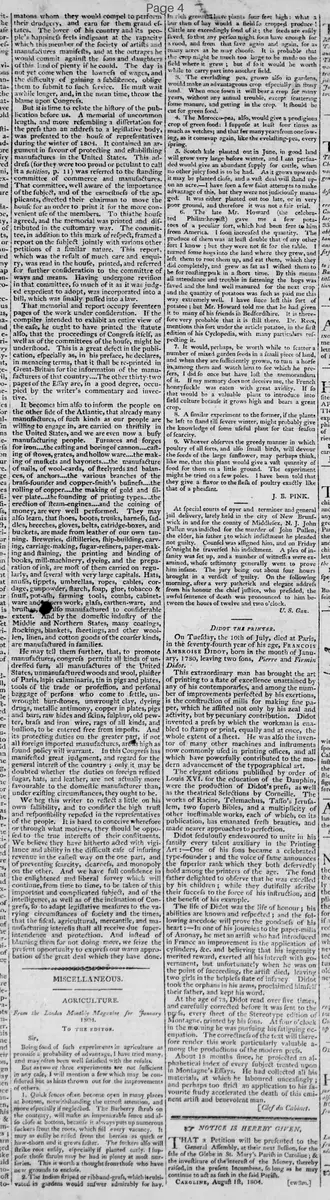
A letter from J. B. Pink to the editor of the London Monthly Magazine (January 1804) shares nine agricultural experiments, including barberry shrubs for impenetrable fences, Indian ribband-grass for hay, everlasting pea and Morocco pea for green food, Scotch kale for winter cattle feed, a special American potato for hogs, and sunflowers for poultry.
Clipping
OCR Quality
95%
Excellent
Full Text
MISCELLANEOUS.
AGRICULTURE.
From the London Monthly Magazine for January 1804.
TO THE EDITOR.
Sir,
Being fond of such experiments in agriculture as promise a probability of advantage, I have tried many, and have often been well satisfied with the results. But as two or three experiments are not sufficient in any case, I will mention a few which may be considered but as hints thrown out for the improvement of others.
1. Quick fences often become open in many places at bottom, notwithstanding the utmost attention, and more especially if neglected. The Barberry Shrub on the contrary, will make an impenetrable fence and also close at bottom, because it always puts up numerous suckers from the roots, which fill every vacancy. It may as easily be raised from the berries as quick or haw-thorn and it grows faster. The suckers also will strike root easily, especially if planted early. I suppose those shrubs may be had in plenty at most nurseries. This is worth a thought from those who have new grounds to enclose.
2. The Indian striped or ribband-grass, which is cultivated in gardens would answer admirably for hay. In rich ground I have plants four feet high: what a burden of hay would a field so cropped produce! Cattle are exceedingly fond of it; the seeds are easily saved, so that any person might soon have enough for a rood, and from that save again and again, for as many acres as he may choose. It is probable that the crop might be much too large to be made on the field where it grew; but if so it would be worth while to carry part into another field.
3. The everlasting pea, grown also in gardens, would make an advantageous crop especially in stony land. When once sown it will bear a crop for many years, without any annual trouble, except scattering some manure, and getting in the crop. It should be cut for green food.
4. The Morocco-pea, also, would give a prodigious crop of green food: I suppose at least four times as much as vetches; and that for many years from one sowing, as it comes up again, like the everlasting-pea, every spring.
5. Scotch kale planted out in June, in good land will grow very large before winter, and I am persuaded would give an abundant supply for cattle, when no other juicy food is to be had. As it grows upwards it may be planted close, and a vast deal will stand upon an acre. I have seen a few faint attempts to make advantage of this, but they were not judiciously managed. It was either planted out too late, or in very poor ground, and therefore it was not a fair trial.
6. The late Mr. Howard (the celebrated Philanthropist) gave me a few potatoes of a peculiar sort, which had been sent to him from America. I soon increased the quantity. The produce of them was at least double that of any other sort I know; but they were not fit for the table. I turned some hogs into the land where they grew, and left them to root them up, and eat them, which they did completely, and grew as fat as I wished them to be for roasting pork in a short time. By this means all attendance and trouble in fattening the hogs was saved and the land well manured for the next crop and the quantity of potatoes was such as paid me this way extremely well. I have since lost this sort of potatoe; but Mr. Howard told me that he had given it to many of his friends in Bedfordshire. It is therefore very probable that it is still there. Dr. Rees, mentions this sort under the article potatoe, in the first edition of his Cyclopedia, with many particulars respecting it.
7. It would, perhaps, be worth while to scatter a number of mixed garden seeds in a small piece of land, and when they are sufficiently grown, to turn a horse in among them and watch him to see which he prefers, I did so once but have lost the memorandum of it. If my memory does not deceive me, the French honeysuckle was eaten with great avidity. If so that would be a valuable plant to introduce into field culture because it grows high and bears a great crop.
8. A similar experiment to the former, if the plants be left to stand till severe winter, might probably give the knowledge of some useful plant for that season of scarcity.
9. Whoever observes the greedy manner in which poultry of all sorts, and also small birds, will devour the seeds of the large sunflower, may perhaps think, like me, that this plant would give a vast quantity of food for them on a little ground. The experiment might be tried on a few poles. I have been told that they give a flavor to the flesh of poultry exactly like that of a pheasant.
J. B. PINK.
AGRICULTURE.
From the London Monthly Magazine for January 1804.
TO THE EDITOR.
Sir,
Being fond of such experiments in agriculture as promise a probability of advantage, I have tried many, and have often been well satisfied with the results. But as two or three experiments are not sufficient in any case, I will mention a few which may be considered but as hints thrown out for the improvement of others.
1. Quick fences often become open in many places at bottom, notwithstanding the utmost attention, and more especially if neglected. The Barberry Shrub on the contrary, will make an impenetrable fence and also close at bottom, because it always puts up numerous suckers from the roots, which fill every vacancy. It may as easily be raised from the berries as quick or haw-thorn and it grows faster. The suckers also will strike root easily, especially if planted early. I suppose those shrubs may be had in plenty at most nurseries. This is worth a thought from those who have new grounds to enclose.
2. The Indian striped or ribband-grass, which is cultivated in gardens would answer admirably for hay. In rich ground I have plants four feet high: what a burden of hay would a field so cropped produce! Cattle are exceedingly fond of it; the seeds are easily saved, so that any person might soon have enough for a rood, and from that save again and again, for as many acres as he may choose. It is probable that the crop might be much too large to be made on the field where it grew; but if so it would be worth while to carry part into another field.
3. The everlasting pea, grown also in gardens, would make an advantageous crop especially in stony land. When once sown it will bear a crop for many years, without any annual trouble, except scattering some manure, and getting in the crop. It should be cut for green food.
4. The Morocco-pea, also, would give a prodigious crop of green food: I suppose at least four times as much as vetches; and that for many years from one sowing, as it comes up again, like the everlasting-pea, every spring.
5. Scotch kale planted out in June, in good land will grow very large before winter, and I am persuaded would give an abundant supply for cattle, when no other juicy food is to be had. As it grows upwards it may be planted close, and a vast deal will stand upon an acre. I have seen a few faint attempts to make advantage of this, but they were not judiciously managed. It was either planted out too late, or in very poor ground, and therefore it was not a fair trial.
6. The late Mr. Howard (the celebrated Philanthropist) gave me a few potatoes of a peculiar sort, which had been sent to him from America. I soon increased the quantity. The produce of them was at least double that of any other sort I know; but they were not fit for the table. I turned some hogs into the land where they grew, and left them to root them up, and eat them, which they did completely, and grew as fat as I wished them to be for roasting pork in a short time. By this means all attendance and trouble in fattening the hogs was saved and the land well manured for the next crop and the quantity of potatoes was such as paid me this way extremely well. I have since lost this sort of potatoe; but Mr. Howard told me that he had given it to many of his friends in Bedfordshire. It is therefore very probable that it is still there. Dr. Rees, mentions this sort under the article potatoe, in the first edition of his Cyclopedia, with many particulars respecting it.
7. It would, perhaps, be worth while to scatter a number of mixed garden seeds in a small piece of land, and when they are sufficiently grown, to turn a horse in among them and watch him to see which he prefers, I did so once but have lost the memorandum of it. If my memory does not deceive me, the French honeysuckle was eaten with great avidity. If so that would be a valuable plant to introduce into field culture because it grows high and bears a great crop.
8. A similar experiment to the former, if the plants be left to stand till severe winter, might probably give the knowledge of some useful plant for that season of scarcity.
9. Whoever observes the greedy manner in which poultry of all sorts, and also small birds, will devour the seeds of the large sunflower, may perhaps think, like me, that this plant would give a vast quantity of food for them on a little ground. The experiment might be tried on a few poles. I have been told that they give a flavor to the flesh of poultry exactly like that of a pheasant.
J. B. PINK.
What sub-type of article is it?
Informative
Persuasive
What themes does it cover?
Agriculture
What keywords are associated?
Agriculture Experiments
Barberry Fences
Ribband Grass Hay
Everlasting Pea
Morocco Pea
Scotch Kale
American Potato
Sunflower Poultry
French Honeysuckle
What entities or persons were involved?
J. B. Pink.
The Editor.
Letter to Editor Details
Author
J. B. Pink.
Recipient
The Editor.
Main Argument
the author shares nine agricultural experiments that have shown promising results and offers them as hints for others to improve their practices.
Notable Details
Barberry Shrub For Impenetrable Fences
Indian Ribband Grass For Hay
Everlasting Pea For Stony Land
Morocco Pea For Green Food
Scotch Kale For Winter Cattle Feed
Special American Potato For Hogs From Mr. Howard
Experiment With Horse Preferring French Honeysuckle
Sunflower Seeds For Poultry