Thank you for visiting SNEWPapers!
Sign up free
Editorial
June 22, 1850
New England Religious Herald
Hartford, Hartford County, Connecticut
What is this article about?
Editorial denouncing novel-reading as morally corrupting, citing Dr. Hawes on its incompatibility with Bible appreciation and serious duties, and Dr. Wayland on how fictional vice excites and develops corrupt moral character.
Clipping
OCR Quality
98%
Excellent
Full Text
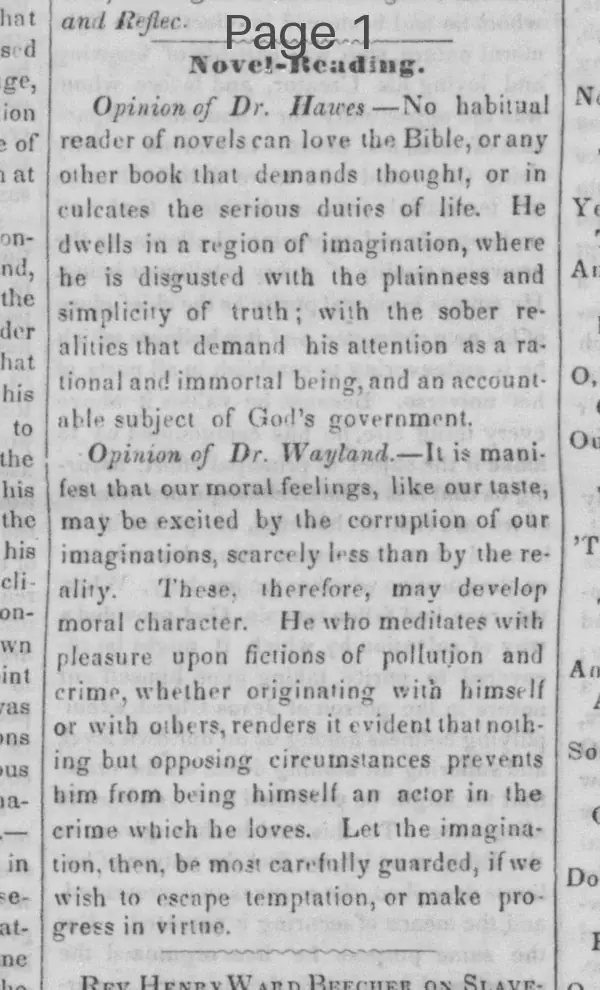
Novel-Reading.
Opinion of Dr. Hawes—No habitual reader of novels can love the Bible, or any other book that demands thought, or inculcates the serious duties of life. He dwells in a region of imagination, where he is disgusted with the plainness and simplicity of truth; with the sober realities that demand his attention as a rational and immortal being, and an accountable subject of God's government.
Opinion of Dr. Wayland.—It is manifest that our moral feelings, like our taste, may be excited by the corruption of our imaginations, scarcely less than by the reality. These, therefore, may develop moral character. He who meditates with pleasure upon fictions of pollution and crime, whether originating with himself or with others, renders it evident that nothing but opposing circumstances prevents him from being himself an actor in the crime which he loves. Let the imagination, then, be most carefully guarded, if we wish to escape temptation, or make progress in virtue.
Opinion of Dr. Hawes—No habitual reader of novels can love the Bible, or any other book that demands thought, or inculcates the serious duties of life. He dwells in a region of imagination, where he is disgusted with the plainness and simplicity of truth; with the sober realities that demand his attention as a rational and immortal being, and an accountable subject of God's government.
Opinion of Dr. Wayland.—It is manifest that our moral feelings, like our taste, may be excited by the corruption of our imaginations, scarcely less than by the reality. These, therefore, may develop moral character. He who meditates with pleasure upon fictions of pollution and crime, whether originating with himself or with others, renders it evident that nothing but opposing circumstances prevents him from being himself an actor in the crime which he loves. Let the imagination, then, be most carefully guarded, if we wish to escape temptation, or make progress in virtue.
What sub-type of article is it?
Moral Or Religious
What keywords are associated?
Novel Reading
Moral Corruption
Imagination
Bible
Virtue
Temptation
What entities or persons were involved?
Dr. Hawes
Dr. Wayland
Editorial Details
Primary Topic
Criticism Of Novel Reading For Moral And Religious Corruption
Stance / Tone
Strongly Condemnatory Of Novels
Key Figures
Dr. Hawes
Dr. Wayland
Key Arguments
Habitual Novel Readers Cannot Love The Bible Or Books Demanding Thought And Serious Duties
Novels Lead To Disgust With Truth's Plainness And Life's Sober Realities
Fictional Corruption Excites Moral Feelings Like Reality, Developing Corrupt Character
Pleasure In Fictional Crime Indicates Potential For Real Criminality
Imagination Must Be Guarded To Avoid Temptation And Progress In Virtue