Thank you for visiting SNEWPapers!
Sign up free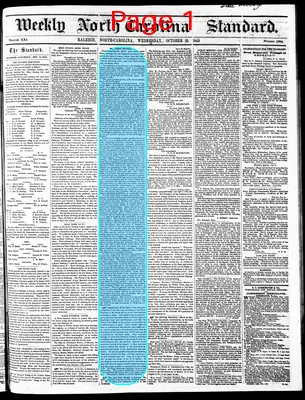
Weekly North Carolina Standard
Raleigh, Wake County, North Carolina
What is this article about?
Editorial from Boston Post excerpted and commented on, arguing the North's anti-slavery sectionalism is unconstitutional and unpatriotic, citing history of Missouri Compromise and statesmen's views; warns of Union dissolution; notes Georgia election win. (248 characters)
Clipping

OCR Quality
Full Text
Notwithstanding the fanatic spirit which, under Know Nothing rule, has disgraced the State of Massachusetts, there are many voices there still raised in behalf of the right and of a Constitutional Union. Read the following noble, just, and liberal article from the Boston Post:
"The Position of the North."—On Tuesday the Boston Atlas put a question, which it is earnestly hoped every citizen will thoroughly consider before he lends himself to a movement so conspicuous and alarming as that journal advocates, to wit: the formation of a great Northern sectional party. The question is this:
"The great question is not, is the South pleased, but is the North right?"
We agree to this form of putting the issue. Is the North right? Is it right in its present defiant attitude? Is it right in forming a party for national purposes in which the citizens of fifteen States in the Union cannot enrol themselves? Is it right in making the basis of this party to be an attack on one of the great interests—the slavery interest—which by the Constitution, was left to be dealt with by the States where it exists? It is a fact that these slave States refused to go into a union with the free States on the basis of the international law, that a slave reaching a free country became free; but stipulated that the fugitive should be returned; and this was, prior to the Constitution, put into the Northwestern ordinance. With this in view, is it right for the North to say that no slave shall be reclaimed from its soil? Is it any more right that this interest—a minority interest—should be attacked, in spite of the State rights limitation, than it would be if the navigation interest, or the manufacturing interest—both minority interests—should be attacked? In a word, is the North right in trying to sever the fraternal ties that connect the South and the North in the grand old common bond of country? We earnestly hope that each patriotic citizen will, in the feeling of a Washington patriotism—at least as near to it as he can get—put the question, Is the North right in all this?
To show more clearly in what position the North has been, let us go back a little, and state a question with scrupulous historical exactness. Bearing in mind that the Northwestern ordinance prohibiting slavery was passed before the adoption of the present constitution, we remark that, from 1789 up to 1820, no law was passed by Congress in relation to a prohibition of slavery in the Territories of the United States, and no State was excluded from the Union on account of slavery. It is true, discussions arose on this subject in Congress. Thus, Illinois and Indiana, when Territories, passed slavery laws—we mean laws recognizing and protecting slavery—notwithstanding the Northwestern ordinance; and when Illinois, in 1818, came in as a State, objection was raised to her admission on this ground, but it was sustained. We state facts that cannot be successfully controverted; and repeat that, from 1789 to 1820, no prohibitory law was passed relative to slavery, and no State was excluded on account of slavery.
In 1819-'20 the North took position that Missouri should not be admitted into the Union without having a restriction put upon her, prohibiting her from allowing slavery to exist within her limits; and the North announced this determination in resolutions passed by, we think, nearly every Northern legislature. And in this manner, the united North stood upon the position that Congress had the power to enact a perpetual prohibition on a sovereign State.
Was the North right in taking this position. To answer this fully would require elaborate argument, for the considerations bearing on it were so weighty as to involve the issue whether there should be a continuance of the old union of co-equal States, or whether a new union should be commenced of superior and inferior States. Rather than go over this ground, we prefer to state that statesmen as illustrious as the country has produced went into the argument, and have left on record answers to the question, was the North right in the position it took i.e., that of insisting on a prohibition on a sovereign State? These answers were given by Presidents Jefferson, Madison, Monroe, John Quincy Adams, Jackson, and Harrison: by a host of statesmen, from Henry Clay and John C. Calhoun, to those far inferior to them in talents and reputation; and these are all to the point that the North was not right! We challenge contradiction on this point. We affirm that the opinions of all the great men whose names we have given are directly opposed to the doctrines that Congress has power to impose a restriction on a sovereign State. They pronounced such restriction to be unconstitutional! If the judgments of these patriots and statesmen have weight, they show that in 1819-'20 the whole North stood upon the ground that was not tenable. It was ground marked out by clamor, passion, demagoguism, and not by reason, judgment, and a regard to the obligations to a common country.
We now return from the past to the present, and repeat that nothing can be more patriotic or more salutary than for each citizen to ask the question, is the North right? The course its majorities—thanks to Maine patriotism, one State excepted—are pursuing, inevitably tends to divide this noble country, to ruin its commerce and its manufacturers, to tear into halves its noble banner, and to make the first experiment the annals of the world afford of a great, self-governed people, to be a failure. Look, patriotic citizens, at the results of this American system thus far, after sixty-five years of trial of our Constitution! Is it possible that the North can be right to act the part of a parricide, and scorn the blessings which the Union confers? Can the North be right in throwing itself in the hands of the madmen tribe of Senator Wade, and proclaim that there is no Union? Will not patriotic instincts here in old Hancock and Adams Massachusetts, and everywhere in our country, compel citizens to pronounce the demagogues who thus play on feelings, and passions, and prejudices to be traitors?
Patriotic citizens! The voices from the past, the prosperous freedom of the present—all that is dear to humanity in the future—unite to proclaim that the North is not right in seeking to divide our noble country.
Judging from all the signs of the times, the probability is that the next movement of the Know Nothings of the South will be one of ultra devotion to Southern rights. The leaders must have perceived by this time that their Order in the free States is hopelessly fused and abolitionized; and that the Union of the States, so far as they are concerned as a national party, is gone. These leaders affect to have no confidence in the national Democratic party; and as, under the circumstances, they must do something for the country, they will be apt to go off to extremes for Southern rights. They may still struggle on with their Northern brethren, and labor to produce the impression on the minds of their deluded followers that the brethren referred to are sound and worthy to be trusted; or they may bow down in silence and submit to the threatened aggressions and insults of the abolitionists and free-soilers. No one can predict with absolute certainty what they will do—but they will bear watching.— As well calculate upon the "way of a ship in the sea" as upon the course of the K. N. leaders. Of one thing we may be assured, however, and that is, they will leave no means untried to deceive and mislead the people in order to advance their own selfish ends. Let every Democrat, therefore, keep an eye upon them. This is due to the South, to the cause of a Constitutional Union, and to the cause of morals. "The price of liberty is eternal vigilance."
The news from Georgia is glorious. We have carried the Governor by five thousand majority. Mr. Stephens, it is considered certain, is also re-elected.
What sub-type of article is it?
What themes does it cover?
What keywords are associated?
What entities or persons were involved?
Where did it happen?
Story Details
Key Persons
Location
Massachusetts, North, South, Missouri, Georgia
Event Date
1789 To 1820, 1819 20
Story Details
The article argues that the North is not right in its defiant anti-slavery attitude threatening the Union, recounts historical facts from 1789-1820 showing no prohibition on slavery in territories or exclusion of states, criticizes the North's 1819-20 position on Missouri as unconstitutional per great statesmen, warns against sectional parties and Know Nothings, and notes Democratic victory in Georgia.