Thank you for visiting SNEWPapers!
Sign up free
Alexandria Daily Gazette, Commercial & Political
Alexandria, Virginia
What is this article about?
On March 6, 1812, in the US House of Representatives, Mr. Randolph continues his speech opposing Mr. Rhea's motion to postpone a petition from Albany citizens against the embargo. He criticizes the majority's war push, highlights public division, lack of naval preparations, and the embargo's harms, warning of disaster without proper measures.
Clipping
OCR Quality
Full Text
March 6, 1812.
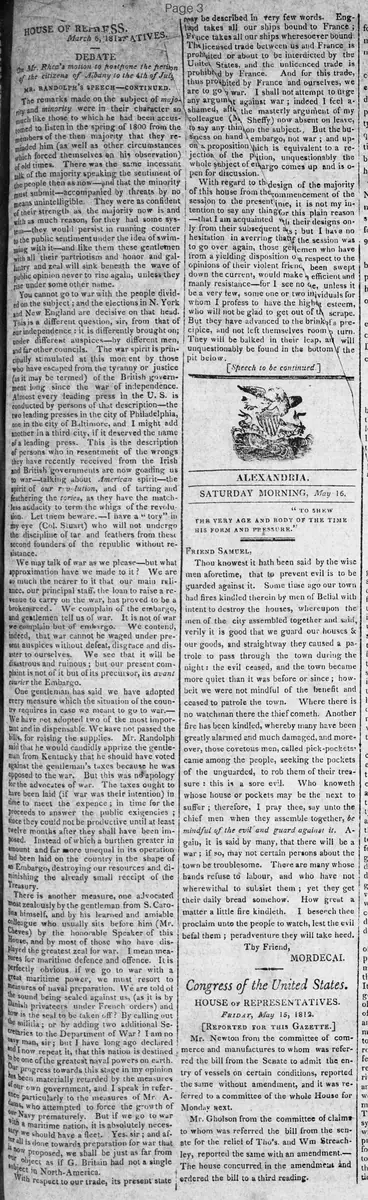
DEBATE
On Mr. Rhea's motion to postpone the petition of the citizens of Albany to the 4th of July
MR. RANDOLPH'S SPEECH--CONTINUED.
The remarks made on the subject of majority and minority were in their character so much like those to which he had been accustomed to listen in the spring of 1800 from the members of the then majority that they reminded him (as well as other circumstances which forced themselves on his observation) of old times. There was the same incessant talk of the majority speaking the sentiment of the people then as now--and that the minority must submit--accompanied by threats by no means unintelligible. They were as confident of their strength as the majority now is and with as much reason, for they had some system--they would persist in running counter to the public sentiment under the idea of swimming with it--and like them these gentlemen with all their patriotism and honor and gallantry and zeal will sink beneath the wave of public opinion never to rise again, unless they rise under some other name.
You cannot go to war with the people divided on the subject; and the elections in N. York and New England are decisive on that head.
This is a different question, sir, from that of our independence: it is differently brought on; under different auspices--by different men, and far other councils. The war spirit is principally stimulated at this moment by those who have escaped from the tyranny or justice (as it may be termed) of the British government long since the war of independence.
Almost every leading press in the U. S. is conducted by persons of that description--the two leading presses in the city of Philadelphia, one in the city of Baltimore, and I might add another in a third city, if it deserved the name of a leading press. This is the description of persons who in resentment of the wrongs they have recently received from the Irish and British governments are now goading us to war--talking about American spirit--the spirit of our revolution, and of tarring and feathering the tories, as they have the matchless audacity to term the whigs of the revolution. Let them beware.--I have a "tory" in my eye (Col. Stuart) who will not undergo the discipline of tar and feathers from these second founders of the republic without resistance.
We may talk of war as we please--but what approximation have we made to it? We are so much the nearer to it that our main reliance, our principal staff, the loan to raise a revenue to carry on the war, has proved to be a broken reed. We complain of the embargo, and gentlemen tell us of war. It is not of war we complain but of embargo. We contend, indeed, that war cannot be waged under present auspices without defeat, disgrace and disaster to ourselves. We see that it will be disastrous and ruinous; but our present complaint is not of it but of its precursor, its avant courier the Embargo.
One gentleman has said we have adopted every measure which the situation of the country requires in case we meant to go to war.--We have not adopted two of the most important and indispensable. We have not passed the bills, for raising the supplies. Mr. Randolph said that he would candidly apprise the gentleman from Kentucky that he should have voted against the gentleman's taxes because he was opposed to the war. But this was no apology for the advocates of war. The taxes ought to have been laid (if war was their intention) in time to meet the expense; in time for the proceeds to answer the public exigencies; since they could not be productive until at least twelve months after they shall have been imposed. Instead of which a burthen greater in amount and far more unequal in its operation had been laid on the country in the shape of an Embargo, destroying our resources and diminishing the already small receipt of the Treasury.
There is another measure, one advocated most zealously by the gentleman from S. Carolina himself, and by his learned and amiable colleague who usually sits before him (Mr. Cheves) by the honorable Speaker of this House, and by most of those who have displayed the greatest zeal for war. I mean measures of maritime defence and offence. It is perfectly obvious, if we go to war with a great maritime power, we must resort to measures of naval preparation. We are told of the sound being sealed against us, (as it is by Danish privateers under French orders) and how is the seal to be taken off? By calling out the militia; or by adding two additional Secretaries to the Department of War? I am no navy man, sir; but I have long ago declared and I now repeat it, that this nation is destined to be one of the greatest naval powers on earth.
Our progress towards this stage in my opinion has been materially retarded by the measures of our own government and I speak in reference particularly to the measures of Mr. Adams who attempted to force the growth of our Navy prematurely with a maritime nation, it is absolutely necessary we should have a fleet after all is done towards preparation for war that is now proposed we shall be just as far from our object as if G. Britain had not a single subject in North-America.
With respect to our trade, its present state may be described in very few words. England takes all our ships bound to France; France takes all our ships wheresoever bound. The licensed trade between us and France is prohibited or about to be interdicted by the United States, and the unlicensed trade is prohibited by France. And for this trade, thus prohibited by France and ourselves, we are to go to war. I shall not attempt to urge any argument against war; indeed I feel ashamed, after the masterly argument of my colleague (Mr. Sheffy) now absent on leave, to say anything on the subject. But the business on hand embargo, not war; and upon a proposition which is equivalent to a rejection of the petition, unquestionably the whole subject of embargo comes up and is open for discussion.
With regard to the design of the majority of this house from the commencement of the session to the present time, it is not my intention to say anything for this plain reason--that I am acquainted with their designs only from their subsequent acts; but I have no hesitation in averring that if the session was to go over again, those gentlemen who have from a yielding disposition or a respect to the opinions of their violent friends, been swept down the current, would make a more efficient and manly resistance--for I see no reason, unless it be a very few, some one or two individuals for whom I profess to have the highest esteem, who will not be glad to get out of the scrape. But they have advanced to the brink of a precipice, and not left themselves room to turn. They will be balked in their leap, and will unquestionably be found in the bottom of the pit below.
Speech to be continued.
What sub-type of article is it?
What themes does it cover?
What keywords are associated?
What entities or persons were involved?
Where did it happen?
Story Details
Key Persons
Location
House Of Representatives
Event Date
March 6, 1812
Story Details
Mr. Randolph critiques the majority's confidence in pushing for war despite public division, especially in New York and New England elections. He argues the current war spirit is driven by resentful immigrants and press, warns of unpreparedness without taxes and naval measures, criticizes the embargo as destructive, and predicts disaster for war advocates.