Thank you for visiting SNEWPapers!
Sign up free
Editorial
September 14, 1816
Richmond Enquirer
Richmond, Richmond County, Virginia
What is this article about?
Editorial from the National Intelligencer critiques the Federal Party's vague proposals for changing U.S. foreign and domestic policies, defending the Republican administration's equitable laws and arguing against unnecessary changes or Federal claims of superiority.
Clipping
OCR Quality
98%
Excellent
Full Text
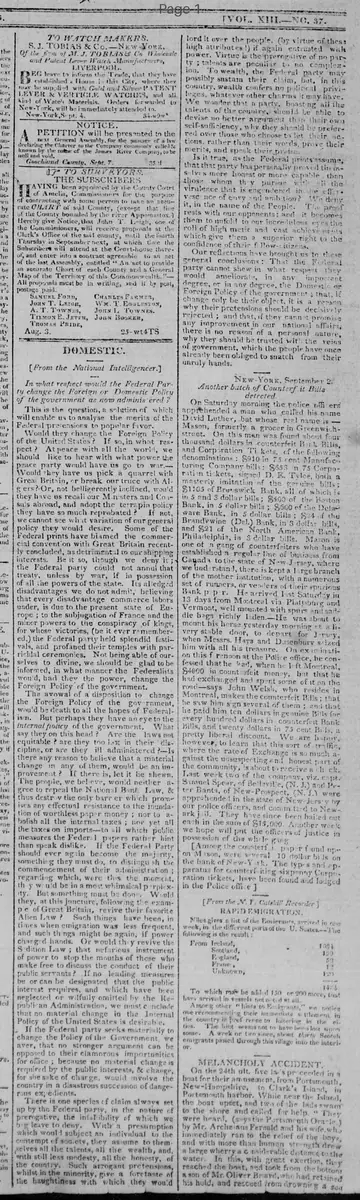
DOMESTIC.
[From the National Intelligencer.]
In what respect would the Federal Party change the Foreign or Domestic Policy of the government as now administered?
This is the question, a solution of which will enable us to analyse the merits of the Federal pretensions to popular favor.
Would they change the Foreign Policy of the United States? If so, in what respect? At peace with all the world, we should like to hear with what power the peace party would have us go to war.— Would they have us pick a quarrel with Great Britain, or break our truce with Algiers?—Or, not belligerently inclined, would they have us recall our Ministers and Consuls abroad, and adopt the terrapin policy they have so much reprobated? If not, we cannot see what variation of our general policy they would desire. Some of the Federal prints have blamed the commercial convention with Great Britain recently concluded, as detrimental to our shipping interests. Be it so, though we deny it; the Federal party could not annul that treaty, unless by war, if in possession of all the powers of the state. Its alleged disadvantages we do not admit, believing that every disadvantage commerce labors under, is due to the present state of Europe ; to the subjugation of France and the minor powers to the conspiracy of kings, for whose victories, (be it ever remembered,) the Federal party held splendid festivals, and profaned their temples with parricidal ceremonies. Not being able of ourselves to divine, we should be glad to be informed, in what manner the Federalists would, had they the power, change the Foreign Policy of the government.
The avowal of a disposition to change the Foreign Policy of the government, would be death to all their hopes of Federalism. But perhaps they have an eye to the internal policy of the government. What say they on this head? Are the laws not equitable? are they too lax in their discipline, or are they ill administered?—Is there any reason to believe that a material change in any of them, would be an improvement? If there is, let it be shewn.
The people, we believe, would neither agree to repeal the National Bank Law, & thus destroy the only barrier which promises any effectual resistance to the inundation of worthless paper money ; nor to abolish all the internal taxes; nor yet all the taxes on imports—to all which public measures the Federal papers rather hint than speak dislike. If the Federal Party should ever again become the majority, something they must do, to distinguish the commencement of their administration ; regarding which, were this the moment, they would be in a most whimsical perplexity. But something must be done. Would they, at this juncture, following the example of Great Britain, revive their favorite Alien Law? Such things have been, in times when emigration was less frequent, and such things might be again, if power changed hands. Or would they revive the Sedition Law ; that nefarious instrument of power to stop the mouths of those who make free to discuss the conduct of their public servants? If no leading measures be or can be designated that the public interest requires, and which have been neglected or wilfully omitted by the Republican Administration, we must conclude that no material change in the Internal Policy of the United States is desirable.
If the Federal party seeks materially to change the Policy of the Government, we aver, that no stronger argument can be opposed to their clamorous importunities for office ; because no material change is required by the public interests, & change for the sake of change, would involve the country in a disastrous succession of dangerous expedients.
There is one species of claim always set up by the Federal party, in the nature of prerogative, the infallibility of which we beg leave to deny. With a presumption which would subject an individual to the contempt of society, they assume to themselves all the talents, all the wealth, and, with still less modesty, all the honesty, of the country. Such arrogant pretensions, whilst in the minority, give a foretaste of the haughtiness with which they would lord it over the people. (by virtue of these high attributes!) if again entrusted with power. Virtue is the prerogative of no party ; talents are peculiar to no complexion. To wealth, the Federal party may possibly sustain their claim, but, in this country, wealth confers no political privileges, whatever other claims it may have.
We wonder that a party, boasting all the talents of the country, should be able to devise no better argument than their own self-sufficiency, why they should be preferred over those who choose to let their actions, rather than their words, prove their merits, and speak their praise.
Is it true, as the Federal prints assume, that that party has personally proved themselves more honest or more capable than those whom they pursue with all the virulence that is engendered in the cauldrons of envy and ambition? We deny it, in the name of the People. The proof rests with our opponents; and it becomes them to unfold to our incredulous eyes the roll of high merit and vast achievements which give them a superior right to the confidence of their fellow-citizens.
Our reflections have brought us to these general conclusions: That the Federal party cannot shew in what respect they would ameliorate, in any important degree, or in any degree, the Domestic or Foreign Policy of the government ; that, if change only be their object, it is a reason why their pretensions should be decisively rejected ; and that, if they cannot promise any improvement in our national affairs, there is no reason of a personal nature, why they should be trusted with the reins of government, which the people have once already been obliged to snatch from their unruly hands.
[From the National Intelligencer.]
In what respect would the Federal Party change the Foreign or Domestic Policy of the government as now administered?
This is the question, a solution of which will enable us to analyse the merits of the Federal pretensions to popular favor.
Would they change the Foreign Policy of the United States? If so, in what respect? At peace with all the world, we should like to hear with what power the peace party would have us go to war.— Would they have us pick a quarrel with Great Britain, or break our truce with Algiers?—Or, not belligerently inclined, would they have us recall our Ministers and Consuls abroad, and adopt the terrapin policy they have so much reprobated? If not, we cannot see what variation of our general policy they would desire. Some of the Federal prints have blamed the commercial convention with Great Britain recently concluded, as detrimental to our shipping interests. Be it so, though we deny it; the Federal party could not annul that treaty, unless by war, if in possession of all the powers of the state. Its alleged disadvantages we do not admit, believing that every disadvantage commerce labors under, is due to the present state of Europe ; to the subjugation of France and the minor powers to the conspiracy of kings, for whose victories, (be it ever remembered,) the Federal party held splendid festivals, and profaned their temples with parricidal ceremonies. Not being able of ourselves to divine, we should be glad to be informed, in what manner the Federalists would, had they the power, change the Foreign Policy of the government.
The avowal of a disposition to change the Foreign Policy of the government, would be death to all their hopes of Federalism. But perhaps they have an eye to the internal policy of the government. What say they on this head? Are the laws not equitable? are they too lax in their discipline, or are they ill administered?—Is there any reason to believe that a material change in any of them, would be an improvement? If there is, let it be shewn.
The people, we believe, would neither agree to repeal the National Bank Law, & thus destroy the only barrier which promises any effectual resistance to the inundation of worthless paper money ; nor to abolish all the internal taxes; nor yet all the taxes on imports—to all which public measures the Federal papers rather hint than speak dislike. If the Federal Party should ever again become the majority, something they must do, to distinguish the commencement of their administration ; regarding which, were this the moment, they would be in a most whimsical perplexity. But something must be done. Would they, at this juncture, following the example of Great Britain, revive their favorite Alien Law? Such things have been, in times when emigration was less frequent, and such things might be again, if power changed hands. Or would they revive the Sedition Law ; that nefarious instrument of power to stop the mouths of those who make free to discuss the conduct of their public servants? If no leading measures be or can be designated that the public interest requires, and which have been neglected or wilfully omitted by the Republican Administration, we must conclude that no material change in the Internal Policy of the United States is desirable.
If the Federal party seeks materially to change the Policy of the Government, we aver, that no stronger argument can be opposed to their clamorous importunities for office ; because no material change is required by the public interests, & change for the sake of change, would involve the country in a disastrous succession of dangerous expedients.
There is one species of claim always set up by the Federal party, in the nature of prerogative, the infallibility of which we beg leave to deny. With a presumption which would subject an individual to the contempt of society, they assume to themselves all the talents, all the wealth, and, with still less modesty, all the honesty, of the country. Such arrogant pretensions, whilst in the minority, give a foretaste of the haughtiness with which they would lord it over the people. (by virtue of these high attributes!) if again entrusted with power. Virtue is the prerogative of no party ; talents are peculiar to no complexion. To wealth, the Federal party may possibly sustain their claim, but, in this country, wealth confers no political privileges, whatever other claims it may have.
We wonder that a party, boasting all the talents of the country, should be able to devise no better argument than their own self-sufficiency, why they should be preferred over those who choose to let their actions, rather than their words, prove their merits, and speak their praise.
Is it true, as the Federal prints assume, that that party has personally proved themselves more honest or more capable than those whom they pursue with all the virulence that is engendered in the cauldrons of envy and ambition? We deny it, in the name of the People. The proof rests with our opponents; and it becomes them to unfold to our incredulous eyes the roll of high merit and vast achievements which give them a superior right to the confidence of their fellow-citizens.
Our reflections have brought us to these general conclusions: That the Federal party cannot shew in what respect they would ameliorate, in any important degree, or in any degree, the Domestic or Foreign Policy of the government ; that, if change only be their object, it is a reason why their pretensions should be decisively rejected ; and that, if they cannot promise any improvement in our national affairs, there is no reason of a personal nature, why they should be trusted with the reins of government, which the people have once already been obliged to snatch from their unruly hands.
What sub-type of article is it?
Partisan Politics
Foreign Affairs
Economic Policy
What keywords are associated?
Federal Party Critique
Foreign Policy
Domestic Policy
National Bank
Alien Sedition Laws
Partisan Politics
What entities or persons were involved?
Federal Party
Republican Administration
Great Britain
National Bank
Editorial Details
Primary Topic
Critique Of Federal Party's Policy Proposals
Stance / Tone
Strongly Anti Federal, Pro Republican
Key Figures
Federal Party
Republican Administration
Great Britain
National Bank
Key Arguments
No Need To Alter Foreign Policy Amid Peace
Current Domestic Laws Are Equitable And Well Administered
Opposition To Repealing National Bank Law Or Abolishing Taxes
Criticism Of Potential Revival Of Alien And Sedition Laws
Federal Claims Of Superior Talents, Wealth, And Honesty Are Arrogant And Unfounded