Thank you for visiting SNEWPapers!
Sign up free
The Virginia Gazette
Williamsburg, Virginia
What is this article about?
In a letter dated Boston, July 9, 1775, General Burgoyne responds to General Lee, defending his loyalist stance in the American conflict. He upholds the British constitution's supremacy of King in Parliament, argues against colonial resistance as subversion rather than restoration, and questions whether the war seeks tax relief or total independence.
Clipping
OCR Quality
Full Text
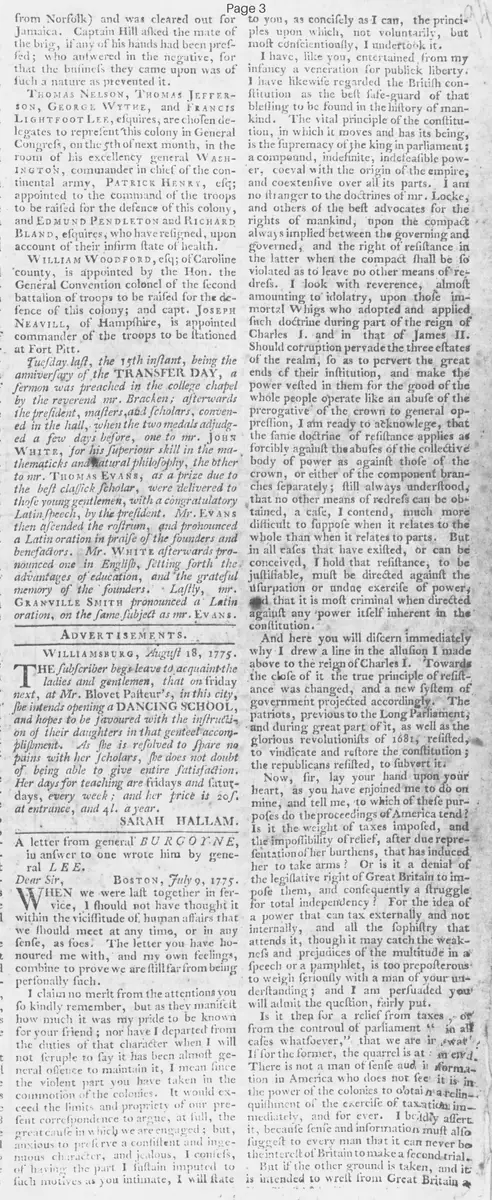
Dear Sir,
Boston, July 9, 1775.
When we were last together in service, I should not have thought it within the vicissitude of human affairs that we should meet at any time, or in any sense, as foes: The letter you have honoured me with, and my own feelings, combine to prove we are still far from being personally such.
I claim no merit from the attentions you so kindly remember, but as they manifest how much it was my pride to be known for your friend; nor have I departed from the duties of that character when I will not scruple to say it has been almost general offence to maintain it, I mean since the violent part you have taken in the commotion of the colonies. It would exceed the limits and propriety of our present correspondence to argue, at full, the great cause in which we are engaged; but, anxious to preserve a consistent and ingenuous character, and jealous, I confess, of having the part I sustain imputed to such motives as you intimate, I will state to you, as concisely as I can, the principles upon which, not voluntarily, but most conscientiously, I undertook it.
I have, like you, entertained from my infancy a veneration for publick liberty. I have likewise regarded the British constitution as the best safe-guard of that blessing to be found in the history of mankind. The vital principle of the constitution, in which it moves and has its being, is the supremacy of the king in parliament; a compound, indefinite, indefeasible power, coeval with the origin of the empire; and coextensive over all its parts. I am no stranger to the doctrines of Mr. Locke, and others of the best advocates for the rights of mankind, upon the compact always implied between the governing and governed, and the right of resistance in the latter when the compact shall be so violated as to leave no other means of redress. I look with reverence, almost amounting to idolatry, upon those immortal Whigs who adopted and applied such doctrine during part of the reign of Charles I. and in that of James II.
Should corruption pervade the three estates of the realm, so as to pervert the great ends of their institution, and make the power vested in them for the good of the whole people operate like an abuse of the prerogative of the crown to general oppression, I am ready to acknowledge, that the same doctrine of resistance applies as forcibly against the abuses of this collective body of power as against those of the crown, or either of the component branches separately; still always understood, that no other means of redress can be obtained, a case, I contend, much more difficult to suppose when it relates to the whole than when it relates to parts. But in all cases that have existed, or can be conceived, I hold that resistance, to be justifiable, must be directed against the usurpation or undue exercise of powers, and that it is most criminal when directed against any power itself inherent in the constitution.
And here you will discern immediately why I drew a line in the allusion I made above to the reign of Charles I. Towards the close of it the true principle of resistance was changed, and a new system of government projected accordingly. The patriots, previous to the Long Parliament, and during great part of it, as well as the glorious revolutionists of 1688, resisted, to vindicate and restore the constitution; the republicans resisted, to subvert it.
Now, sir, lay your hand upon your heart, as you have enjoined me to do on mine; and tell me, to which of these purposes do the proceedings of America tend? Is it the weight of taxes imposed, and the impossibility of relief, after due representation of her burthens, that has induced her to take arms? Or is it a denial of the legislative right of Great Britain to impose them, and consequently a struggle for total independency? For the idea of a power that can tax externally and not internally, and all the sophistry that attends it, though it may catch the weakness and prejudices of the multitude in a speech or a pamphlet, is too preposterous to weigh seriously with a man of your understanding; and I am persuaded you will admit the question, fairly put.
Is it then for a relief from taxes or from the controul of parliament "in all cases whatsoever," that we are at war? If for the former, the quarrel is at an end. There is not a man of sense and information in America who does not see it is in the power of the colonies to obtain a relinquishment of the exercise of taxation immediately, and for ever. I boldly assert it, because sense and information must also suggest to every man that it can never be the interest of Britain to make a second trial. But if the other ground is taken, and it is intended to wrest from Great Britain a
What sub-type of article is it?
What keywords are associated?
What entities or persons were involved?
Where did it happen?
Foreign News Details
Primary Location
Boston
Event Date
July 9, 1775
Key Persons
Event Details
General Burgoyne writes to General Lee defending his conscientious support for the British cause, venerating public liberty and the British constitution's supremacy of King in Parliament. He discusses doctrines of resistance from Locke and historical Whigs, arguing colonial resistance subverts rather than restores the constitution, and questions if the American struggle is for tax relief or total independence from parliamentary control.