Thank you for visiting SNEWPapers!
Sign up free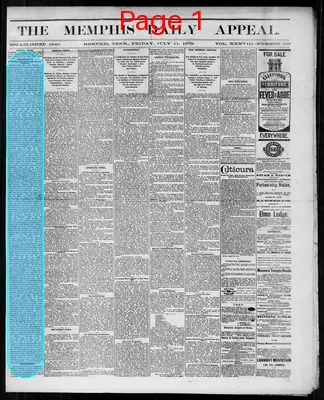
Story
July 11, 1879
Memphis Daily Appeal
Memphis, Shelby County, Tennessee
What is this article about?
Cotton market prices reported, followed by a detailed account of panic in Memphis over confirmed yellow fever cases, criticizing sensationalism and urging community self-help and preparation, referencing the 1878 epidemic.
Clipping

OCR Quality
95%
Excellent
Full Text
Yesterday's cotton: 6 7-8d; Memphis cotton, 11 7-8c; New Orleans cotton, 11 7-8c; New York cotton, 12 3-16c.
MEMPHIS AND THE PANIC OF YESTERDAY.
Memphis has again been subjected to panic, and fear and dread again dominate in all her business and social centers. The result of the autopsy on the body of Mulbrandon, on Wednesday afternoon, spread like wildfire, and, as is usual in such cases, it was made the basis for the wildest misstatements and the baldest lies. At the hotels, which are nightly thronged with business men, the dread news was discussed in the most excited manner, each one borrowing from the other until reason and common-sense were lost in an almost frenzy. Many, seized with panic at the first announcement, fled precipitately, taking the first trains on the Louisville or Charleston railroads. As late as twelve o'clock at night groups of persons were to be met with on the streets vainly endeavoring to discuss what admitted of no discussion, some eager to squeeze from a simple fact a crumb of comfort, most of them to find in it a stronger reason for the flight they thought it inspired. But put it as they would they could only make out of it a case of yellow-fever declared to be such by doctors who have the public confidence. Some, as was the case in each of the years when Memphis was invaded by plague and cursed by sensationalists, drew upon their imagination for cases that had no existence: and there were not wanting physicians who lead the loudest, and pitilessly warred upon the peace and security of which at such times they should be among the special guardians. One of these suddenly found himself in charge of five cases, every one of which, after careful examination by Dr. Thornton, the health officer, were pronounced not to be yellow-fever. Ignorance is said to be sometimes bliss; in this instance it was a curse that blighted and blasted all it touched, and assailed the integrity of a profession that in times of public peril by disease is the last hope, the last refuge of the helpless layman. The exaggerations of these men, whose title stamps with authority whatever they say touching disease, was eagerly caught up and the panic which had oscillated between two extremes gained an assured strength and went forward to its work of engulfing the courage and discretion of almost a whole population. Since the awful days of 1878, when the yellow-fever, as it usually does, moved with the rapidity of a powder train to which a match has suddenly been applied, nothing like the terrors of Wednesday night greeted our eyes until yesterday, when the demons of sensation resumed their work, as if insatiate and unappeasable by the almost craze to which our streets bore witness. Appeals were in vain. Each man acted as if he thought himself the special object of the vengeance of a fearful monster, to elude which flight, instant and rapid, was the only means. The lessons of the past were forgotten. The good name of the city, its trade, its future, the fate of its poor, all these were sunk under the one consideration of personal safety. And all this sensation, excitement, worry and trouble, by which homes have been broken up, and a sense of insecurity for the future as well as the present, has been engendered, rests upon four cases of yellow-fever, three of which were reported to the board of health only after the autopsy which decided so dreadful, so awful a fate for Memphis again. All this upon four cases which, though six days have passed since the first was taken, have not spread beyond the residences of the parties, and though finding three victims in one family has, so far, failed of any effect among the nine children of Mulbrandon. Brief as the time has been since we emerged from the death and gloom of the phenomenal epidemic of 1878—only eight months—we seem to have forgotten it all, to have been eased of all disposition to cool and dispassionate inquiry, and to be the mere creatures of our fears. No one of all the throng that yesterday surged upon our highways, like an eager wave, uttered one word for the poor or asked to take counsel for the safety of property and life. They seemed to take it for granted that the great world whose charity came to us in unstinted abundance last, will this year pour upon us again in measure proportioned to our needs. They seemed to rest content that a suppliant attitude as beggars becomes a community whose pride can so readily yield to panic. But the great world is too busy with its own concerns—its trials and tribulations, its sorrows and its woes—to permit itself to be annoyed every year by a community that has proven its capacity for self-help in every other respect—a community that has faced civil war and cheerfully surrendered its private property to secure a victory. We cannot again appeal to the government for rations and for tents: we cannot expect that the great cities of our own country, or of Europe, will again make our plaint the text for appealing sermons for aid for a sorely stricken people. The suddenness and severity of the plague of last year, like any other of the awful visitations that have wrecked communities and brought disaster to nations, spoke for us as with a million eloquent tongues. Warned by it, it will be expected of us that, if there is really furnished us this summer occasion for panic, we will be able to take care of ourselves, and furnish proof, in the worst of all emergencies, of our capacity for self-help in adversity as well as prosperity. The poor who cannot go away must either be sent away at our expense, and maintained away; or if, in cold blood, we abandon them to such a fate as that of last summer, we may look for consequences such as a few discreet, brave men then saved us from. Perhaps to-day, when it is seen that the four cases have not, like the gourd that sprung up in a night, increased to forty, to four hundred, or four thousand, the men who have property in houses, in lands, tenements and goods, will take time to deliberate, and, if an emergency of epidemic is imminent, provide the ways and means at once to save the lives and provide for those whose condition as that of merely daily bread-winners leaves them utterly helpless. This we submit, is worthy of thought, and while we are waiting for the fever to breed beyond the four cases or perish in them, we suggest that panic give way to reason, that, like sensible men, we take counsel as becomes us and provide for the future that the sensationalists have in store for us, as if we believed it—provide in a spirit as if of perfect independence of the world, as if we had learned at least one lesson of the epidemic of 1878.
THE APPEAL solicits from its friends in the States of Arkansas, Alabama and Mississippi, as well as from West Tennessee, letters as to the crops, new or contemplated improvements or industries, political affairs, or anything that is of interest to the people.
MEMPHIS AND THE PANIC OF YESTERDAY.
Memphis has again been subjected to panic, and fear and dread again dominate in all her business and social centers. The result of the autopsy on the body of Mulbrandon, on Wednesday afternoon, spread like wildfire, and, as is usual in such cases, it was made the basis for the wildest misstatements and the baldest lies. At the hotels, which are nightly thronged with business men, the dread news was discussed in the most excited manner, each one borrowing from the other until reason and common-sense were lost in an almost frenzy. Many, seized with panic at the first announcement, fled precipitately, taking the first trains on the Louisville or Charleston railroads. As late as twelve o'clock at night groups of persons were to be met with on the streets vainly endeavoring to discuss what admitted of no discussion, some eager to squeeze from a simple fact a crumb of comfort, most of them to find in it a stronger reason for the flight they thought it inspired. But put it as they would they could only make out of it a case of yellow-fever declared to be such by doctors who have the public confidence. Some, as was the case in each of the years when Memphis was invaded by plague and cursed by sensationalists, drew upon their imagination for cases that had no existence: and there were not wanting physicians who lead the loudest, and pitilessly warred upon the peace and security of which at such times they should be among the special guardians. One of these suddenly found himself in charge of five cases, every one of which, after careful examination by Dr. Thornton, the health officer, were pronounced not to be yellow-fever. Ignorance is said to be sometimes bliss; in this instance it was a curse that blighted and blasted all it touched, and assailed the integrity of a profession that in times of public peril by disease is the last hope, the last refuge of the helpless layman. The exaggerations of these men, whose title stamps with authority whatever they say touching disease, was eagerly caught up and the panic which had oscillated between two extremes gained an assured strength and went forward to its work of engulfing the courage and discretion of almost a whole population. Since the awful days of 1878, when the yellow-fever, as it usually does, moved with the rapidity of a powder train to which a match has suddenly been applied, nothing like the terrors of Wednesday night greeted our eyes until yesterday, when the demons of sensation resumed their work, as if insatiate and unappeasable by the almost craze to which our streets bore witness. Appeals were in vain. Each man acted as if he thought himself the special object of the vengeance of a fearful monster, to elude which flight, instant and rapid, was the only means. The lessons of the past were forgotten. The good name of the city, its trade, its future, the fate of its poor, all these were sunk under the one consideration of personal safety. And all this sensation, excitement, worry and trouble, by which homes have been broken up, and a sense of insecurity for the future as well as the present, has been engendered, rests upon four cases of yellow-fever, three of which were reported to the board of health only after the autopsy which decided so dreadful, so awful a fate for Memphis again. All this upon four cases which, though six days have passed since the first was taken, have not spread beyond the residences of the parties, and though finding three victims in one family has, so far, failed of any effect among the nine children of Mulbrandon. Brief as the time has been since we emerged from the death and gloom of the phenomenal epidemic of 1878—only eight months—we seem to have forgotten it all, to have been eased of all disposition to cool and dispassionate inquiry, and to be the mere creatures of our fears. No one of all the throng that yesterday surged upon our highways, like an eager wave, uttered one word for the poor or asked to take counsel for the safety of property and life. They seemed to take it for granted that the great world whose charity came to us in unstinted abundance last, will this year pour upon us again in measure proportioned to our needs. They seemed to rest content that a suppliant attitude as beggars becomes a community whose pride can so readily yield to panic. But the great world is too busy with its own concerns—its trials and tribulations, its sorrows and its woes—to permit itself to be annoyed every year by a community that has proven its capacity for self-help in every other respect—a community that has faced civil war and cheerfully surrendered its private property to secure a victory. We cannot again appeal to the government for rations and for tents: we cannot expect that the great cities of our own country, or of Europe, will again make our plaint the text for appealing sermons for aid for a sorely stricken people. The suddenness and severity of the plague of last year, like any other of the awful visitations that have wrecked communities and brought disaster to nations, spoke for us as with a million eloquent tongues. Warned by it, it will be expected of us that, if there is really furnished us this summer occasion for panic, we will be able to take care of ourselves, and furnish proof, in the worst of all emergencies, of our capacity for self-help in adversity as well as prosperity. The poor who cannot go away must either be sent away at our expense, and maintained away; or if, in cold blood, we abandon them to such a fate as that of last summer, we may look for consequences such as a few discreet, brave men then saved us from. Perhaps to-day, when it is seen that the four cases have not, like the gourd that sprung up in a night, increased to forty, to four hundred, or four thousand, the men who have property in houses, in lands, tenements and goods, will take time to deliberate, and, if an emergency of epidemic is imminent, provide the ways and means at once to save the lives and provide for those whose condition as that of merely daily bread-winners leaves them utterly helpless. This we submit, is worthy of thought, and while we are waiting for the fever to breed beyond the four cases or perish in them, we suggest that panic give way to reason, that, like sensible men, we take counsel as becomes us and provide for the future that the sensationalists have in store for us, as if we believed it—provide in a spirit as if of perfect independence of the world, as if we had learned at least one lesson of the epidemic of 1878.
THE APPEAL solicits from its friends in the States of Arkansas, Alabama and Mississippi, as well as from West Tennessee, letters as to the crops, new or contemplated improvements or industries, political affairs, or anything that is of interest to the people.
What sub-type of article is it?
Disaster
Historical Event
Medical Curiosity
What themes does it cover?
Catastrophe
Misfortune
Moral Virtue
What keywords are associated?
Yellow Fever
Memphis Panic
Epidemic Fear
Sensationalism
Self Help
1878 Epidemic
What entities or persons were involved?
Mulbrandon
Dr. Thornton
Where did it happen?
Memphis
Story Details
Key Persons
Mulbrandon
Dr. Thornton
Location
Memphis
Event Date
Yesterday; Wednesday; 1878 (Eight Months Prior)
Story Details
Panic grips Memphis following autopsy confirming yellow fever in Mulbrandon's family, leading to exaggerated rumors, flights from the city, and criticism of sensationalism; only four cases reported, none spreading further; editorial urges self-reliance and preparation instead of relying on external aid, recalling the 1878 epidemic.