Thank you for visiting SNEWPapers!
Sign up free
Letter to Editor
February 12, 1881
The Weekly Visitor
Providence, Providence County, Rhode Island
What is this article about?
George Howe defends the Irish Land League against criticism in the Journal, asserting that land rights are universal under Christian law, condemning landlords as thieves who monopolize others' labor, and calling for revision of unjust US laws.
Clipping
OCR Quality
95%
Excellent
Full Text
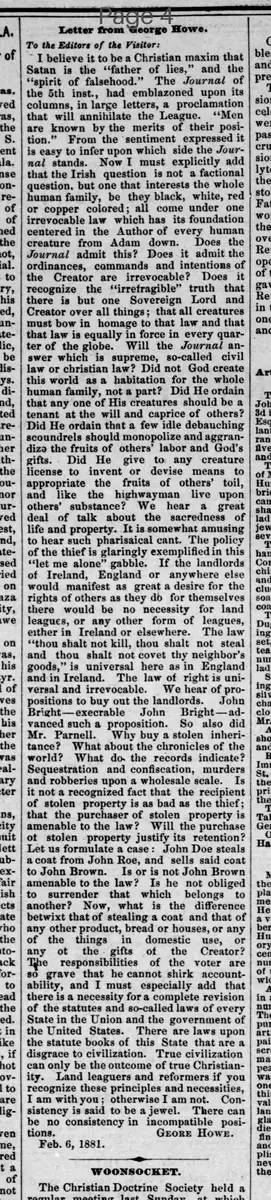
Letter from George Howe.
To the Editors of the Visitor:
I believe it to be a Christian maxim that Satan is the "father of lies," and the "spirit of falsehood." The Journal of the 5th inst., had emblazoned upon its columns, in large letters, a proclamation that will annihilate the League. "Men are known by the merits of their position." From the sentiment expressed it is easy to infer upon which side the Journal stands. Now I must explicitly add that the Irish question is not a factional question, but one that interests the whole human family, be they black, white, red or copper colored; all come under one irrevocable law which has its foundation centered in the Author of every human creature from Adam down.
Does the Journal admit this? Does it admit the ordinances, commands and intentions of the Creator are irrevocable? Does it recognize the "irrefragible" truth that there is but one Sovereign Lord and Creator over all things; that all creatures must bow in homage to that law and that that law is equally in force in every quarter of the globe?
Will the Journal answer which is supreme, so-called civil law or Christian law? Did not God create this world as a habitation for the whole human family, not a part? Did He ordain that any one of His creatures should be a tenant at the will and caprice of others? Did He ordain that a few idle debauching scoundrels should monopolize and aggrandize the fruits of others' labor and God's gifts? Did He give to any creature license to invent or devise means to appropriate the fruits of others' toil, and like the highwayman live upon others' substance? We hear a great deal of talk about the sacredness of life and property. It is somewhat amusing to hear such pharisaical cant. The policy of the thief is glaringly exemplified in this "let me alone" gabble. If the landlords of Ireland, England or anywhere else would manifest as great a desire for the rights of others as they do for themselves there would be no necessity for land leagues, or any other form of leagues, either in Ireland or elsewhere. The law "thou shalt not kill, thou shalt not steal and thou shalt not covet thy neighbor's goods," is universal here as in England and in Ireland. The law of right is universal and irrevocable. We hear of propositions to buy out the landlords, John Bright—execrable John Bright—advanced such a proposition. So also did Mr. Parnell.
Why buy a stolen inheritance? What about the chronicles of the world? What do the records indicate? Sequestration and confiscation, murder and robberies upon a wholesale scale. Is it not a recognized fact that the recipient of stolen property is as bad as the thief; that the purchaser of stolen property is amenable to the law? Will the purchase of stolen property justify its retention?
Let us formulate a case: John Doe steals a coat from John Roe, and sells said coat to John Brown. Is or is not John Brown amenable to the law? Is he not obliged to surrender that which belongs to another? Now, what is the difference betwixt that of stealing a coat and that of any other product, bread or houses, or any of the things in domestic use, any of the gifts of the Creator?
The responsibilities of the voter are so grave that he cannot shirk accountability, and I must especially add that there is a necessity for a complete revision of the statutes and so-called laws of every State in the Union and the government of the United States.
There are laws upon the statute books of this State that are a disgrace to civilization. True civilization can only be the outcome of true Christianity. Land leaguers and reformers if you recognize these principles and necessities, I am with you; otherwise I am not. Consistency is said to be a jewel. There can be no consistency in incompatible positions.
George Howe.
Feb. 6, 1881.
Woonsocket.
To the Editors of the Visitor:
I believe it to be a Christian maxim that Satan is the "father of lies," and the "spirit of falsehood." The Journal of the 5th inst., had emblazoned upon its columns, in large letters, a proclamation that will annihilate the League. "Men are known by the merits of their position." From the sentiment expressed it is easy to infer upon which side the Journal stands. Now I must explicitly add that the Irish question is not a factional question, but one that interests the whole human family, be they black, white, red or copper colored; all come under one irrevocable law which has its foundation centered in the Author of every human creature from Adam down.
Does the Journal admit this? Does it admit the ordinances, commands and intentions of the Creator are irrevocable? Does it recognize the "irrefragible" truth that there is but one Sovereign Lord and Creator over all things; that all creatures must bow in homage to that law and that that law is equally in force in every quarter of the globe?
Will the Journal answer which is supreme, so-called civil law or Christian law? Did not God create this world as a habitation for the whole human family, not a part? Did He ordain that any one of His creatures should be a tenant at the will and caprice of others? Did He ordain that a few idle debauching scoundrels should monopolize and aggrandize the fruits of others' labor and God's gifts? Did He give to any creature license to invent or devise means to appropriate the fruits of others' toil, and like the highwayman live upon others' substance? We hear a great deal of talk about the sacredness of life and property. It is somewhat amusing to hear such pharisaical cant. The policy of the thief is glaringly exemplified in this "let me alone" gabble. If the landlords of Ireland, England or anywhere else would manifest as great a desire for the rights of others as they do for themselves there would be no necessity for land leagues, or any other form of leagues, either in Ireland or elsewhere. The law "thou shalt not kill, thou shalt not steal and thou shalt not covet thy neighbor's goods," is universal here as in England and in Ireland. The law of right is universal and irrevocable. We hear of propositions to buy out the landlords, John Bright—execrable John Bright—advanced such a proposition. So also did Mr. Parnell.
Why buy a stolen inheritance? What about the chronicles of the world? What do the records indicate? Sequestration and confiscation, murder and robberies upon a wholesale scale. Is it not a recognized fact that the recipient of stolen property is as bad as the thief; that the purchaser of stolen property is amenable to the law? Will the purchase of stolen property justify its retention?
Let us formulate a case: John Doe steals a coat from John Roe, and sells said coat to John Brown. Is or is not John Brown amenable to the law? Is he not obliged to surrender that which belongs to another? Now, what is the difference betwixt that of stealing a coat and that of any other product, bread or houses, or any of the things in domestic use, any of the gifts of the Creator?
The responsibilities of the voter are so grave that he cannot shirk accountability, and I must especially add that there is a necessity for a complete revision of the statutes and so-called laws of every State in the Union and the government of the United States.
There are laws upon the statute books of this State that are a disgrace to civilization. True civilization can only be the outcome of true Christianity. Land leaguers and reformers if you recognize these principles and necessities, I am with you; otherwise I am not. Consistency is said to be a jewel. There can be no consistency in incompatible positions.
George Howe.
Feb. 6, 1881.
Woonsocket.
What sub-type of article is it?
Persuasive
Ethical Moral
Religious
What themes does it cover?
Politics
Morality
Religion
What keywords are associated?
Irish Land League
Christian Law
Landlords Theft
Universal Rights
John Bright
Parnell
Legal Reform
What entities or persons were involved?
George Howe
To The Editors Of The Visitor
Letter to Editor Details
Author
George Howe
Recipient
To The Editors Of The Visitor
Main Argument
the irish land question concerns universal human rights under irrevocable christian law, which supersedes civil law; landlords are thieves monopolizing god's gifts, and unjust laws must be revised in the us to align with true christianity.
Notable Details
References Satan As Father Of Lies
Criticizes Journal's Proclamation Against The League
Analogy Of Stolen Coat To Stolen Land
Mentions John Bright And Mr. Parnell
Calls For Revision Of Us Statutes