Thank you for visiting SNEWPapers!
Sign up free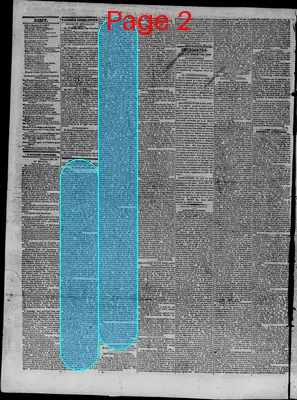
The Intelligencer, & Petersburg Commercial Advertiser
Petersburg, Virginia
What is this article about?
Thomas H. Benton explains to Henry St. George Tucker the 1826 duel between John Randolph and Henry Clay near the Potomac River in Virginia, detailing Randolph's initial intent not to fire, an accidental discharge, the exchange of shots, and their reconciliation, vindicating Randolph's honor and respect for Virginia law.
Clipping
OCR Quality
Full Text
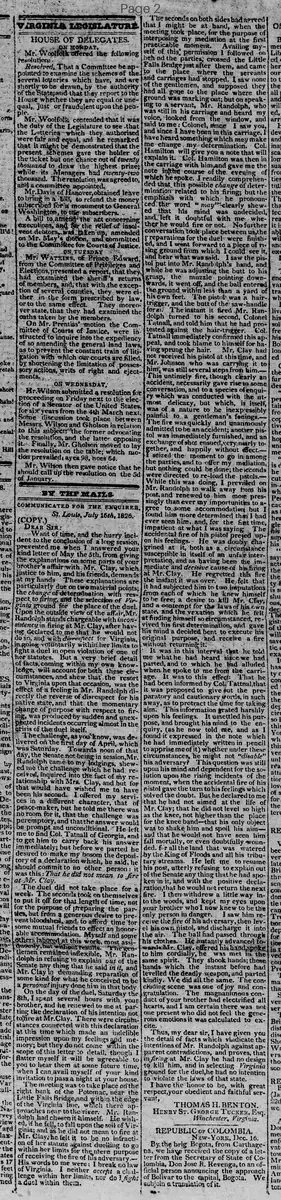
COMMUNICATED FOR THE ENQUIRER.
St. Louis, July 16th, 1826.
(COPY)
DEAR SIR:
Want of time, and the hurry incident to the conclusion of a long session, prevented me when I answered your kind letter of May the 5th, from giving the explanations on some parts of your brother's affair with Mr. Clay, which justice to him, and his friends, demands at my hands. These explanations are particularly due on two material points: the change of determination with respect to firing and the selection of Virginia ground for the place of the duel.
Upon the outside view of the affair, Mr. Randolph stands chargeable with inconsistency in firing at Mr. Clay, after having declared to me that he would not do so, and with disrespect for Virginia, in going voluntarily within her limits to fight a duel in open violation of one of her statutes. But a very brief detail of facts, coming within my own knowledge, will account for both these circumstances, and shew that the resort to Virginia upon that occasion, was the effect of a feeling in Mr. Randolph directly the reverse of disrespect for his native state, and that the momentary change of purpose with respect to firing, was produced by sudden and unexpected incidents occurring almost in the crisis of the duel itself.
The challenge, as you know, was delivered on the first day of April, which was Saturday. Towards noon of that day, the Senate not being in session, Mr. Randolph came to my lodgings, shewed me the challenge which he had received, inquired into the fact of my relationship with Mrs. Clay, and but for that would have wished me to have been his second. I offered my services in a different character, that of peace-maker, but he told me there was no room for it, that the challenge was peremptory, and that the answer would be prompt and unconditional. He left me to find Col. Tattnall of Georgia, and to get him to carry back his answer immediately; but before we parted he desired to make my bosom the depository of a declaration which, he said, he should commit to no other person: it was this: That he did not mean to fire at Mr. Clay.
The duel did not take place for a week. The seconds took on themselves to put it off for that length of time, not for the purpose of preparing the parties, but from a generous desire to prevent bloodshed, and to afford time for some mutual friends to effect an honorable accommodation. Myself and some others labored at this work, most assiduously, but without success. The gentlemen remained inflexible, Mr. Randolph in refusing to explain out of the Senate any thing that he said in it, and Mr. Clay in demanding reparation of some kind for what he conceived to be a personal injury done him in that body.
On the day of the duel, Saturday the 8th, I spent several hours with your brother, and he renewed to me at parting the declaration of his intention not to fire at Mr. Clay. There were circumstances connected with this declaration at this time which made an indelible impression upon my feelings and memory; but they do not come within the scope of this letter to detail, though I flatter myself it will be agreeable to you to hear them at some future time, when I can avail myself of your kind invitation to pass a night at your house.
The meeting was to take place on the right bank of the Potomac, near the Little Falls Bridge, and within the edge of the Virginia line, which there approaches near to the river: Mr. Randolph had chosen it himself. He wished, if he fell, to fall upon the soil of Virginia; and as he did not mean to fire at Mr. Clay, he felt it to be no infraction of her statute against duelling to go within her limits for the mere purpose of receiving the fire of his adversary. His words to me were: I break no law of Virginia. I neither accept a challenge within her limits, nor do I fight a duel within them.
The seconds on both sides had agreed that I might be at hand, when the meeting took place, for the purpose of interposing my mediation at the first practicable moment. Availing myself of this permission I followed on behind the parties, crossed the Little Falls Bridge just after them, and came to the place where the servants and carriages had stopped. I saw none of the gentlemen, and supposed they had all gone to the place where the ground was marking out; but on speaking to a servant, Mr. Randolph, who was still in his carriage and heard my voice, looked from the window, and said to me: Colonel, since I saw you, and since I have been in this carriage, I have heard something which may make me change my determination. Col. Hamilton will give you a note that will explain it. Col. Hamilton was then in the carriage with him, and gave me the note in the course of the evening of which he spoke. I readily comprehended that this possible change of determination related to his firing; but the emphasis with which he pronounced the word "may" clearly showed that his mind was undecided, and left it doubtful with me whether he would fire or not. No further conversation took place between us, the preparations for the duel were finished, and I went forward to a piece of rising ground from which I could see it, and hear what was said. I saw the pistol put into Mr. Randolph's hand, and while he was adjusting the butt to his grasp, the muzzle pointing downwards, it went off, and the ball entered the ground within less than a yard of his own feet. The pistol was a hair-trigger, and the butt of the saw-handle form. The instant it fired Mr. Randolph turned to his second, Colonel Tattnall, and told him that he had protested against the hair-trigger. Col. Tattnall immediately confirmed this appeal, and took blame to himself for having sprung the hair.
Mr. Clay had not received his pistol at this time, and Mr. Jesup who was carrying it to him, was still several steps from him. This untimely fire, though clearly an accident, necessarily gave rise to some conversation, and to a species of enquiry which was conducted with the utmost delicacy, but which, in itself, was of a nature to be inexpressibly painful to a gentleman's feelings. The fire was quickly and unanimously admitted to be an accident; another pistol was immediately furnished, and an exchange of shots ensued, very nearly together, and happily without effect.
I seized the moment to go in among the parties, and to offer my mediation, but nothing could be done; the seconds were directed to re-load the pistols. While this was doing, I prevailed on Mr. Randolph to walk away from his post, and renewed to him more pressingly than ever my importunities to agree to some accommodation but I found him more determined than I had ever seen him, and, for the first time, impatient at what I was saying. The accidental fire of his pistol pressed upon his feelings. He was doubly chagrined at it, both as a circumstance susceptible in itself of an unfair interpretation, and as having been the immediate and decisive cause of his firing at Mr. Clay. He regretted this fire the instant it was over. He felt that it had subjected him to two imputations from each of which he knew himself to be free; a desire to kill Mr. Clay, and a contempt for the laws of his own state, and the vexation which he felt at finding himself so circumstanced, revived his first determination, and gave his mind a decided bent to execute his original purpose, and receive a fire without returning it."
It was in this interval that he told me what he had heard since we had parted, and to which he had alluded when he spoke to me from the carriage. It was to this effect: That he had been informed by Col. Tattnall, that it was proposed to give out the preparatory and cautionary words, in such way, as to protract the time for taking aim. This information grated harshly upon his feelings. It unsettled his purpose, and brought his mind to the enquiry, (as he now told me, and as I found it expressed in the note which he had immediately written in pencil to apprise me of it) whether under these circumstances, he might not "disable" his adversary? This question was still upon his mind and dependent for the solution upon the rising incidents of the moment, when the accidental fire of his pistol gave the turn to his feelings which solved the doubt. But he declared to me that he had not aimed at the life of Mr. Clay; that he did not level so high as the knee, not higher than the place for the knee band—that his only object was to shake him and spoil his aim and that he would not have seen him fall mortally, or even doubtfully wounded, for all the land that was watered by the King of Floods and all his tributary streams. He left me to resume his post, utterly refusing to explain out of the Senate any thing that he had spoken in it, and with the positive declaration, that he would not return the next fire. I then withdrew a little way into the woods, and kept my eyes upon your brother who I now knew to be the only person in danger. I saw him receive the fire of his adversary, then level his own pistol, and discharge it into the air. The ball had passed through his clothes. He instantly advanced towards Mr. Clay, offered his hand, spoke to him cordially, he was met in the same spirit. They shook hands; those hands which the instant before had levelled the deadly weapon, and parted kindly. We did all the same. The concluding scene was one of joy and congratulation. The magnanimous conduct of your brother had electrified all hearts, and I am certain there was not one present who did not feel the generous emotions it was calculated to excite.
Thus, my dear sir, I have given you the detail of facts which vindicate the intentions of Mr. Randolph against apparent contradictions, and proves, that in firing at Mr. Clay he had no design to kill him, and in selecting Virginia ground for the duel, he had no intention to violate the laws of that state.
I have the honor to be, with great respect, your obedient and faithful servant,
THOMAS H. BENTON.
Henry St. George Tucker, Esq
Winchester, Virginia.
What sub-type of article is it?
What themes does it cover?
What keywords are associated?
What entities or persons were involved?
Where did it happen?
Story Details
Key Persons
Location
Right Bank Of The Potomac, Near The Little Falls Bridge, Within The Edge Of The Virginia Line
Event Date
April 8, 1826
Story Details
Thomas H. Benton details the duel between Mr. Randolph and Mr. Clay, explaining Randolph's initial intent not to fire, choice of Virginia ground to honor his state without violating its laws, an accidental pistol discharge that led him to fire low to disable without killing, and their subsequent reconciliation after Randolph fired into the air.