Thank you for visiting SNEWPapers!
Sign up free
Literary
September 14, 1739
The Virginia Gazette
Richmond, Williamsburg, Richmond County, Virginia
What is this article about?
An essay arguing that moderate wine consumption enlivens but excess leads to quarrelsome behavior and diseases, advocating sobriety for intellectual pursuits, virtuous habits, and true spriteliness of mind, illustrated by Italian customs and Pythagoras's wisdom.
Merged-components note: The epigraph is a Latin quote about wine that directly introduces the following literary essay on the effects of drinking wine, so they form a single coherent literary component.
Clipping
OCR Quality
98%
Excellent
Full Text
Vino forma perit, vino corrumpitur Etas.
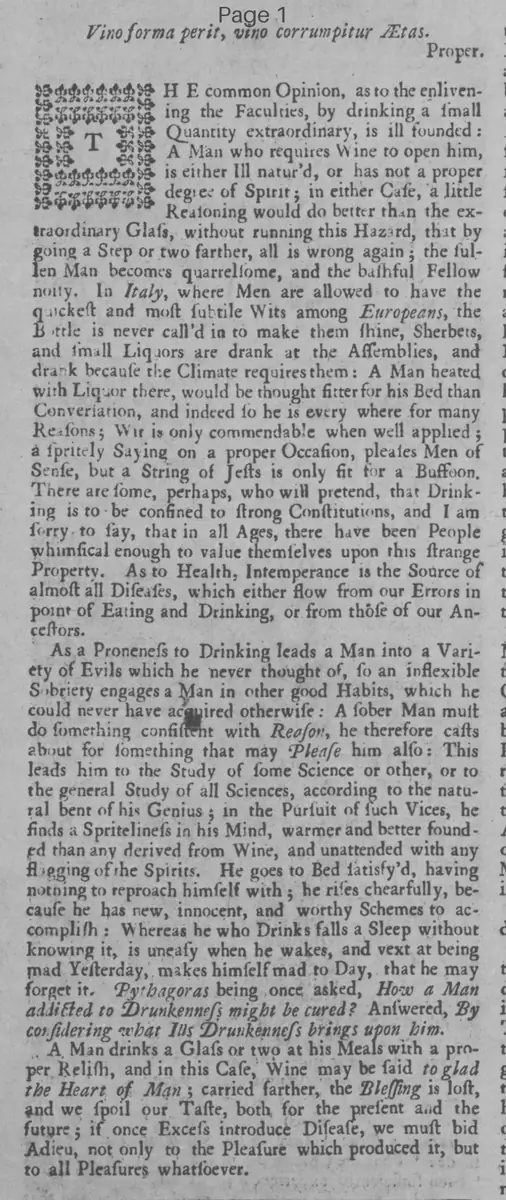
THE common Opinion, as to the enlivening the Faculties, by drinking a small Quantity extraordinary, is ill founded: A Man who requires Wine to open him, is either Ill natur'd, or has not a proper degree of Spirit; in either Case, a little Reasoning would do better than the extraordinary Glass, without running this Hazard, that by going a Step or two farther, all is wrong again; the sullen Man becomes quarrelsome, and the bashful Fellow noisily. In Italy, where Men are allowed to have the quickest and most subtle Wits among Europeans, the Bottle is never call'd in to make them shine, Sherbets, and small Liquors are drank at the Assemblies, and drank because the Climate requires them: A Man heated with Liquor there, would be thought fitter for his Bed than Conversation, and indeed so he is every where for many Reasons; Wit is only commendable when well applied; a spritely Saying on a proper Occasion, pleases Men of Sense, but a String of Jests is only fit for a Buffoon.
There are some, perhaps, who will pretend, that Drinking is to be confined to strong Constitutions, and I am sorry to say, that in all Ages, there have been People whimsical enough to value themselves upon this strange Property. As to Health, Intemperance is the Source of almost all Diseases, which either flow from our Errors in point of Eating and Drinking, or from those of our Ancestors.
As a Proneness to Drinking leads a Man into a Variety of Evils which he never thought of, so an inflexible Sobriety engages a Man in other good Habits, which he could never have acquired otherwise: A sober Man must do something consistent with Reason, he therefore casts about for something that may Please him alone: This leads him to the Study of some Science or other, or to the general Study of all Sciences, according to the natural bent of his Genius; in the Pursuit of such Virtues, he finds a Spriteliness in his Mind, warmer and better founded than any derived from Wine, and unattended with any sagging of the Spirits. He goes to Bed satisfied, having nothing to reproach himself with; he rises cheerfully, because he has new, innocent, and worthy Schemes to accomplish: Whereas he who Drinks falls asleep without knowing it, is uneasy when he wakes, and vexed at being mad Yesterday, makes himself mad to Day, that he may forget it. Pythagoras being once asked, How a Man addicted to Drunkenness might be cured? Answered, By considering what Ills Drunkenness brings upon him.
A Man drinks a Glass or two at his Meals with a proper Relish, and in this Case, Wine may be said to glad the Heart of Man; carried farther, the Blessing is lost, and we spoil our Taste, both for the present and the future; if once Excess introduce Disease, we must bid Adieu, not only to the Pleasure which produced it, but to all Pleasures whatsoever.
THE common Opinion, as to the enlivening the Faculties, by drinking a small Quantity extraordinary, is ill founded: A Man who requires Wine to open him, is either Ill natur'd, or has not a proper degree of Spirit; in either Case, a little Reasoning would do better than the extraordinary Glass, without running this Hazard, that by going a Step or two farther, all is wrong again; the sullen Man becomes quarrelsome, and the bashful Fellow noisily. In Italy, where Men are allowed to have the quickest and most subtle Wits among Europeans, the Bottle is never call'd in to make them shine, Sherbets, and small Liquors are drank at the Assemblies, and drank because the Climate requires them: A Man heated with Liquor there, would be thought fitter for his Bed than Conversation, and indeed so he is every where for many Reasons; Wit is only commendable when well applied; a spritely Saying on a proper Occasion, pleases Men of Sense, but a String of Jests is only fit for a Buffoon.
There are some, perhaps, who will pretend, that Drinking is to be confined to strong Constitutions, and I am sorry to say, that in all Ages, there have been People whimsical enough to value themselves upon this strange Property. As to Health, Intemperance is the Source of almost all Diseases, which either flow from our Errors in point of Eating and Drinking, or from those of our Ancestors.
As a Proneness to Drinking leads a Man into a Variety of Evils which he never thought of, so an inflexible Sobriety engages a Man in other good Habits, which he could never have acquired otherwise: A sober Man must do something consistent with Reason, he therefore casts about for something that may Please him alone: This leads him to the Study of some Science or other, or to the general Study of all Sciences, according to the natural bent of his Genius; in the Pursuit of such Virtues, he finds a Spriteliness in his Mind, warmer and better founded than any derived from Wine, and unattended with any sagging of the Spirits. He goes to Bed satisfied, having nothing to reproach himself with; he rises cheerfully, because he has new, innocent, and worthy Schemes to accomplish: Whereas he who Drinks falls asleep without knowing it, is uneasy when he wakes, and vexed at being mad Yesterday, makes himself mad to Day, that he may forget it. Pythagoras being once asked, How a Man addicted to Drunkenness might be cured? Answered, By considering what Ills Drunkenness brings upon him.
A Man drinks a Glass or two at his Meals with a proper Relish, and in this Case, Wine may be said to glad the Heart of Man; carried farther, the Blessing is lost, and we spoil our Taste, both for the present and the future; if once Excess introduce Disease, we must bid Adieu, not only to the Pleasure which produced it, but to all Pleasures whatsoever.
What sub-type of article is it?
Essay
What themes does it cover?
Temperance
Moral Virtue
What keywords are associated?
Temperance
Sobriety
Drunkenness
Intemperance
Wine
Moral Virtues
Intellectual Pursuits
Literary Details
Key Lines
Vino Forma Perit, Vino Corrumpitur Etas.
Wit Is Only Commendable When Well Applied; A Spritely Saying On A Proper Occasion, Pleases Men Of Sense, But A String Of Jests Is Only Fit For A Buffoon.
Intemperance Is The Source Of Almost All Diseases, Which Either Flow From Our Errors In Point Of Eating And Drinking, Or From Those Of Our Ancestors.
Pythagoras Being Once Asked, How A Man Addicted To Drunkenness Might Be Cured? Answered, By Considering What Ills Drunkenness Brings Upon Him.
Wine May Be Said To Glad The Heart Of Man; Carried Farther, The Blessing Is Lost, And We Spoil Our Taste, Both For The Present And The Future.