Thank you for visiting SNEWPapers!
Sign up free
Virginia Argus
Richmond, Virginia
What is this article about?
The Massachusetts House of Representatives responds to Governor Gerry's speech, praising his re-election, defending republican government, criticizing party spirit and resistance to laws, supporting national policies on neutral rights and commerce, and affirming commitment to state and national constitutions.
Merged-components note: Merged the two parts of the 'Answer of the House of Representatives of Massachusetts' which continues across pages; relabeled from story and editorial to domestic_news as it is a formal political document on national affairs.
Clippings
1 of 2
OCR Quality
Full Text
May it please your Excellency,
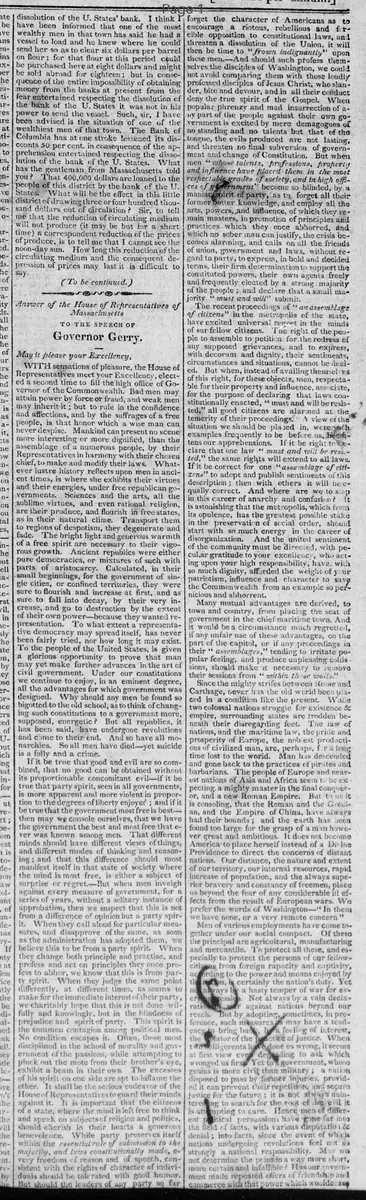
WITH sensations of pleasure, the House of Representatives meet your Excellency, elected a second time to fill the high office of Governor of the Commonwealth. Bad men may attain power by force or fraud, and weak men may inherit it; but to rule in the confidence and affections, and by the suffrages of a free people, is that honor which a wise man can never despise. Mankind can present no scene more interesting or more dignified, than the assemblage of a numerous people, by their Representatives in harmony with their chosen chief, to make and modify their laws. Whatever lustre history reflects upon men in ancient times, is where she exhibits their virtues and their energies, under free republican governments. Sciences and the arts, all the sublime virtues, and even rational religion, are their produce, and flourish in free states, as in their natural clime. Transport them to regions of despotism, they degenerate and fade. The bright light and generous warmth of a free spirit are necessary to their vigorous growth. Ancient republics were either pure democracies, or mixtures of such with parts of aristocracy. Calculated, in their small beginnings, for the government of single cities, or confined territories, they were sure to flourish and increase at first, and as sure to fall into decay, by their very increase, and go to destruction by the extent of their own power—because they wanted representation. To what extent a representative democracy may spread itself, has never been fairly tried, nor how long it may exist. To the people of the United States, is given a glorious opportunity to prove that man may yet make further advances in the art of civil government. Under our constitutions we continue to enjoy, in an eminent degree, all the advantages for which government was designed. Why should any men be found so bigotted to the old school, as to think of changing such constitutions to a government more, supposed, energetic? But all republics, it has been said, have undergone revolutions and come to their end. And so have all monarchies. So all men have died—yet suicide is a folly and a crime. If it be true that good and evil are so combined, that no good can be obtained without its proportionable concomitant evil—if it be true that party spirit, seen in all governments, is more apparent and more violent in proportion to the degrees of liberty enjoyed; and if it be true that the government most free is best—then may we console ourselves, that we have the government the best and most free that ever was known among men. That different minds should have different views of things, and different modes of thinking and reasoning; and that this difference should most manifest itself in that state of society where the mind is most free, is either a subject of surprise or regret.—But when men inveigh against every measure of government, for a series of years, without a solitary instance of approbation, then we suspect that this is not from a difference of opinion but a party spirit. When they call aloud for particular measures, and disapprove of the same, as soon as the administration has adopted them, we believe this to be from a party spirit. When they change both principle and practise, and profess and act on principles they once professed to abhor, we know that this is from party spirit. When they judge the same point differently, at different times, as seems to make for the immediate interest of their party, we charitably hope that this is not done wilfully and knowingly, but in the blindness of prejudice and spirit of party. This spirit is the common contagion among political men. No condition escapes it. Often, those most disciplined in the school of morality and government of the passions, while attempting to pluck out the mote from their brother's eye, exhibit a beam in their own. The excesses of his spirit on one side are apt to inflame the other. It shall be the serious endeavor of the House of Representatives to guard their minds against it. It is important that the citizens of a state, where the mind is left free to think and speak on subjects of religion and politics, should cherish in their hearts a generous benevolence. While party preserves itself within the essential rule of submission to the majority, and laws constitutionally made, every freedom of reason and of speech, consistent with the rights of character of individuals should be tolerated with good humor. But should the leaders of any party so far forget the character of Americans as to encourage a riotous, rebellious and forcible opposition to constitutional laws, and threaten a dissolution of the Union, it will then be time to "frown indignantly" upon these men.—And should such profess themselves the disciples of Washington, we could not avoid comparing them with those loudly professed disciples of Jesus Christ, who slander, bite and devour, and in all their conduct deny the true spirit of the Gospel. When popular phrenzy and mad insurrection of any part of the people against their own government is excited by mere demagogues of no standing and no talents but that of the tongue, the evils produced are not lasting, and threaten no final subversion of government and change of Constitution. But when men "whose talents, professions, property and influence have placed them in the most respectable grades of society, and in high offices of government" become so blinded, by a maniac spirit of party, as to forget all their former better knowledge, and employ all the arts, powers, and influence, of which they remain masters, in promotion of principles and practices which they once abhorred, and which no sober man can justify, the crisis becomes alarming, and calls on all the friends of union, government and laws, without regard to party, to express, in bold and decided terms, their firm determination to support the constituted powers, their own agents freely and frequently elected by a strong majority of the people; and declare that a small majority "must and will" submit. The recent proceedings of "an assemblage of citizens" in the metropolis of the state, have excited universal regret in the minds of our fellow citizens. The right of the people to assemble to petition for the redress of any supposed grievances, and to express, with decorum and dignity, their sentiments, circumstances and situations, cannot be denied. But when, instead of availing themselves of this right, for these objects, men, respectable for their property and influence, associate, for the purpose of declaring that laws constitutionally enacted, "must and will be resisted," all good citizens are alarmed at the temerity of their proceedings. A view of the situation we should be placed in, were such examples frequently to be before us, heightens our apprehensions. If it be right to declare that one law "must and will be resisted," the same rights will extend to all laws. If it be correct for one "assemblage of citizens" to adopt and publish sentiments of this description; then with others it will be equally correct. And where are we to stop in this career of anarchy and confusion? It is astonishing that the metropolis, which from its opulence, has the greatest possible stake in the preservation of social order, should start with so much energy in the career of disorganization. And the united sentiment of the community must be directed, with peculiar gratitude to your excellency, who acting upon your high responsibility, have, with so much dignity, afforded the weight of your patriotism, influence and character to save the Commonwealth from an example so pernicious and abhorrent. Many mutual advantages are derived, to town and country, from placing the seat of government in the chief maritime town. And it would be a circumstance much regretted, if any unfair use of these advantages, on the part of the capitol, or if any proceedings in their "assemblages," tending to irritate popular feeling, and produce unpleasing collisions, should make it necessary to remove their sessions from "within the walls." Since the mighty strifes between Rome and Carthage, never has the old world been placed in a condition like the present. While two colossal nations struggle for existence & empire, surrounding states are trodden beneath their disregarding feet. The law of nations, and the maritime law, the pride and prosperity of Europe, the noblest productions of civilized man, are, perhaps, for a long time lost to the world. Man has descended and gone back to the practices of pirates and barbarians. The people of Europe and nearest nations of Asia and Africa seem to be expecting a mighty master in the final conqueror, and a new Roman Empire. But to us it is consoling, that the Roman and the Grecian, and the Empire of China, have always had their bounds; and the earth has been found too large for the grasp of a man however great and ambitious. It does not become America to place herself instead of a Divine Providence to direct the concerns of distant nations. Our distance, the nature and extent of our territory, our internal resources, rapid increase of population, and the always superior bravery and constancy of freemen, place us beyond the fear of any considerable effects from the result of European wars. We prefer the words of Washington—"In them we have none, or a very remote concern" Men of various employments have come together under our social compact. Of these the principal are agricultural, manufacturing and mercantile. To protect all these, and especially to protect the persons of our fellow-citizens from foreign rapacity and captivity, according to the power and means enjoyed by the nation, is certainly the nation's duty. Yet no always by a hasty temper of war for every crisis. Not always by a vain declaration of war against nations beyond our reach. But by adopting, sometimes, in preference, such measures as may have a tendency to bring back, by a feeling of interest, the violator to the practice of justice. When two belligerents have done us wrong, it seems at first view degrading to ask which wronged us first Yet to a government, whose genius is more civil than military; a nation disposed to pass by former injuries, provided it can prevent their repetition, and secure justice for the future; it is not always uninteresting to search for the root of the evil it is attempting to cure. Hence men of different political persuasions have gone far into the field of facts, with various disputation & denial; into facts, since the event of which nations undergoing revolutions feel not so strongly a national responsibility. May we not determine the point in a way more short, more certain and infallible? Has our government made repeated offers of friendship and commerce with that power which would cease To violate our neutral rights, accompanied with promise of non-intercourse with the other, until it should consent to do the same? Did the English plenipotentiary Erskine, accept this offer? The question is not now, whether he was authorised, but whether the terms were more than just? If not, then England would not recall her unjust orders in council and blockades; not because our non intercourse with France, in case of her non-compliance, would not be as effectual against the trade of her enemy as all her cruising ships; but because she feared France would also repeal her decrees, and thus restore our rightful trade with both. Have our government made a later, similar, equal offer to both nations? Has France declared her acceptance, provided we, with good faith, keep our promise of non-intercourse with England, till she also complies? We consider this proviso as an insulting doubt of our national faith and firmness. And shall we justify this doubt, and break our own faith and promise, because we fear in turn that the emperor of France may not keep his promise? No. Though all nations should be false, let America be true. No dishonor attaches to a nation deceived by a direct breach of faith. We believe that the people of the U. S. have too much common sense to prefer the scraps of a skulking commerce, preyed upon by all nations, to a probable free trade with continental Europe, and a hope at least that England, finding us firm and persevering in our prudent and peaceful policy, may discover it to be her true interest as well as honor, to return to that regard to law and justice, which formerly secured to her the confidence of nations, and raised her to high pre-eminence in glory and power; to that justice without which the world must rather rejoice in her desolation.
The whole history of America has given convincing proof of a benevolent Providence, deducing good from seeming evil. And have we not now reason to expect that the manufacturing spirit, encouraged by the embarrassments on our commerce, may yet, in a national view, more than compensate for all the evils, which we are sorry to see so many of our fellow citizens now suffering from those embarrassments. For next to husbandmen, from what class can we expect to find more strong and brave soldiers in war, and virtuous citizens in time of peace, than from our industrious mechanics and manufacturers; and what can tend to make us more an independent nation, free from foreign influence, than an industry and ingenuity which can supply us with all the necessaries and elegances of life from our own resources. We wish always to see our agriculture and commerce aiding each other; while we cannot but rejoice to observe our farmers paying attention to a greater variety of produce, wanted in manufactures, and always finding a ready sale at home; promoting internal commerce, & lessening the necessity of importations. Surplus productions from our soil, fisheries and manufactures, we expect to have, "To establish" for these "a market at home," suffering nations to come and purchase, "who inhibit our commerce with them," would certainly be most "unwise." And if any nations persist in attempts to prevent our resort to what market we choose, we "shun all commerce" with such nations--we can live "independent of them." And if this produces war we have no reason to fear. We have "towering forests, fertile soil, rich mines, ample materials for a navy, and intrepid officers and seamen to man it."
The laws regulating elections are fundamental and of primary importance in every republican state. Their violation, whether by the fraud, unjust influence and partiality of officers concerned in them, or by open riot and "turbulent proceedings in our primary assemblies," or ungenerous influence of the wealthy over the poor, by a too open ballot, are in the nature of high treason against the sovereign people. The House of Representatives will not fail to pay due attention to the suggestions of your Excellency on this subject.
We bless God for our rights of conscience and "that there exists a general spirit of liberality and tolerance," both among our people and clergy; and a willingness to secure, by wholesome laws, these sacred rights to all. If any of that venerable order, which the people always wish to respect, should "perchance, wander into the devious paths of party politics," they will soon discover their own impotence; and regret the loss of that usefulness, which it was their duty to preserve.
To secure justice by good laws and an impartial administration of them; to promote and diffuse knowledge and morality by seminaries of learning and wise public institutions and a free press; to encourage a national republican spirit, by banishing all regard for the tinsel titles and trappings of monarchy and aristocracy; to foster a sacred regard for our state and national Constitutions, dreading their infringements and fearing the very approach towards their confines, these are the first care and the first duties of the Representatives of the free people of this state: and though on this occasion we have thought it necessary and not improper, to follow your Excellency, in expressing our confidence in our constituted national authorities, and determination to support a union so dear to every true American; yet in all their proceedings the House of Representatives will strictly confine themselves to subjects within their own state legislation and state concerns: leaving the management of national and foreign affairs to that President and Legislature of the whole nation, to which they belong.
What sub-type of article is it?
What keywords are associated?
What entities or persons were involved?
Where did it happen?
Domestic News Details
Primary Location
Massachusetts
Key Persons
Event Details
The House of Representatives addresses Governor Gerry, congratulating his re-election, extolling republican government, decrying party spirit and resistance to laws, commenting on international relations and neutral rights, supporting commerce and manufacturing, emphasizing election integrity, religious tolerance, and commitment to constitutions.