Thank you for visiting SNEWPapers!
Sign up free
Centre Democrat
Bellefonte, Centre County, Pennsylvania
What is this article about?
In 1776, Revolutionary War widow Madame Pierpont hosts George Washington at her farm, tends to his party despite being alone, learns of her son Henry's battlefield death, yet remains composed, embodying patriotic bravery and faith. (187 chars)
Clipping
OCR Quality
Full Text
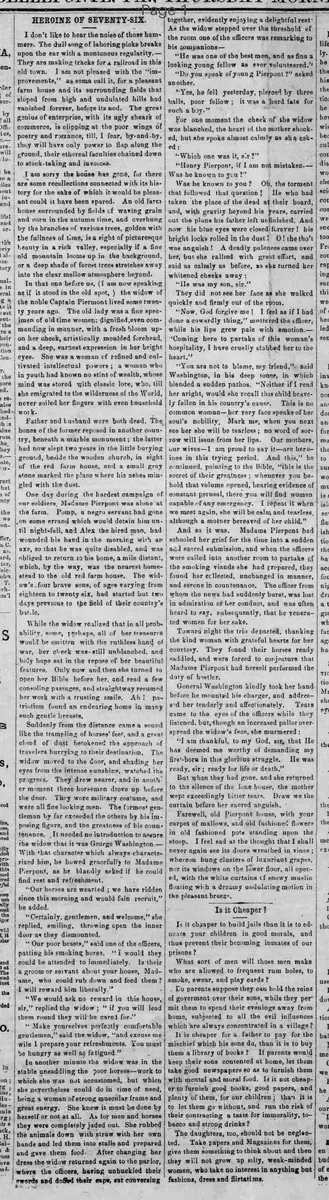
I don't like to hear the noise of those hammers. The dull song of laboring picks breaks upon the ear with a monotonous regularity.
They are making tracks for a railroad in this old town. I am not pleased with the "improvements," as some call it, for a pleasant farm house and its surrounding fields that sloped from high and undulated hills had vanished forever, before its nod. The great genius of enterprise, with its ugly shears of commerce, is clipping at the poor wings of poetry and romance, till, I fear, by-and-by, they will have only power to flap along the ground, their ethereal faculties chained down to stock-taking and invoices.
I am sorry the house has gone, for there are some recollections connected with its history for the sake of which it would be pleasant could it have been spared. An old farm house surrounded by fields of waving grain and corn in the autumn time, and overhung by the branches of various trees, golden with the fullness of time, is a sight of picturesque beauty in a rich valley, especially if a fine old mountain looms up in the background, or a deep shade of forest trees stretches away into the clear mellow atmosphere beyond.
In that one before us, (I am now speaking as if it stood in the old spot,) the widow of the noble Captain Pierpont lived some twenty years ago. The old lady was a fine specimen of old time women; dignified, even commanding in manner, with a fresh bloom upon her cheek, artistically moulded forehead, and a deep, earnest expression in her bright eyes. She was a woman of refined and cultivated intellectual powers; a woman who in youth had known no stint of wealth, whose mind was stored with classic lore, who, till she emigrated to the wilderness of the world, never soiled her fingers with even household work.
Father and husband were both dead. The bones of the former reposed in another country, beneath a marble monument; the latter had now slept two years in the little burying ground, beside the wooden church, in sight of the red farm house, and a small gray stone marked the place where his ashes mingled with the dust.
One day during the hardest campaign of our soldiers, Madame Pierpont was alone at the farm. Pomp, a negro servant had gone on some errand which would detain him until night-fall, and Alex the hired man, had wounded his hand in the morning with an axe, so that he was quite disabled, and was obliged to return to his home, a mile distant, which, by the way, was the nearest homestead to the old red farm house, the widow's four brave sons, of ages varying from eighteen to twenty-six, had started but two days previous to the field of their country's battle.
While the widow realized that in all probability, some, perhaps, all of her treasures would be smitten with the ruthless hand of war, her cheek was still unblanched, and holy hope sat in the repose of her beautiful features. Only now and then she turned to open her Bible before her, and read a few consoling passages, and straightway resumed her work with a trusting smile. Ah! patriotism found an endearing home in many such gentle breasts.
Suddenly from the distance came a sound like the trampling of horses' feet, and a great cloud of dust betokened the approach of travelers hurrying to their destination. The widow moved to the door, and shading her eyes from the intense sunshine, watched the progress. They drew nearer, and in another moment three horsemen drove up before the door. They wore military costume, and were all fine looking men. The foremost gentleman by far exceeded the others by his imposing figure, and the greatness of his countenance. It needed no introduction to assure the widow that it was George Washington.
With that character which always characterized him, he bowed gracefully to Madame Pierpont, as he blandly asked if he could find rest and refreshment.
"Our horses are wearied; we have ridden since this morning and would fain recruit," he added.
"Certainly, gentlemen, and welcome," she replied, smiling, throwing open the inner door as they dismounted.
"Our poor beasts," said one of the officers, patting his smoking horse. "I would they could be attended to immediately. Is there a groom or servant about your house, Madame, who could rub down and feed them?
I will reward him liberally."
"We would ask no reward in this house sir," replied the widow; "if you will lead them round they will be cared for."
"Make yourselves perfectly comfortable gentlemen," said the widow, "and excuse me while I prepare your refreshments. You must be hungry as well as fatigued."
In another minute the widow was in the stable unsaddling the poor horses—work to which she was not accustomed, but which she nevertheless could do in time of need, being a woman of strong muscular frame and great energy. She knew it must be done by herself or not at all. As for men and horses they were completely jaded out. She rubbed the animals down with straw with her own hands and led them into stalls and prepared and gave them food. After changing her dress the widow returned again to the parlor, where the officers, having unbuckled their swords and doffed their caps, sat conversing together, evidently enjoying a delightful rest.
As the widow stepped over the threshold of the room one of the officers was remarking to his companions—
"He was one of the best men, and as fine a looking young fellow as ever volunteered."
"Do you speak of young Pierpont?" asked another.
"Yes, he fell yesterday, pierced by three balls, poor fellow; it was a hard fate for such a boy."
For one moment the cheek of the widow was blanched, the heart of the mother shocked, but she spoke almost calmly as she asked:
"Which one was it, sir?"
"Henry Pierpont, if I am not mistaken.— Was he known to you?"
Was he known to you? Oh, the torment that followed that question! He who had taken the place of the dead at their board, and, with gravity beyond his years, carried out the plans his father left unfinished. And now his blue eyes were closed forever! his bright locks rolled in the dust! O! the thought was anguish! A deadly paleness came over her, but she rallied with great effort, and said as calmly as before, as she turned her whitened cheeks away:
"He was my son, sir."
They did not see her face as she walked quickly and firmly out of the room.
"Now, God forgive me! I feel as if I had done a cowardly thing," muttered the officer, while his lips grew pale with emotion.—
"Coming here to partake of this woman's hospitality, I have cruelly stabbed her to the heart."
"You are not to blame, my friend," said Washington, in his deep tones, in which blended a sudden pathos. "Neither if I read her aright, would she recall this child bravely fallen in his country's cause. This is no common woman—her very face speaks of her soul's nobility. Mark me, when you next see her she will be tearless; no word of sorrow will issue from her lips. Our mothers, our wives—I am proud to say it—are heroines in this trying period. And this," he continued, pointing to the Bible, "this is the secret of their greatness; whenever you behold that volume opened, bearing evidence of constant perusal, there you will find women capable of any emergency. I repeat it where we meet again, she will be calm and tearless, although a mother bereaved of her child."
And so it was. Madame Pierpont had schooled her grief for the time into a sudden and sacred submission, and when the officers were called into another room to partake of the smoking viands she had prepared, they found her collected, unchanged in manner, and serene in countenance. The officer from whom the news had suddenly burst, was lost in admiration of her conduct, and was often heard to say, subsequently, that he venerated women for her sake.
Toward night the trio departed, thanking the kind woman with grateful hearts for her courtesy. They found their horses ready saddled, and were forced to conjecture that Madame Pierpont had herself performed the duty of hostler.
General Washington kindly took her hand before he mounted his charger, and addressed her tenderly and affectionately. Tears came to the eyes of the officers while they listened, but, though an increased pallor overspread the widow's face, she murmured:
"I am thankful to my God, sir, that He has deemed me worthy of demanding my first-born in this glorious struggle. He was ready, sir; ready for life or death."
But when they had gone, and she returned to the silence of the lone house, the mother wept exceedingly bitter tears. Draw we the curtain before her sacred anguish,
Farewell, old Pierpont house, with your carpet of mallows, and old fashioned flowers in old fashioned pots standing upon the stoop. I feel sad at the thought that I shall never again see its doors wreathed in vines; whereon hung clusters of luxuriant grapes, nor its windows on the lower floor, all opened, with the white curtains of snowy muslin floating with a dreamy undulating motion in the pleasant breeze.
What sub-type of article is it?
What themes does it cover?
What keywords are associated?
What entities or persons were involved?
Where did it happen?
Story Details
Key Persons
Location
Old Red Farm House In A Rich Valley
Event Date
1776
Story Details
During the Revolutionary War, widow Madame Pierpont, alone at her farm, hosts George Washington and two officers. She tends to their horses herself and prepares refreshments. An officer unwittingly informs her of her son Henry Pierpont's death in battle. Despite her grief, she maintains composure and serenity, earning admiration for her patriotic heroism.