Thank you for visiting SNEWPapers!
Sign up free
The Enquirer
Richmond, Henrico County, Virginia
What is this article about?
A submission to the Enquirer copies a letter from the Medical Repository praising Jefferson's donation of fossil bones to the French National Institute, defending him against Federalist criticism by emphasizing science's international nature, and includes a translated thank-you letter from Count Lacepede to D.B. Warden.
Merged-components note: The page 2 component continues the letter to the editor from page 1 about Jefferson's contribution to the French Institute.
Clippings
1 of 2
OCR Quality
Full Text
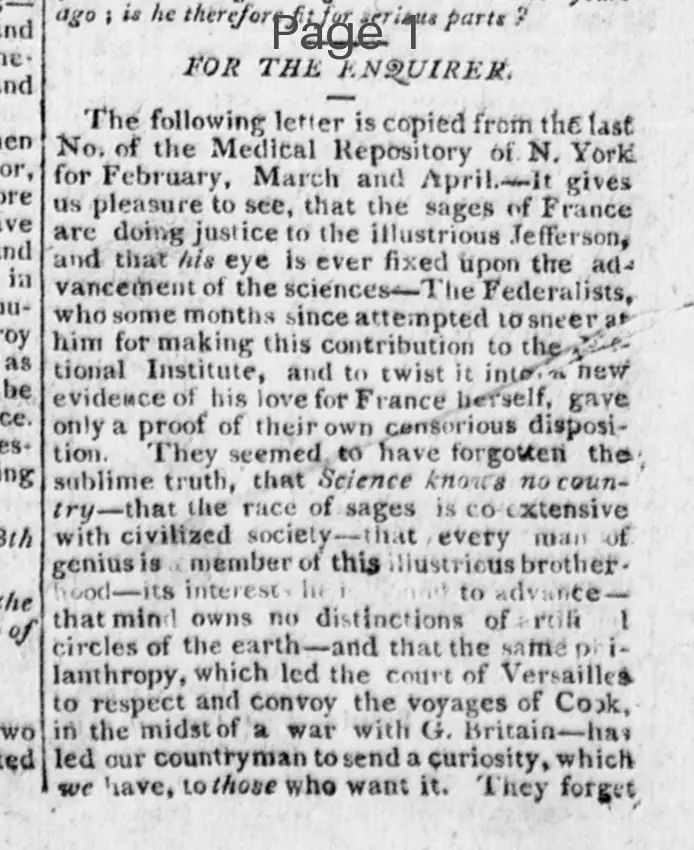
The following letter is copied from the last No. of the Medical Repository of N. York for February, March and April.—it gives us pleasure to see, that the sages of France are doing justice to the illustrious Jefferson, and that his eye is ever fixed upon the advancement of the sciences—The Federalists, who some months since attempted to sneer at him for making this Contribution to the national Institute, and to twist it into new evidence of his love for France herself, gave only a proof of their own censorious disposition. They seemed to have forgotten the sublime truth, that Science knows no country—that the race of sages is co-extensive with civilized society—that, every man of genius is a member of this illustrious brotherhood—its interest to advance—that mind owns no distinctions of artificial circles of the earth—and that the same philanthropy, which led the court of Versailles to respect and convoy the voyages of Cook, in the midst of a war with G. Britain—has led our countryman to send a curiosity, which we have, to those who want it. They forget
besides, that he was a member of the Institute of France, and that the same objections would not have been made to this act, if he had only been a Fellow of the Royal Society of London:
Translation of the Count Lacepede's letter to D. B. Warden, Esq. concerning the Fossil Bones, presented to the National Institute by the President of the United States, Dated Paris, 1st September, 1808.
SIR,
I hastened to communicate to the Institute, in their sitting of Monday last, the letter which Mr. Jefferson was pleased to address, and which you had the complaisance to deliver to me.
The Institute, penetrated with gratitude for this new mark of interest which its illustrious member has manifested, has resolved that an expression of thanks shall be solemnly addressed to him by its proper officers. It has also engaged me to testify to Mr. Jefferson the value it attaches to his attention.
The Institute has decided, that the fossil bones and other objects of natural history, which Mr. Jefferson has had the goodness to put at its disposal, shall be placed in the Museum of Natural History; the only place where the public can conveniently and usefully examine this fine present of Mr. Jefferson.
In consequence of this decision of the Institute, I shall immediately make known to my colleagues of the Museum, what you have communicated to me, Sir, concerning the arrival of these Bones; and as they come by the river, from Havre, and are, by their nature, susceptible of being injured, perhaps you may think proper to debark them at the bridge of Austerlitz, at the northern gate of the garden of plants, across which these precious objects can be easily transported to the apartment destined for their reception.
Accept, Sir, the new assurance of all the sentiments you merit, as also the renewal of my thanks for all that you have been pleased to communicate to me.
I have the honor to salute you,
Signed,
COUNT DE LACEPEDE.
Monsieur Warden, Secretary of the American Legation.
P. S. I shall have the honor of sending to you, according to your permission, my answer to your Illustrious President.
What sub-type of article is it?
What themes does it cover?
What keywords are associated?
What entities or persons were involved?
Letter to Editor Details
Recipient
The Enquirer
Main Argument
defends jefferson's donation of fossil bones to the french national institute against federalist criticism, highlighting that science transcends national boundaries and jefferson's membership in the institute justifies the act.
Notable Details