Thank you for visiting SNEWPapers!
Sign up free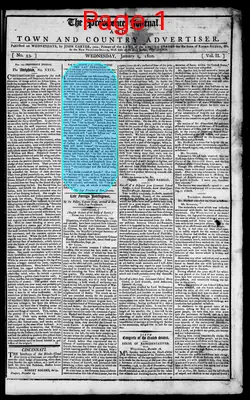
Editorial
January 1, 1800
The Providence Journal, And Town And Country Advertiser
Providence, Providence County, Rhode Island
What is this article about?
The Lay Preacher delivers a poetic eulogy on the death of a revered national leader, whose loss evokes universal mourning across the nation, contrasting with indifferent royal deaths. His deeds of valor and counsel, ensuring liberty and happiness, are eternally inscribed in the people's hearts.
Clipping
OCR Quality
98%
Excellent
Full Text
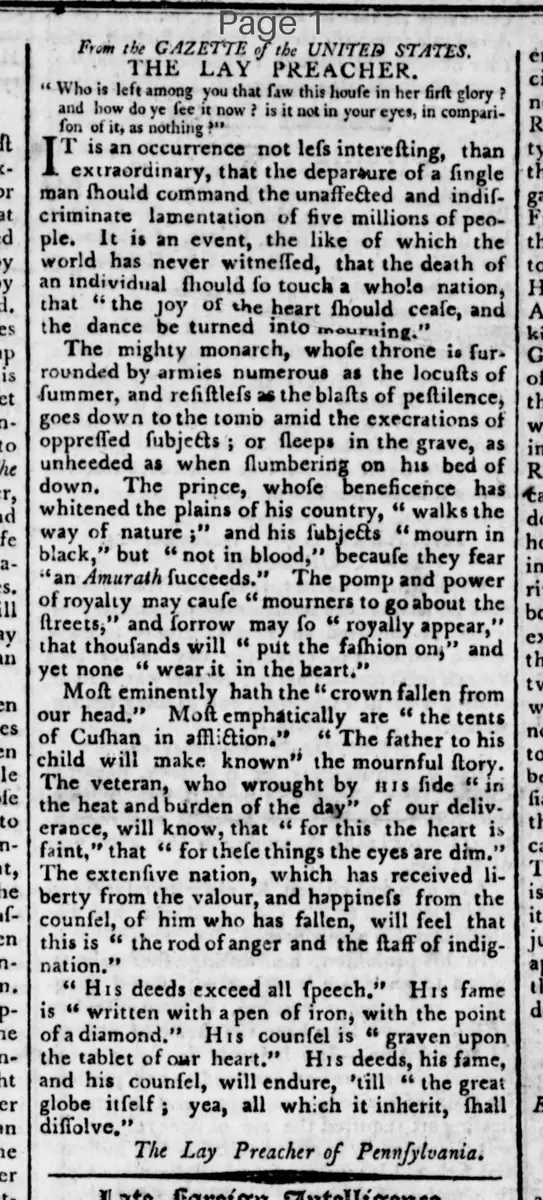
From the GAZETTE of the UNITED STATES.
THE LAY PREACHER.
"Who is left among you that saw this house in her first glory? and how do ye see it now? is it not in your eyes, in comparison of it, as nothing?"
It is an occurrence not less interesting, than extraordinary, that the departure of a single man should command the unaffected and indiscriminate lamentation of five millions of people. It is an event, the like of which the world has never witnessed, that the death of an individual should so touch a whole nation, that "the joy of the heart should cease, and the dance be turned into mourning."
The mighty monarch, whose throne is surrounded by armies numerous as the locusts of summer, and resistless as the blasts of pestilence, goes down to the tomb amid the execrations of oppressed subjects; or sleeps in the grave, as unheeded as when slumbering on his bed of down. The prince, whose beneficence has whitened the plains of his country, "walks the way of nature;" and his subjects "mourn in black," but "not in blood," because they fear "an Amurath succeeds." The pomp and power of royalty may cause "mourners to go about the streets," and sorrow may so "royally appear," that thousands will "put the fashion on;" and yet none "wear it in the heart."
Most eminently hath the "crown fallen from our head." Most emphatically are "the tents of Judah in affliction." "The father to his child will make known" the mournful story. The veteran, who wrought by His side "in the heat and burden of the day" of our deliverance, will know, that "for this the heart is faint," that "for these things the eyes are dim."
The extensive nation, which has received liberty from the valour, and happiness from the counsel, of him who has fallen, will feel that this is "the rod of anger and the staff of indignation."
"His deeds exceed all speech." His fame is "written with a pen of iron, with the point of a diamond." His counsel is "graven upon the tablet of our heart." His deeds, his fame, and his counsel, will endure, 'till "the great globe itself; yea, all which it inherit, shall dissolve."
The Lay Preacher of Pennsylvania.
THE LAY PREACHER.
"Who is left among you that saw this house in her first glory? and how do ye see it now? is it not in your eyes, in comparison of it, as nothing?"
It is an occurrence not less interesting, than extraordinary, that the departure of a single man should command the unaffected and indiscriminate lamentation of five millions of people. It is an event, the like of which the world has never witnessed, that the death of an individual should so touch a whole nation, that "the joy of the heart should cease, and the dance be turned into mourning."
The mighty monarch, whose throne is surrounded by armies numerous as the locusts of summer, and resistless as the blasts of pestilence, goes down to the tomb amid the execrations of oppressed subjects; or sleeps in the grave, as unheeded as when slumbering on his bed of down. The prince, whose beneficence has whitened the plains of his country, "walks the way of nature;" and his subjects "mourn in black," but "not in blood," because they fear "an Amurath succeeds." The pomp and power of royalty may cause "mourners to go about the streets," and sorrow may so "royally appear," that thousands will "put the fashion on;" and yet none "wear it in the heart."
Most eminently hath the "crown fallen from our head." Most emphatically are "the tents of Judah in affliction." "The father to his child will make known" the mournful story. The veteran, who wrought by His side "in the heat and burden of the day" of our deliverance, will know, that "for this the heart is faint," that "for these things the eyes are dim."
The extensive nation, which has received liberty from the valour, and happiness from the counsel, of him who has fallen, will feel that this is "the rod of anger and the staff of indignation."
"His deeds exceed all speech." His fame is "written with a pen of iron, with the point of a diamond." His counsel is "graven upon the tablet of our heart." His deeds, his fame, and his counsel, will endure, 'till "the great globe itself; yea, all which it inherit, shall dissolve."
The Lay Preacher of Pennsylvania.
What sub-type of article is it?
Moral Or Religious
What keywords are associated?
National Mourning
Leader Death
Lay Preacher
Biblical Lament
American Liberty
Enduring Legacy
What entities or persons were involved?
The Lay Preacher Of Pennsylvania
Him Who Has Fallen
Editorial Details
Primary Topic
National Lamentation For The Death Of A Great Leader
Stance / Tone
Mournful Elegy
Key Figures
The Lay Preacher Of Pennsylvania
Him Who Has Fallen
Key Arguments
Departure Of One Man Evokes Universal Lamentation From Five Million People
Death Touches The Whole Nation, Turning Joy To Mourning
Contrast With Monarchs' Deaths, Which Are Execrated Or Unheeded
Royal Mourning Is Superficial, Unlike Genuine National Sorrow
Liberty Received From His Valour, Happiness From His Counsel
His Deeds, Fame, And Counsel Endure Eternally